Asset Leader Ryu Seung-gu 38.8 Billion KRW · 2nd Place Kim Eun-hye
3,516 Individuals with Criminal Records... Maximum 14 Cases
Lowered Candidacy Age, 3 Teen Candidates
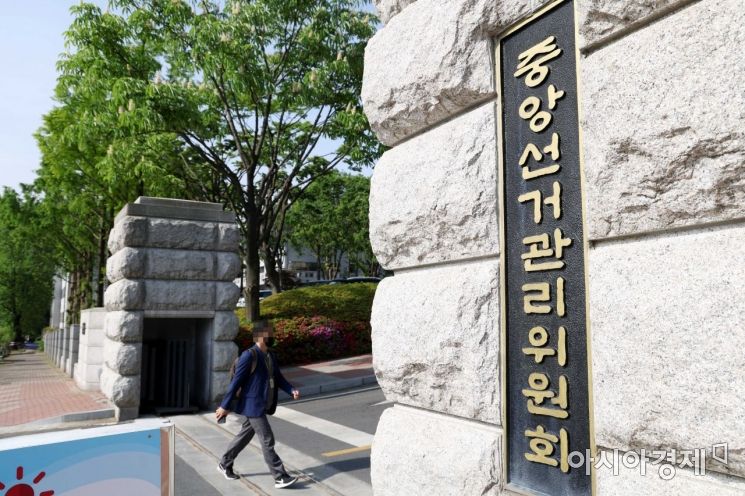 The 8th nationwide local elections are 20 days away, as seen on the 12th at the Central Election Commission in Gwacheon-si, Gyeonggi-do. Photo by Mun Ho-nam munonam@
[Asia Economy Reporter Kwon Hyun-ji] On the first day of candidate registration for the June 1 local elections, the 12th, among the 4,770 candidates who completed registration, 16 were billionaires with assets exceeding 10 billion KRW. Candidates with criminal records numbered 3,516, accounting for 73.71% of the total. The amount of money that can be spent on election campaigns has also increased.
According to the National Election Commission on the 13th, as of 9 p.m. the previous day, a total of 4,770 candidates had completed registration for metropolitan and basic local government heads, as well as metropolitan and basic council members. This number excludes candidates for education superintendent, education council members, and by-elections for the National Assembly. In the metropolitan government head elections, 39 candidates registered, showing a competition ratio of 2.3 to 1. The most competitive election was the Gyeonggi Province governor election, with 6 candidates registered. For basic local government heads, 410 candidates registered; metropolitan council members numbered 1,003; basic council members 2,922; and metropolitan and basic proportional representation candidates totaled 396.
Among them, the candidate with the highest assets was Ryu Seung-gu, a Korea Party candidate running for Seoul Jongno District Mayor. As of December 31 last year, Ryu reported assets worth 38.8 billion KRW, but also had the highest amount of unpaid taxes among all candidates, totaling 412 million KRW. The second wealthiest candidate was Kim Eun-hye, the People Power Party candidate for Gyeonggi Province governor, who reported assets of 22.531 billion KRW. Her tax payments were also high at 2.434 billion KRW compared to other candidates. The third richest candidate was Seo Eun-kyung of the Democratic Party, running for Seongnam City Council in Gyeonggi Province, with assets totaling 18.461 billion KRW. Including these candidates, a total of 16 candidates reported assets exceeding 10 billion KRW.
The candidate with the least assets was Shin Hwa-soon, a Democratic Party candidate for Jangseong County Council in Jeollanam-do, who reported debts of 3.38 billion KRW. A total of 179 candidates reported negative net assets.
There were 3,516 candidates with criminal records involving fines of 1 million KRW or more. Chae Nam-duk, an independent candidate for Gunsan Mayor in Jeollabuk-do, and Kang Hae-bok, an independent candidate for Busanjin District Council in Busan, each had the highest number of 14 criminal records.
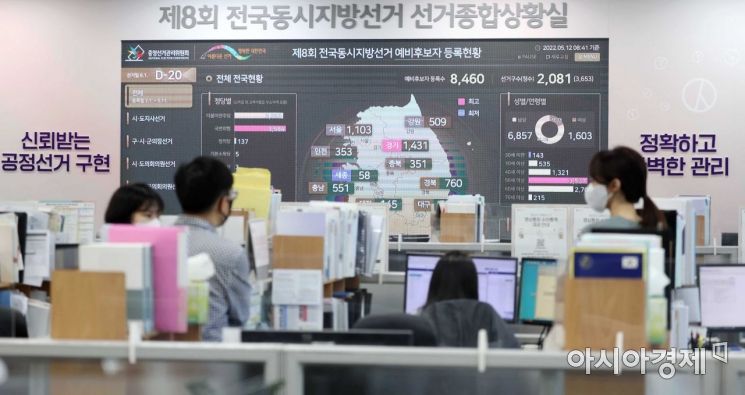 Employees are working at the Election Comprehensive Situation Room of the Central Election Commission in Gwacheon-si, Gyeonggi-do, 12 days before the 8th nationwide local elections, which are 20 days away. Photo by Mun Ho-nam munonam@
Three candidates in their teens were registered. Kim Kyung-joo, a Democratic Party candidate for Gyeongju City Council, and Lee Jae-hyuk, a Justice Party candidate for Gyeonggi Province Council (proportional representation), are both 18 years old, while Shin Eun-jin, a Progressive Party candidate for Gyeonggi Province Council (proportional representation), is 19 years old. This is due to the revision of the Public Official Election Act, which lowered the minimum age to run in local elections from 25 to 18. Candidates aged 20 to 24 numbered 18.
The National Election Commission also announced that the election expense limits for the local elections and National Assembly by-elections have been revised. The average revised limit for city and provincial governor elections is 1.553 billion KRW, an increase of 120 million KRW from the amount announced in January. Compared to the 2018 local elections (1.418 billion KRW), this is an increase of 135 million KRW. This means the maximum amount candidates can spend on election expenses has increased. This adjustment follows the April revision of the Public Official Election Act, which raised allowances for election-related personnel such as election managers, election liaison officers, and election staff, and adjusted expense limits due to electoral district delineation.
© The Asia Business Daily(www.asiae.co.kr). All rights reserved.
![Clutching a Stolen Dior Bag, Saying "I Hate Being Poor but Real"... The Grotesque Con of a "Human Knockoff" [Slate]](https://cwcontent.asiae.co.kr/asiaresize/183/2026021902243444107_1771435474.jpg)

















