Baemin, Tmon, Yanolja, etc. Implement Permanent Remote Work
Flexible Work Combined... Employee Satisfaction Increases
"Do not come to the office.", "You can work from a resort.", "If necessary, use nearby hub offices."... Since COVID-19, more companies are eliminating the physical constraints of the office as a workspace. In these companies, arriving at the office on time and working with colleagues during office hours is gradually becoming a thing of the past. Rather than insisting on traditional work methods, the main direction is to support working from anywhere as long as efficiency is improved. This change is being led by domestic unicorn companies (valued over 1 trillion KRW).
According to the IT industry on the 13th, unicorn companies are institutionalizing remote work systems that were developed from the work-from-home practices implemented during COVID-19, allowing them to be used regularly. Instead of suddenly implementing work-from-home due to external factors, they are adopting systems that enable working anytime and anywhere based on remote work.
The companies that have most actively institutionalized remote work are Yanolja and TMON. E-commerce company TMON decided to officially implement ‘Smart & Remote Work’ from early July this year, removing physical space constraints for work. To this end, TMON plans to implement full work-from-home and relocate its headquarters to a newly constructed building in front of Sinsa Middle School on Garosu-gil, Sinsa-dong. The headquarters office will be used for studios, meetings, and customer meetings. They are preparing a work environment that allows autonomous work by increasing accessibility through hub offices in Jamsil, Seongsu, and Euljiro. The ‘workation’ work program, operated in Jeju, Busan, and Namhae, will also be implemented from this month. Since it is possible for up to 5 days, by utilizing weekends, employees can stay locally for 9 days, combining work and rest.
Yanolja has been implementing a permanent remote work system without setting a specific period. Employees can freely choose their preferred work location among the office, work-from-home, or hub offices. For employees who have difficulty setting up a work environment at home, hub offices have been established in the Gangseo area of Seoul and Bundang, Seongnam, Gyeonggi Province.
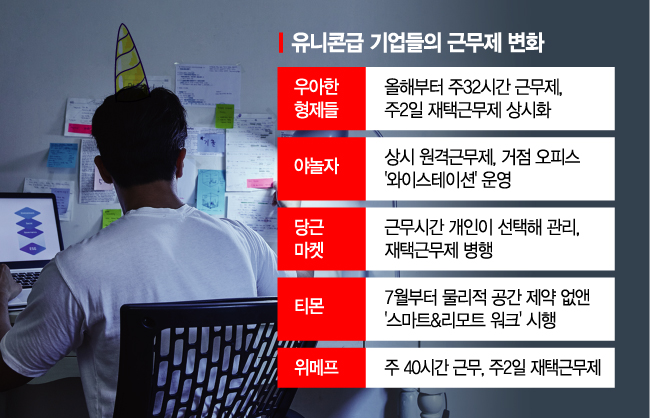
Baedal Minjok (Baemin), Danggeun Market, and others have also introduced systems that allow working from home regardless of the COVID-19 situation. Woowa Brothers, which operates Baemin, implemented full work-from-home during COVID-19 and decided to institutionalize a work-from-home system that allows remote work two days a week even after the pandemic ends. Additionally, Baemin has been implementing a 32-hour workweek since this year. On Mondays, employees work only from 1 PM to 5 PM. On other days, working hours are from 9:30 AM to 5:30 PM.
Danggeun Market has adopted a system where employees can alternate between office attendance and working from home, managing their working hours individually rather than by the company. Employees can autonomously choose their start time between 7 AM and 11 AM, and to facilitate smooth collaboration, a ‘core time’ from 11 AM to 4 PM is set for intensive team work. Wemakeprice (WEMAKEPRICE) also operates a 40-hour workweek with two days of work-from-home per week.
This change is interpreted as a judgment that returning to an office-based work system is not reasonable given the organizational characteristics of unicorn companies, which are mainly composed of developers and the MZ generation (Millennials + Generation Z). They are shifting work methods toward prioritizing efficiency. The experience of working from home during COVID-19 and becoming accustomed to various collaboration tools is also a background for these companies’ work style innovations.
An industry official explained, "As remote work systems become normalized, unicorn-level companies are focusing on building flexible work environments that enhance both employee convenience and work efficiency," adding, "Eliminating location constraints is directly linked not only to productivity improvement but also to work satisfaction, which helps these companies secure diverse talent, their top priority."
© The Asia Business Daily(www.asiae.co.kr). All rights reserved.
![Clutching a Stolen Dior Bag, Saying "I Hate Being Poor but Real"... The Grotesque Con of a "Human Knockoff" [Slate]](https://cwcontent.asiae.co.kr/asiaresize/183/2026021902243444107_1771435474.jpg)
















