KCCI Hosts 3rd Regional Economy Forum
Chungcheong Region Growth Rate Ranks 2nd Nationwide After Capital Area
Adjacent to Capital Area, Serving as 'New Industry Production Base'
Half-Baked Industrial Ecosystem Without Headquarters of Companies Facing Skilled Labor Shortage
Jung Tae-hee, Chairman of Daejeon KCCI
"New Government Should Provide Tailored Policy Support and Deregulation for New Industries"
[Asia Economy Reporter Donghoon Jeong] While the Chungcheong region has achieved quantitative growth by taking charge of production in new industries such as semiconductors and batteries, concerns have been raised that the region still suffers from a 'half-baked industrial ecosystem' heavily dependent on the Seoul metropolitan area, making improvement urgent.
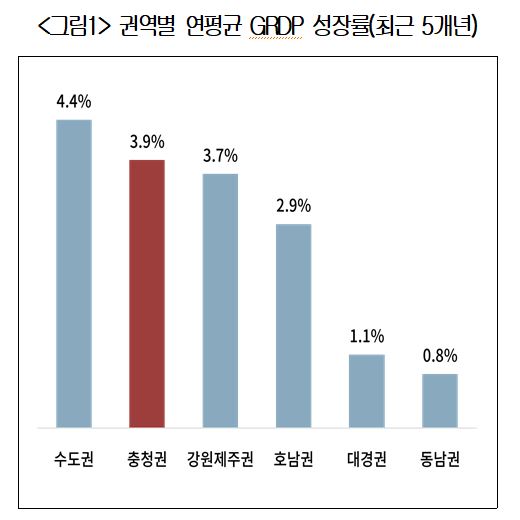
The Korea Chamber of Commerce and Industry (KCCI) held the '3rd Regional Economic Forum' on the 13th targeting the Daejeon, Chungnam, and Chungbuk areas to review regional issues and discuss response tasks. According to the data presented at the forum, the Chungcheong region's GRDP (Gross Regional Domestic Product) annual average growth rate over the past five years was 3.9%, ranking second among the six regions nationwide. The Chungcheong area, adjacent to the Seoul metropolitan area, has taken on the role of a production base for new industries such as semiconductors and batteries, creating new growth momentum.
Despite this outward growth of the Chungcheong region, there are criticisms that the industrial ecosystem remains poor, limiting its ability to catch up with the Seoul metropolitan area. Not only is there a severe shortage of technical personnel at new industry production sites, but there are also no corporate headquarters or research and development (R&D) centers that can practically lead the region's new industries.
In fact, when KCCI surveyed eight major companies with production plants in the semiconductor, battery, and bio sectors located in the Chungcheong area, none had their headquarters in Chungcheong. Regarding R&D centers, only 2 out of the total 10 R&D centers of these eight companies were located in the Chungcheong region.
The shortage of technical personnel in new industries also poses significant difficulties for local companies. According to the 'Industrial Technology Workforce Supply and Demand Survey' released by the Ministry of Trade, Industry and Energy, as of 2020, the shortage of technical personnel in the Chungcheong region was 5,935, the second highest after the Seoul metropolitan area.
At the forum, Cha Misook, Senior Research Fellow at the Korea Research Institute for Human Settlements, who presented on the population status of the Chungcheong region, expressed concern, saying, "Although the Chungcheong region, being adjacent to the Seoul metropolitan area, experienced less youth population outflow compared to other regions, the recent increase in new industry jobs within the region has made the shortage of technical personnel a serious issue."
The Top Priority Task is the 'Establishment of the Jungwon New Industry Belt'
Many pointed out that the top priority for the sustainable growth of the Chungcheong economy is to fully restore the incomplete industrial ecosystem centered on production. Accordingly, there was strong anticipation for the new government, which launched with the pledge to create the 'Jungwon New Industry Belt.'
The Jungwon New Industry Belt is one of President Yoon Suk-yeol's regional development pledges. It is a plan to create a future industry and startup belt by linking the Daejeon and Chungnam/Chungbuk areas, which are centers of science and technology and new industries, with the Gangwon and Honam regions.
At the forum, Kim Yangjoong, Research Fellow at the Chungnam Development Institute, who presented on the "Current Status and Prospects of Chungcheong Region's Specialized Industries," pointed out, "With the recent establishment of semiconductor, battery, and bio factories in the Chungcheong region, the cradle of science and technology, national expectations for it as a new industry hub have increased, but organic connections among them are still insufficient." He added, "We hope the government will promptly concretize and accelerate the implementation of the Jungwon New Industry Belt pledge promised to the Chungcheong region."
For the Chungcheong region, which hosts thermal power plants and petrochemical complexes, a successful 'energy transition' is also an important task. As of 2019, the Chungcheong region's carbon emissions amounted to 190 million tons, the highest among the six regions nationwide.
Research Fellow Kim Yangjoong emphasized, "Carbon neutrality is both an international demand and a promise to future generations, so it is a task that must be pursued. However, it is true that the industry faces many difficulties in implementation," adding, "The new government should provide bold policy support that aligns with companies aiming to practice carbon neutrality."
"New Government Should Provide Tailored Policy Support and Deregulation for New Industries"
There were also many demands for the new government to actively improve the industrial environment and business conditions in the Chungcheong region.
Jeong Taehee, Chairman of the Daejeon Chamber of Commerce and Industry, representing the Daejeon business community, said, "For the Chungcheong region to become a hub for new industries, tailored policy support and deregulation that correspond to this goal are necessary," urging the government, "Please broadly include solutions to the technical workforce shortage and tax benefits for large-scale facility investments in the soon-to-be-enacted National Advanced Industry Special Act."
Professor Jang Seokin of Korea Polytechnic University called for improvements in regional infrastructure to attract companies. Professor Jang said, "The Chungcheong region has production infrastructure in place, giving it relatively favorable innovation conditions compared to other non-metropolitan areas," adding, "In the Regional-Led Opportunity Development Zone (ODZ) project that the new government plans to promote, it is necessary to maximize the advantages of Chungcheong, such as national research complexes, and create conditions for organic collaboration among industry, academia, and research."
Woo Taehee, Executive Vice President of KCCI, stated, "The Chungcheong region is a geographical and industrial hub encompassing various industries, but it is also true that there is nothing outstanding enough to be called a specialized industry," and added, "We expect local governments and the regional industry to actively participate in the new government's Jungwon New Industry Belt initiative and develop it into a genuine Chungcheong brand."
Meanwhile, attendees at the forum included Woo Taehee, Executive Vice President of KCCI; Park Jongwon, Regional Economic Policy Officer at the Ministry of Trade, Industry and Energy; Kim Myungsoo, Vice Mayor for Science of Daejeon City; Jeong Taehee, Chairman of Daejeon Chamber of Commerce and Industry; Jeong Wonchun, Executive Vice President of Chungnambuk Chamber of Commerce and Industry; Lee Kyungmi, Chair of the National Balanced Development Committee Evaluation Advisory Group; Kim Hyonyong, Director of the Korea Automotive Technology Institute; Lim Yonghun, Director of Osong Advanced Medical Industry Promotion Foundation; and Park Eunil, Director of Daedeok Research and Development Special Zone Promotion Foundation.
Following this 3rd Regional Economic Forum targeting Daejeon, Chungnam, and Chungbuk, the 4th forum will be held in the Jeju region and is scheduled for late June.
© The Asia Business Daily(www.asiae.co.kr). All rights reserved.

















