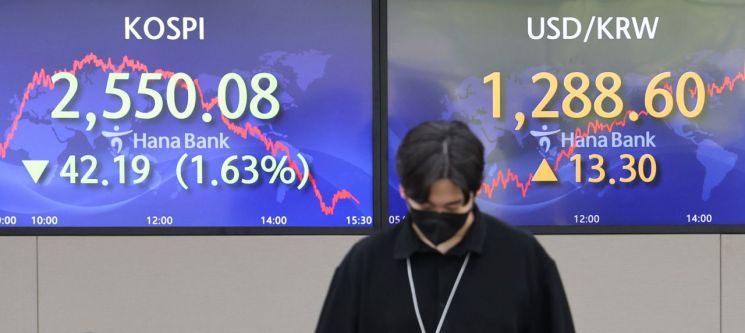
[Asia Economy Reporter Lee Jung-yoon] The KOSPI index fell to the 2550 level on the 12th amid multiple adverse factors, including a sharp drop in the U.S. stock market.
The KOSPI index closed at 2550.08, down 42.19 points (1.63%) from the previous day. On that day, the KOSPI rose to 2591.57 in the morning but then widened its decline, plunging to 2546.80. However, as the market close approached, the decline slightly narrowed, ending the trading around the 2550 level. The KOSPI fell for eight consecutive trading days for the first time since August last year. It was also the first time since November 19, 2020. Foreigners and institutions sold a net 281.5 billion KRW and 154.2 billion KRW, respectively, while individuals bought a net 386 billion KRW, helping to defend against further index declines.
Among the top market capitalization stocks, only Kia closed higher, up 0.23%. Foreign and institutional buying continued on that day as well. LG Chem recorded the largest drop, falling 6.63%. This was followed by Kakao (-5.50%), Samsung SDI (-3.42%), Naver (NAVER) (-3.23%), Hyundai Motor (-1.37%), SK Hynix (-1.36%), Samsung Electronics (-1.22%), LG Energy Solution (-0.89%), and Samsung Biologics (-0.63%).
By sector, machinery fell the most, down 3.81%. Banks (-3.62%), chemicals (-3.48%), services (-3.41%), and construction (-2.81%) also declined. On the other hand, telecommunications rose 1.07%. Insurance, which had fallen more than 2% in the previous trading day, rose 0.89% on this day. Electricity and gas, as well as transportation and warehousing, rose 0.78% and 0.35%, respectively, while medical precision showed a slight increase of 0.04%.
The KOSDAQ index fell nearly 4% on the day, closing at 833.66, down 32.68 points (3.77%) from the previous day. This was the lowest closing level since November 4, 2020. Individuals bought a net 331.8 billion KRW, but foreigners and institutions sold 69.3 billion KRW and 240.5 billion KRW, respectively.
Among the top market capitalization stocks, HLB, which had risen more than 7% the previous day, was the only one to show strength, rising 9.03%. Cheonbo fell more than 7%, and Celltrion Pharm, EcoPro BM, L&F, and Kakao Games also dropped more than 6%. Celltrion Healthcare (-5.76%) and Rino Industrial (-3.45%) also declined. Studio Dragon, which newly entered the top 10 in market capitalization, fell 4.17%. CJ ENM, which previously ranked 10th in market capitalization, fell 12.29% on the day and dropped to 11th place.
The domestic stock market's plunge on this day is analyzed to be due to the U.S. April Consumer Price Index (CPI) rising 8.3% compared to the same period last year, exceeding the expected 8.1%, and the sharp drop in the New York stock market. On the 11th (local time), the Nasdaq index, centered on technology stocks, fell 373.43 points (3.18%) to 11,364.24. The Dow Jones Industrial Average fell 326.63 points (1.02%) to 31,834.11, and the Standard & Poor's (S&P) 500 index closed down 65.87 points (1.65%) at 3,935.18. Lee Kyung-min, a researcher at Daishin Securities, explained, "Although the U.S. consumer price inflation rate slowed, it exceeded all expectations. Rent and food price increases surpassed forecasts, rekindling concerns about economic slowdown, which triggered investor anxiety."
Additionally, the crash in the cryptocurrency market also affected the domestic stock market. The price of TerraUSD (UST), a stablecoin issued by blockchain company Terraform Labs, plummeted to $0.57. UST was designed to be pegged at $1 per coin, but it was not backed by cash or government bonds as safe assets; instead, its value was supported by its sister cryptocurrency Luna. However, as TerraUSD's price collapsed and Luna also fell, this mechanism broke down.
Furthermore, concerns about the possible liquidation of Bitcoin to supply liquidity caused Bitcoin prices to plunge. According to the global cryptocurrency market data site CoinMarketCap, as of 4:15 p.m. on that day, Bitcoin's price dropped 12.69% from the previous day to $26,764 (approximately 34.51 million KRW). This was the first time since December 2020 that Bitcoin's price fell to the $26,000 range. The decline in Bitcoin prices triggered a sharp drop in the Nasdaq, which shows a synchronization phenomenon centered on technology stocks. Seo Sang-young, a researcher at Mirae Asset Securities, said, "Due to reduced consumption caused by high inflation and concerns about economic slowdown, the U.S. stock market declined, and furthermore, the cryptocurrency market crashed, which dampened investor sentiment itself. As a result, investment sentiment toward technology stocks deteriorated significantly, affecting today's decline in the domestic stock market."
In addition, the strong dollar also acted as a negative factor for the domestic stock market. The won-dollar exchange rate closed at 1,288.6 won, up 13.3 won. This was the highest closing level in 12 years and 10 months since July 14, 2009. If the dollar continues to strengthen, foreign investors holding domestic stocks may incur exchange losses when converting to dollars, increasing the likelihood of foreign investor withdrawal.
© The Asia Business Daily(www.asiae.co.kr). All rights reserved.

















