5 Years of Shutdown Since 2017
Yoon Administration's Signal for 'Nuclear Power Revival'
CLP Verification Completed by the 13th
Original Committee Decision Variable in Nuclear Phase-Out Policy
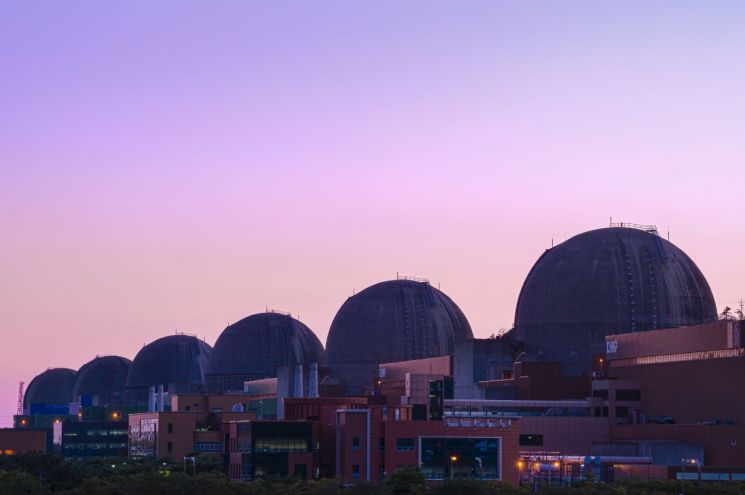
The Hanbit Nuclear Power Plant Unit 4 in Yeonggwang, Jeollanam-do, which was halted due to voids (gaps) in the containment building walls, is expected to resume operation as early as this October. If Hanbit Unit 4, which has been offline for five years since 2017, restarts in the second half of this year, it is anticipated to signal the new government's commitment to energy security through the "revival of nuclear power."
According to the nuclear power industry on the 12th, Korea Hydro & Nuclear Power (KHNP) recently submitted a roadmap for the restart of Hanbit Unit 4 to the Presidential Transition Committee before President Yoon Suk-yeol's inauguration. Specifically, by the 13th, KHNP plans to complete verification of the internal steel plate (CLP) of the upper dome of the concrete containment building surrounding the reactor and report the results to the Nuclear Safety and Security Commission (NSSC).
The independent verification report submitted by KHNP must be reviewed by the Korea Institute of Nuclear Safety (KINS), an agency under the NSSC, before the agenda is presented. This review assesses not only the report’s adequacy but also whether the conditions for submission are met.
Once a "no issues" confirmation is obtained, the agenda for approval to commence repairs on Hanbit Unit 4 will be formally submitted to the NSSC meeting. Considering that KINS’s review of the report typically takes about a week, it is likely that the repair approval will be discussed at the first meeting next month.
According to the roadmap, KHNP estimates that approximately four months will be required to obtain approval for the restart of Hanbit Unit 4. This minimum period includes two months for wall void repairs, one month for nuclear power performance verification, and the final restart approval through the NSSC meeting. The restart of Hanbit Unit 4 is expected to accelerate the Yoon Suk-yeol administration’s pledge to achieve a 30% share of nuclear power by 2030.
However, the decision of the NSSC, which holds the ultimate authority over nuclear power operations, could be a variable. For restart approval, preliminary consultations will be held at the NSSC meeting, and if consensus is not reached, a vote among the commissioners will be conducted, requiring a majority of votes in favor. Currently, among the seven NSSC commissioners excluding the chairman and secretary-general, four are classified as anti-nuclear power figures.
© The Asia Business Daily(www.asiae.co.kr). All rights reserved.
![Clutching a Stolen Dior Bag, Saying "I Hate Being Poor but Real"... The Grotesque Con of a "Human Knockoff" [Slate]](https://cwcontent.asiae.co.kr/asiaresize/183/2026021902243444107_1771435474.jpg)
















