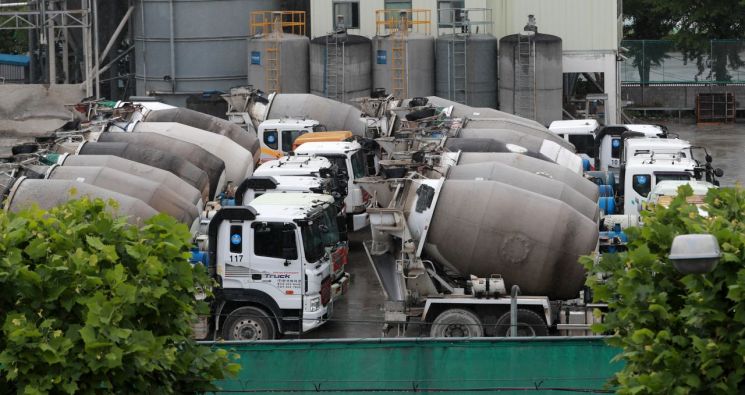
[Asia Economy Reporter Kim Jong-hwa] The ongoing cement and ready-mixed concrete (remicon) crisis this year shows little sign of resolution.
According to the industry on the 18th, the current domestic cement inventory stands at about 750,000 tons, slightly more than half of the optimal peak season inventory of 1.25 million tons. This is an increase of about 100,000 tons compared to March, when the cement supply crisis was at its peak. This improvement is thanks to the government and the cement industry increasing production by converting export volumes to domestic supply and operating 10 additional cement production kilns last month.
Ssangyong C&E's daily production increased by about 2,000 to 3,000 tons (5-7%) compared to the end of April last year (approximately 40,000 tons). Hanil and Hanil Hyundai Cement also increased production by 3-5% during the same period. Separately, the three coastal companies?Ssangyong C&E, Sampyo, and Halla Cement?have been supplying an additional 30% of their export volumes to the domestic market since last month according to their annual plans.
However, resolving the supply crisis remains difficult. Despite steady construction demand and increased cement sales prices, soaring thermal coal prices are not alleviating but rather exacerbating the manufacturing cost burden for cement companies.
Thermal coal prices, which account for about 40% of cement manufacturing costs, are shaking the entire related industry. International thermal coal prices traded at an average of $70 per ton in 2020 but surged more than threefold within a year, surpassing $220 in October last year. This year, due to the outbreak of the Ukraine war and heavy rains in Australia, prices soared to an all-time high of $422 in March.
This month, prices have again exceeded $400, putting the industry on high alert. On the 8th, high-quality thermal coal (6,000 kcal/kg standard) at Newcastle Port, Australia, was priced at $376 per ton, rising to $394 on the 9th, $398 on the 13th, and finally reaching $416 on the 16th, surpassing the $400 mark. A cement industry official said, "Prices seemed to dip briefly after March but have sharply reversed this month. At this rate, the expected price increase effects after the second quarter may not materialize, and negative impacts could continue into the second half of the year."
These concerns have been reflected in financial results. Ssangyong C&E announced on the 10th that its operating profit for the first quarter of this year plummeted 98.6% year-on-year to 450 million won. During the same period, sales increased 11.8% year-on-year to 376.2 billion won, but net loss was preliminarily estimated at 15.5 billion won, turning to a deficit. A Ssangyong C&E representative explained, "The tripling of thermal coal prices compared to last year had a significant impact."
Hanil Cement and Hanil Hyundai Cement saw sales rise by 9.0% and 5.6% to 284.1 billion won and 82.0 billion won respectively, but both returned to operating losses. Asia Cement also recorded an 18% increase in sales to 196.8 billion won, but operating profit fell 36% to 3.7 billion won. Sungshin Cement’s sales and operating profit decreased by 5.6% and 66% to 197.8 billion won and 2.7 billion won, respectively.
Sampyo Cement was the only company to show positive results, with sales growing 33% to 154.1 billion won and operating profit turning to a surplus of 2.8 billion won. However, this is interpreted as a base effect due to reduced production from major equipment maintenance in the first quarter of last year. Although overall sales increased due to rising cement demand from the recovery of the construction market, profitability worsened due to the surge in thermal coal prices and other factors.
As the cost burden makes production increasingly unprofitable, Ssangyong C&E agreed with the Korea Ready-Mixed Concrete Industry Cooperative Federation to supply cement at 90,800 won per ton, a 15.2% (12,000 won) increase starting from April shipments. Other companies are also trading at increased prices ranging from 91,000 to 92,200 won per ton (17-19% increase).
A cement industry official said, "Even though production has increased, shipments are immediate, so inventory does not accumulate. International thermal coal prices continue to create a fearful atmosphere, and the supply crisis is not easing. We expect conditions to improve somewhat only after the rainy season begins and construction demand decreases."
A ready-mixed concrete industry official said, "This thermal coal price shock has been ongoing since 2020. Honestly, the government's response has been complacent so far. With the new administration in place, we hope they will fulfill their role."
© The Asia Business Daily(www.asiae.co.kr). All rights reserved.

















