[Asia Economy Reporter Jang Hyowon] “Volocopter aims to provide 100% electric-powered air taxi services in Seoul by 2024.”
On the 11th, Christian Bauer, Chief Commercial Officer (CCO) of Volocopter, announced this while signing a contract to establish ‘Volocopter Korea’ with Wang Lei, Chairman of WP Investment, an investor based in Korea, and Tiffany Park, Co-Chairperson.
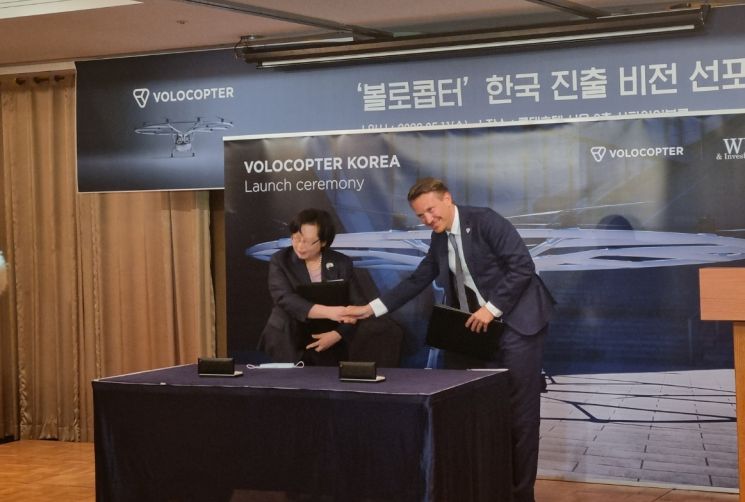 Tiffany Park, Co-Chairman of WP Investment (left), Christian Bauer, CCO of Volocopter. / Photo by Jang Hyowon
Volocopter Korea is a joint venture between the two companies, planning to transfer technology from Germany’s Volocopter and proceed with domestic localization including in-house production. They are preparing to launch the air taxi Volocity this year and plan to begin construction of the takeoff and landing site, VoloPort, next year.
Founded in 2011, the German company Volocopter is developing the short-distance air taxi ‘Volocity’ for urban transportation and the urban takeoff and landing site ‘VoloPort’ where Volocity can be boarded. They are also creating ‘VoloDrone’ capable of carrying 200kg of cargo, the long-distance air taxi ‘VoloConnector’ which can fly up to 100km, and the software platform ‘VoloIQ’ that controls and operates these vehicles.
In 2019, Volocopter became the first startup to receive the Design Organization Approval (DOA) from the European Union Aviation Safety Agency (EASA) for developing eVTOL (electric vertical takeoff and landing) aircraft. In June of the same year, the air taxi model Volocity ‘VC200-2’ was approved as an air taxi.
Test flights were also conducted domestically. In November last year, Volocopter held a UAM flight demonstration event at the Seoul Gimpo Business Aviation Center (SGBAC), hosted by the Ministry of Land, Infrastructure and Transport. During the test flight, Volocopter showcased a circular flight of approximately 3km.
Volocopter plans to operate electric air taxis at the 2024 Paris Olympics. According to Volocopter, the current two-seater air taxi can travel up to 35km on a single charge with a top speed of 110 km/h. This means it can travel from Gangnam Station in Seoul to Dongtan, Hwaseong in Gyeonggi Province in about 20 minutes.
Christian CCO stated, “Volocopter’s products operate entirely on electric batteries, resulting in low noise and minimal pollutant emissions,” adding, “They are also designed with 18 motors so that even if one or two fail, normal operation is possible, enhancing safety.”
For Volocopter’s UAM to be commercialized domestically in the future, approval and support from authorities are expected to be crucial. Recently, the Yoon Seok-yeol administration selected UAM as a future core industry and set a plan to commercialize it by 2025. Additionally, Seoul City announced the expansion of UAM-based infrastructure facilities while establishing the ‘2040 Seoul Urban Basic Plan’ last March.
Christian CCO said, “Volocopter will complete all licensing preparations for commercialization by 2024,” and added, “Commercialization in Korea depends on how quickly authorities and local governments approve infrastructure construction such as takeoff and landing sites and urban flight permissions for UAM introduction.”
Meanwhile, UAM-related investments are actively progressing domestically as well. Hyundai Motor plans to invest 1.8 trillion KRW in UAM-related research and development by 2025. Hanwha Systems is also preparing to build an aviation mobility platform.
© The Asia Business Daily(www.asiae.co.kr). All rights reserved.

















