Hanwha "Committed to the 2nd Nuriho Launch"
Ultimately, Growth as a 'Global Company' Is the Only Way Forward
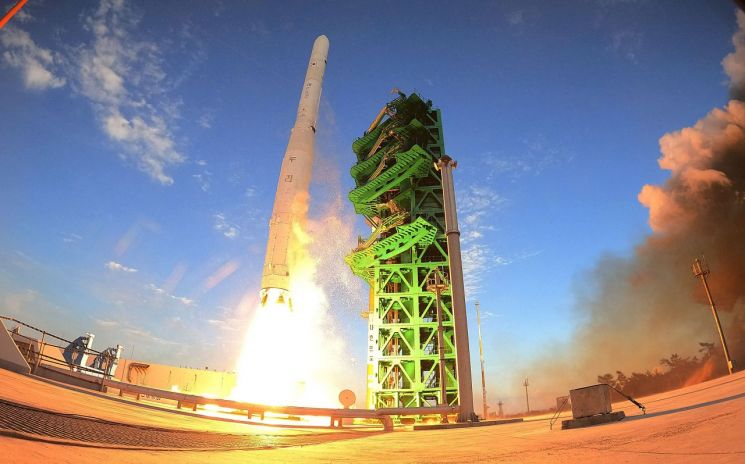 The Korean-type launch vehicle 'Nuriho' (KSLV-II), designed and manufactured with Korean indigenous technology, was launched on October 21 last year at the Naro Space Center in Goheung-gun, Jeollanam-do. (Image source=Yonhap News)
[Asia Economy Reporter Moon Chaeseok] Kim Dong-kwan, President of Hanwha Solutions, is making every effort to leap forward as a world-class aerospace company. After restructuring the governance centered on Hanwha Aerospace, the control tower of Hanwha Group's space business, President Kim is expanding the business territory by leading the development of the engine for Korea's space launch vehicle Nuriho. In particular, there is high interest in President Kim's 'space business performance' due to the excessive dependence on Hanwha in Korea's aerospace industry and the limitation of focusing on public institution projects rather than private sector projects.
According to the industry on the 11th, after the 'big deal' with Samsung in 2015, Hanwha Group changed the name of the former Hanwha Techwin (Samsung Techwin) to Hanwha Aero and separated five business divisions into affiliates. It is regarded as a success in vertical integration centered on Hanwha Aero, which oversees the group's aerospace engine, machinery, and launch vehicle industries. It has the capability to carry out various tasks such as the engine of the Korean launch vehicle Nuriho (Hanwha Aero), satellites (Satrec-I Hanwha Systems), ground systems (Satrec-I, Hanwha Systems), and launch pads (Hanwha Defense). Especially, it attracts industry attention as the only one among the top 10 companies engaged in the aerospace business and because the owner family leads the business. The group's space business organization led by President Kim, called 'Space Hub,' has been actively operating, including establishing a space research center with KAIST (Korea Advanced Institute of Science and Technology) last May.
Hanwha's goal is to become the world's 4th largest company. According to the industry, currently, three companies?Elon Musk's SpaceX, Amazon's Blue Origin (both from the U.S.), and Virgin Galactic (UK)?are effectively leading the global market. The consensus is that fostering private companies that lead high value-added businesses such as 'low Earth orbit satellites' at altitudes of 500 to 1500 km and occupy economies of scale in the global market is urgent. This is why Hanwha's role, having succeeded in vertical integration, is considered crucial.
Hanwha is putting all its efforts into the success of the 6th launch scheduled for 2027, including the second Nuriho launch planned for the 15th of next month. First, Korea must be recognized as capable of independently launching satellites weighing over 1 ton for profitable businesses like low Earth orbit satellites to become active. A Hanwha Aero official emphasized, "The launch vehicle sector is a business where success comes only by securing future opportunities," adding, "Currently, the entire company is focusing its capabilities on the Nuriho launch."
Ultimately, there is a widespread opinion that the aerospace industry, currently government (官)-centered, needs to be reorganized to be private (民)-centered. According to Morgan Stanley, the share of the global space industry market held by the private sector is already overwhelmingly high at 79%, compared to 21% by governments. In Korea, unlike other new industries such as new and renewable energy and mobility, the space industry supply chain is not dense, so interest in the success of Hanwha's 'space management' is inevitable. According to the '2021 Space Industry Status Survey' announced by the Ministry of Science and ICT, the number of space industry personnel, including companies, research institutes, and universities, is less than 10,000, and the number of participating companies sharply decreased from 24 in 2014 to 5 last year.
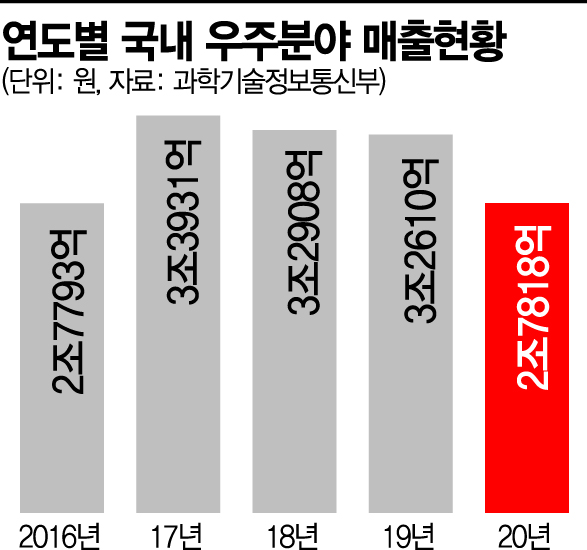
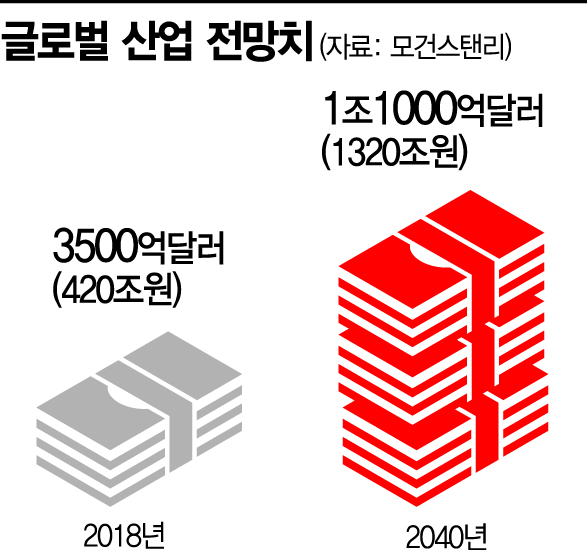
A bigger problem is that, unlike the global aerospace industry showing rapid growth, Korea is 'going backward.' According to the Ministry of Science and ICT, Korea's space sector sales decreased for four consecutive years from 3.3931 trillion won in 2017 to 2.7818 trillion won in 2020. Morgan Stanley forecasts that the global space industry size will grow from $350 billion (about 420 trillion won) in 2018 to $1.1 trillion (about 1,320 trillion won) by 2040.
An industry official said, "While news of space-related orders led by the Ministry of National Defense and the Defense Acquisition Program Administration is meaningful, ultimately, private companies must increase their market share in businesses such as low Earth orbit satellites," adding, "It is no exaggeration to say that the reality of Korea's aerospace industry depends on the success of Hanwha Group's 'space management.'"
© The Asia Business Daily(www.asiae.co.kr). All rights reserved.
![User Who Sold Erroneously Deposited Bitcoins to Repay Debt and Fund Entertainment... What Did the Supreme Court Decide in 2021? [Legal Issue Check]](https://cwcontent.asiae.co.kr/asiaresize/183/2026020910431234020_1770601391.png)

















