38% Support Introduction After Conditions Met, 31.4% Temporary Postponement
'Absolute Evaluation of School Records, Difficult to Change College Admissions' Opposition
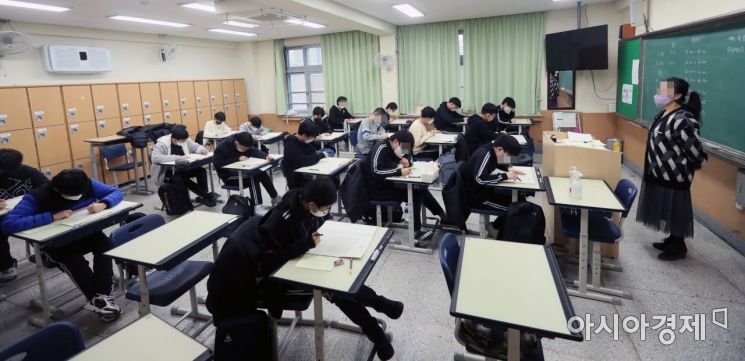 On the 24th, the 2022 academic year March National Joint Academic Achievement Test was conducted for 950,000 high school students from grades 1 to 3 nationwide. Third-year students at Jamsin High School in Songpa-gu, Seoul, are taking the exam. This academic achievement test is being held simultaneously nationwide on the same day for the first time in three years since the COVID-19 pandemic.
 Photo by Joint Press Corps
Although the Yoon Suk-yeol administration has announced plans to review and supplement the high school credit system, 85% of on-site teachers oppose its full implementation in 2025.
On the 11th, the Korea Federation of Teachers' Associations released the results of the "41st Teachers' Day Commemorative Teacher Awareness Survey," conducted from April 29 to May 6 with 8,431 teachers from nationwide kindergartens, elementary, middle, high schools, and universities. Regarding the full implementation of the high school credit system in 2025, 85% opposed it.
Teachers most frequently responded with "Reconsider the implementation timing after preparing conditions" (38.0%), followed by "Temporarily postpone due to a large gap with educational reality" (31.4%), and "Oppose the system introduction itself" (15.9%). Only 14.8% supported "Proceeding with full implementation in 2025 as originally planned." Among respondents, high school teachers, unlike other school levels who mostly chose "Reconsider the timing after preparing conditions," ranked "Temporarily postpone due to a large gap with educational reality" (35.0%) as their top choice. Additionally, the response "Oppose the system introduction itself" (23.3%) was uniquely high among high school teachers, exceeding 20%.
Regarding the biggest problem in introducing the high school credit system, the most cited issue was "It is realistically impossible to introduce due to difficulties in changing evaluation methods such as absolute grading for school records and college admissions" (40.9%). The next most common concern was "Lack of teacher recruitment, which is fundamental for offering diverse subjects."
On expanding the regular admission process in college entrance exams, 63.6% supported it, while only 22.7% opposed. By school level, elementary school teachers showed the highest support rate at 68.7%, and high school teachers the lowest at 54.3%. The primary reason for supporting the expansion of regular admissions was "Responding to the public demand for fairness in college entrance exams" (60.8%).
For revitalizing vocational high schools, the most necessary measure was "Changing the labor and industrial structure focused on academic background and creating quality jobs" (27.5%). This was followed by "Expanding recruitment of high school graduates by public institutions, large corporations, and mid-sized companies" (21.5%). Improving educational conditions at specialized high schools (17.9%), expanding advancement within the same field (16.6%), and improving on-site training (16.5%) followed. The Korea Federation of Teachers' Associations stated, "Ultimately, the revitalization of vocational high schools and vocational education shows the limitation of achieving this solely through educational policies," adding, "Fundamental national measures that improve labor and employment together must be prepared."
Regarding the seriousness of students' basic academic skills issues, 62.5% responded that it is "serious." Only 12.4% answered that "It will easily improve once the COVID-19 situation normalizes." The federation emphasized, "A comprehensive academic assessment for all students should be conducted, and teacher support for educational recovery must be strengthened," adding, "Administrative tasks should be drastically reduced so that teachers can focus on individual student education, and the number of students per class should be reduced to fewer than 20."
Meanwhile, 78.7% said that teachers' morale has declined over the past 1-2 years, which is 23 percentage points higher than the 55.3% recorded in the 2009 survey. Regarding protection of teachers' rights on-site, 55.8% answered "No," while only 16.2% answered "Yes."
© The Asia Business Daily(www.asiae.co.kr). All rights reserved.
![User Who Sold Erroneously Deposited Bitcoins to Repay Debt and Fund Entertainment... What Did the Supreme Court Decide in 2021? [Legal Issue Check]](https://cwcontent.asiae.co.kr/asiaresize/183/2026020910431234020_1770601391.png)















