Delivery Platform Users Continue to Decline This Year
#. Office worker Kim Myung-gi (alias) hesitated when trying to order food delivery for lunch while working from home. The delivery fee seemed more expensive than expected. The delivery fee amounted to 40% of the food price. After some consideration, Kim decided to visit the restaurant in person to eat, since social distancing measures had been lifted despite the inconvenience.
#. Lee Young-ho (alias), who runs a restaurant in Seoul, recently gave up on delivery services. This was because the delivery agency raised delivery fees by 1.5 times. Single-order deliveries were too costly, and bundled deliveries required visiting multiple locations, resulting in customers receiving cold food and the restaurant having to bear customer complaints. Thus, Lee decided to stop offering delivery altogether.
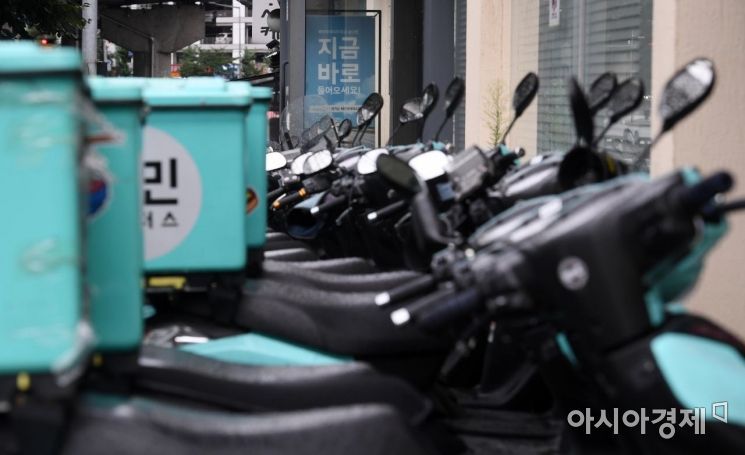
Delivery platforms, which had experienced rapid growth due to the spread of COVID-19, are now slowing down. Recently, with the advent of the "endemic" phase and an increase in dining out, the number of users has been steadily decreasing. Although seasonal off-peak effects play a part, the situation is quite different from last year when users surged. Coupled with issues like delivery fee hikes, dissatisfaction among restaurant owners and customers is accumulating, raising concerns that if user attrition accelerates, the delivery ecosystem could be destabilized.
According to Mobile Index by data company IGAWorks on the 11th, last month’s monthly active users (MAU) of Baemin, Yogiyo, and Coupang Eats on Android and iPhone (iOS) smartphones were 20.2 million, 7.95 million, and 5.06 million respectively. Compared to March, Baemin and Coupang Eats each lost 600,000 users, and Yogiyo lost 880,000 users. Compared to December last year, the growth of each delivery platform has clearly slowed this year. Yogiyo lost over 1 million users this year, and Coupang Eats saw a decrease of 2 million users. Coupang Eats has experienced a user decline for four consecutive months this year, with a 28% drop compared to the end of last year. Even Baemin, which performed relatively well, lost 550,000 users this year.
This contrasts with last year when users were rapidly increasing. In April last year, Baemin and Coupang Eats increased their users by 1.85 million and 1.98 million respectively compared to December of the previous year. As the growth of Baemin, the industry leader, and Coupang Eats, which was fiercely competing with Yogiyo, began to slow, the overall atmosphere has cooled down. Industry insiders attribute the prominent user decline this year mainly to the endemic effect. With the lifting of social distancing, restaurants are crowded, and pent-up dining-out demand is exploding, naturally reducing delivery orders.
Last year, Baemin and Coupang Eats engaged in an all-out battle over “single-order delivery,” where one rider handles one order, but after revising their pricing plans and raising delivery fees, the issue of increased delivery costs may have contributed to the decline in delivery platform usage. In fact, in communities of restaurant owners, complaints about delivery fee hikes and the high proportion of delivery fees relative to food prices are constant. Some owners are even considering giving up delivery services due to the burden of delivery fees. Users are turning to takeout or group purchases in local communities to avoid delivery fees.
The problem is that delivery fee increases are inevitable due to rider shortages and other issues, and delivery platforms’ profit improvements are slow. For example, Woowa Brothers, the industry leader, exceeded 2 trillion won in sales last year but saw a decrease in profit and recorded an operating loss on a consolidated basis including subsidiaries. The concern is that if user decline continues, the carefully built delivery ecosystem could be shaken. An industry official said, "Each delivery platform is closely monitoring the recent user decline and the impact of the endemic," adding, "With issues like delivery fee hikes intertwined, it is time to consider strategic measures that satisfy restaurants, users, and riders?the key players in the ecosystem."
© The Asia Business Daily(www.asiae.co.kr). All rights reserved.

















