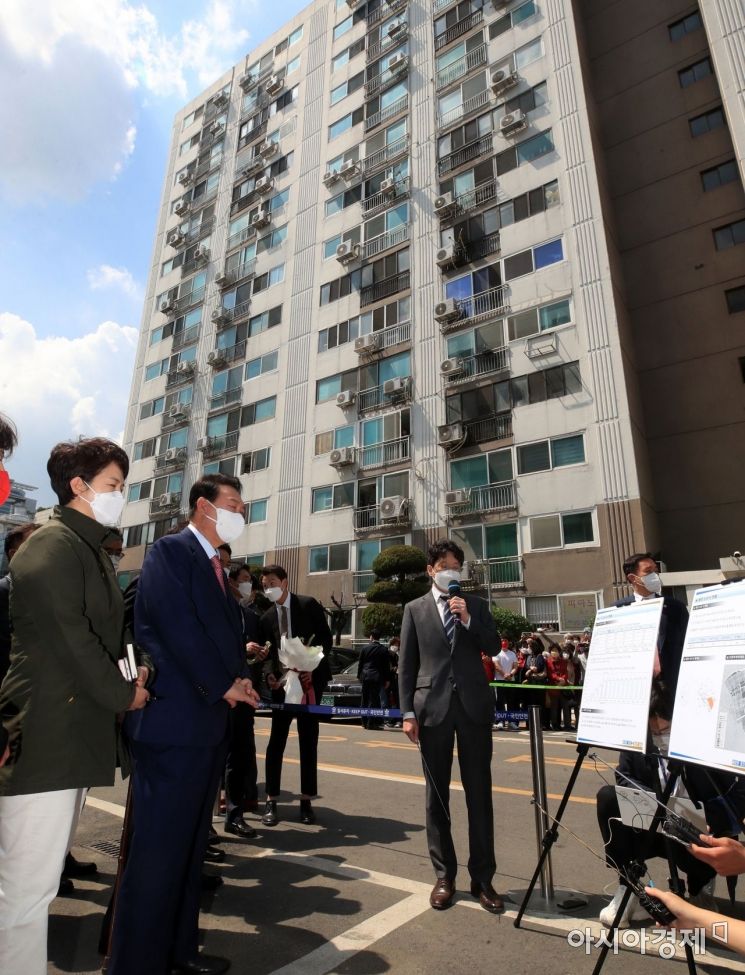
 President-elect Yoon Suk-yeol visited Chowon 7 Complex Booyoung Apartments in Dongan-gu, Anyang-si, Gyeonggi Province on the afternoon of the 2nd to inspect the issues of aging apartments in the first-generation new towns. Photo by Transition Team Press Corps
Real Estate Market Outlook
Mixed Trends Continue Due to Rising and Falling Factors
Concerns Over Supply Disruptions Amid Soaring Raw Material Prices
[Asia Economy Reporters Minyoung Kim, Hyemin Kim] Currently, the real estate market is showing a mixed trend as the housing market's downward momentum spreads due to weakened buying demand, but popular complexes with high demand are seeing record-high prices. Since both upward and downward factors coexist in determining the direction of the housing market, it is difficult to predict house prices this year. However, experts advise that since the new government's real estate policy goals are 'market-oriented' and 'price stability,' unreasonable regulations should be eased, but regulations should be relaxed rationally and sequentially within limits that do not destabilize house prices.
Experts commonly point out that the real estate market is currently in a wait-and-see mode due to the interplay of new real estate policies after the presidential election and interest rate hikes. Professor Han Mundo of Yonsei University’s Department of Finance and Real Estate said, "The variable now is that the scale and speed of interest rate hikes are large," adding, "While house prices have surged, the ability to bear interest burdens has decreased due to rate hikes, and especially with expectations of increased supply, more people have turned to a wait-and-see stance, which characterizes the current real estate market." It is explained that with loan regulations still in place and increased loan interest burdens due to rate hikes, it has become more difficult to secure funds for home purchases, making buyers hesitant to act. The disappearance of debt-financed investments (debt investment) and 'Eonggeul' (pulling together all resources) by people in their 30s, which drove last year's housing market surge, is also seen as reflecting this atmosphere.
Additionally, the second year of enforcement of the Lease 3 Act and rising raw material prices are expected to act as variables in the housing market this year. Kim Deokrye, head of the Housing Policy Research Office at the Korea Research Institute for Human Settlements, pointed out, "The fact that we are entering a full-fledged period of interest rate hikes, that households with expiring lease renewal rights will enter the market in the second half of this year, and the rise in raw material prices are real estate market variables facing the Yoon Seok-yeol administration."
The surge in raw material prices could lead to supply delays, potentially disrupting the plan to supply 2.5 million housing units, which is expected to be a factor in rising house prices. Excessive expectations regarding the easing of reconstruction regulations are also likely to serve as a barometer for this year’s house price trends. Since the end of March, when the policy to ease reconstruction regulations was announced, house prices in some reconstruction complexes, including Seoul’s Gangnam area, have turned upward. Some predict that for these reasons, house prices will ultimately trend upward this year.
Park Won-gap, senior real estate expert at KB Kookmin Bank, said, "In Seoul, there are banners celebrating reconstruction promotion in apartments that are 25 to 30 years old," adding, "House prices are influenced more by psychological expectations than fundamentals." He forecasted, "In conclusion, transaction contraction will continue, and while urgent sales may appear, statistically, house prices are likely to rise slightly."
There are also calls for a pace adjustment in deregulation as the new government emphasizes the 'market' while pursuing 'house price stability.' Professor Han said, "The Yoon Seok-yeol administration needs to clearly inform the public about the downward stabilization trend of house prices," and added, "Redevelopment and reconstruction regulations should be eased rationally and sequentially within limits that do not destabilize house prices."
© The Asia Business Daily(www.asiae.co.kr). All rights reserved.

















