KOFIA Releases April OTC Bond Market Trends
Foreigners' Domestic Bond Holdings Increase by Only 700 Billion Won
Impact of Base Rate Hike and Sharp Exchange Rate Rise
[Asia Economy Reporter Hwang Yoon-joo] Due to the U.S. Federal Reserve's (Fed) tightening policy, foreign investment in domestic bonds has stagnated for two consecutive months. As bond yields surged following the base interest rate hike, the net purchase volume significantly slowed down.
The Korea Financial Investment Association announced on the 10th that the balance of domestic bonds held by foreigners in April recorded 223.2322 trillion won, an increase of 700 billion won compared to the previous month (222.5419 trillion won).
Foreigners made net purchases totaling 6.5 trillion won, including 1.7 trillion won in government bonds, 3.8 trillion won in Monetary Stabilization Bonds, and 1 trillion won in bank bonds, but the overall domestic bond holdings increased only slightly. Foreign investors had been purchasing domestic bonds in the trillion-won range monthly, but since March, the net purchase volume (+630 billion won) has remained flat.
The stagnation in foreign net purchases of domestic bonds was largely influenced by the Fed's accelerated tightening and additional domestic base rate hikes. In March, the U.S. raised its base interest rate by 25 basis points, and on April 14, the Bank of Korea's Monetary Policy Committee also raised the base rate by 25 basis points to 1.50%.
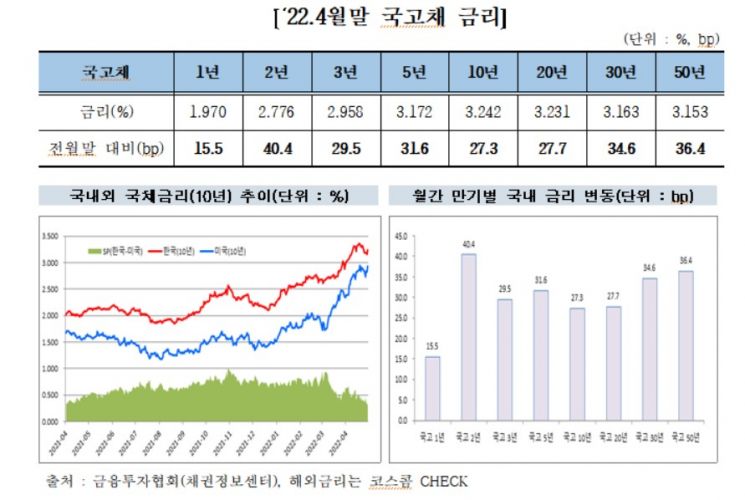
The Korea Financial Investment Association explained, "In early April, concerns over the Fed's quantitative tightening (QT) led to a sharp rise in U.S. bond yields, inflation worries due to domestic consumer price increases (April year-on-year +4.8%), and the Monetary Policy Committee's rate hike caused government bond yields to rise significantly. Since mid-April, yields fluctuated slightly due to concerns over a global economic slowdown and eased worries about government bond supply related to supplementary budgets."
The bond issuance volume in April decreased by 900 billion won compared to the previous month (70.7 trillion won → 69.8 trillion won) due to reductions in government bonds and Monetary Stabilization Bonds. The outstanding issuance balance increased by 18.3 trillion won due to net issuance of government bonds, special bonds, and ABS, reaching 2,548.8 trillion won.
Corporate bond issuance recorded 8.5 trillion won, a slight increase of 700 billion won from the previous month due to interest rate hikes amid tightening. Corporate bond credit spreads widened due to the sharp rise in government bond yields.
The demand forecast amount for corporate bonds in April was 3.605 trillion won across 43 cases, a decrease of 3.94 trillion won compared to the same month last year (7.545 trillion won).
The total participation amount in demand forecasts was 10.13 trillion won, down 18.91 trillion won from the same month last year (28.221 trillion won), and the participation rate (participation amount/demand forecast amount) recorded 281.1%, a decrease of 93.0 percentage points from the same month last year (374.0%).
The over-the-counter bond trading volume in April was 404 trillion won, down 16.3 trillion won from the previous month due to reduced trading amid rising yields, and the average daily trading volume was 19.2 trillion won, down 800 billion won from the previous month.
© The Asia Business Daily(www.asiae.co.kr). All rights reserved.
![Clutching a Stolen Dior Bag, Saying "I Hate Being Poor but Real"... The Grotesque Con of a "Human Knockoff" [Slate]](https://cwcontent.asiae.co.kr/asiaresize/183/2026021902243444107_1771435474.jpg)











