GIST to Hold Opening Ceremony of 'PAUL Center for Ultra-High-Power Laser Plasma Applications' on the 9th
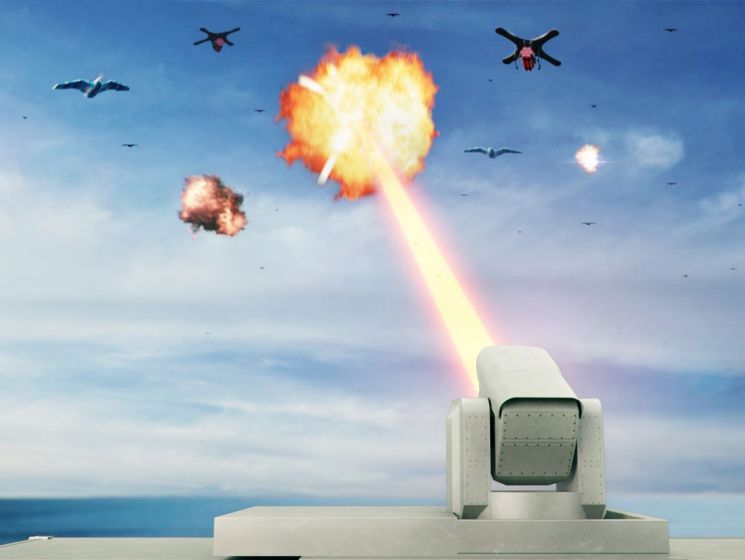
[Asia Economy Reporter Kim Bong-su] Amid the recent demonstration of drone power in the Russia-Ukraine war and other conflicts, a domestic research team has embarked on developing technology to neutralize enemy drones and robots using ultra-powerful lasers.
The Gwangju Institute of Science and Technology (GIST) announced on the 9th that it will conduct cutting-edge defense technology research to disable electronic equipment of enemy forces such as small drones and unmanned robots using ultra-powerful lasers. Ultra-powerful lasers are pulse lasers with extremely high instantaneous output exceeding terawatts (10^12 watts) within femtoseconds (10^-15 seconds, one quadrillionth of a second). They can instantly ionize all objects to form a plasma state.
While conventional laser weapons damage objects by focusing a thin laser beam on them for an extended period to accumulate heat, ultra-powerful lasers can damage all objects instantaneously, enabling the development of defensive weapons that can quickly strike the core parts of enemy weapons.
Previously, the research team at GIST’s Advanced Photonics Research Institute was selected last year for the Defense Acquisition Program Administration’s Future Challenge Defense Technology R&D project. The goal over the next five years is to develop 'ultra-powerful lasers and laser plasma technology for electronic equipment neutralization.' On this day, GIST held an opening ceremony for the 'Ultra-Powerful Laser Plasma Application Research Center (PAUL Center)' at the Advanced Photonics Research Institute.
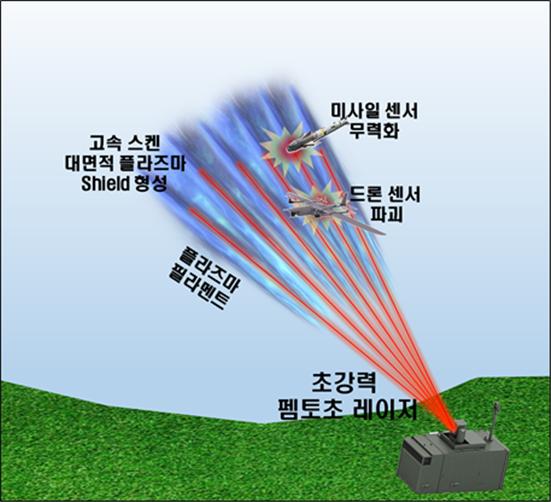
The research team plans to advance the ultra-powerful femtosecond laser plasma defense weapon technology, which has so far remained at the level of basic scientific principle demonstration, to a level applicable in actual combat. When an ultra-powerful femtosecond laser propagates through the air, ionization and nonlinear focusing occur simultaneously, generating filament plasma of several hundred micrometers in size. This allows the ultra-powerful laser pulse to be focused (narrowing the beam diameter) and transmitted over distances of kilometers (km), similar to an optical fiber. Applying this, technology can be developed to damage small drones, missile sensors, and other targets along the laser path without requiring precise focusing devices.
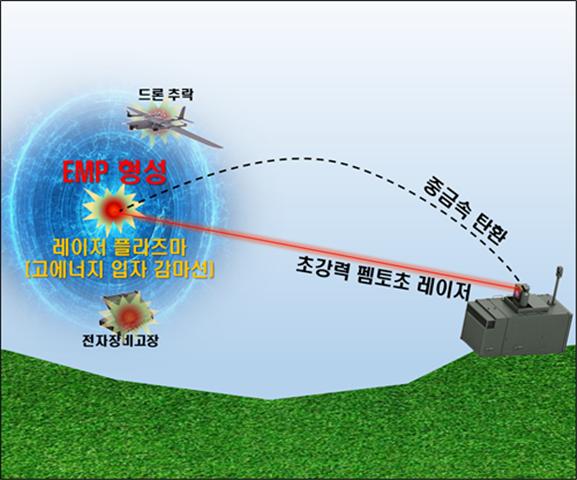
Additionally, by rapidly scanning the direction of the ultra-powerful femtosecond laser, a filament plasma shield structure can be formed in the air, enabling the development of defensive weapons that damage the core parts of attacking weapons passing through the shield area. When focused in the air onto heavy metals and other targets, high electromagnetic field plasma and radiation are generated, producing a high-intensity electromagnetic pulse (EMP) that can instantly disable enemy communication equipment, computers, networks, and military devices.
The research team plans to develop new technology to simplify and stabilize the complex structure and vacuum chambers of existing basic research ultra-powerful femtosecond lasers, and to focus them in the atmosphere to generate high-density, high-electromagnetic field plasma. The developed technology is expected to be applicable in various fields such as laser radiation cancer treatment, ultra-precise medical imaging, remote hazardous material detection, remote atmospheric quality measurement, ultra-precise nondestructive testing, and real-time precise material analysis.
Senior Researcher Kim Hyung-taek said, “With growing concerns over smart attacks such as small drone network attacks, portable missile attacks, and unmanned robot attacks, the development of new defensive weapons is urgent. Using ultra-powerful femtosecond laser plasma, it is expected to effectively neutralize multiple small weapons at high speed and respond effectively to the threat of enemy smart attacks.”
© The Asia Business Daily(www.asiae.co.kr). All rights reserved.



















