500 Companies Identify Labor Regulations as 'Top Priority'
Yoon Seok-yeol's New Government Pushes Enforcement Decree of Serious Accident Punishment Act and Flexible 52-Hour Workweek
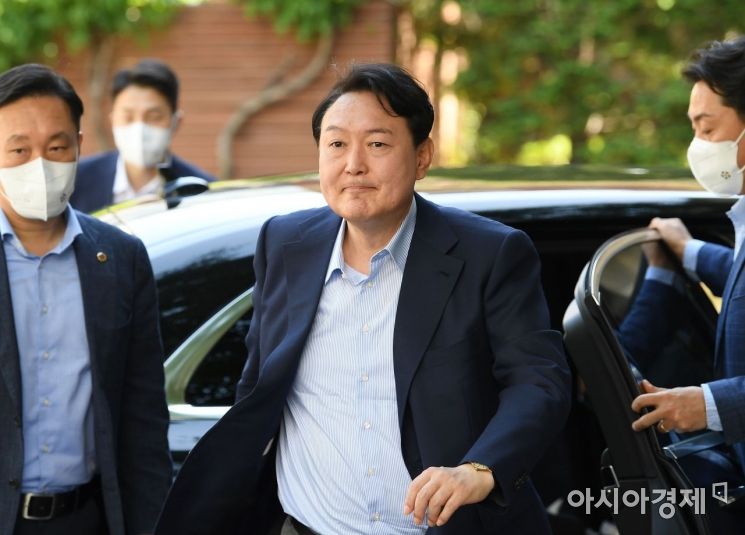 President-elect Yoon Suk-yeol is arriving at the 20th Presidential Transition Committee office in Tongui-dong, Jongno-gu, Seoul on the 5th. Photo by Transition Committee Press Corps
Domestic companies remain dissatisfied with the government's regulatory reform achievements, according to a recent survey. On the 10th, the business community expressed expectations that the new Yoon Suk-yeol administration will actively pursue regulatory reforms. The top priority task that companies most want to be addressed is in the ‘labor’ sector. In particular, there is a strong call to remove the shackles related to labor regulations such as the ‘Serious Accidents Punishment Act’ and the ‘52-hour workweek’ that are holding back companies.
◆Regulations Still Holding Back Companies=On the 9th, the Federation of Korean Industries (FKI) conducted a survey of 500 companies on the ‘2022 Regulatory Reform Perception Index,’ which scored 95.9. The Regulatory Reform Perception Index indicates how satisfied companies are with the previous year’s government regulatory reforms.
This year’s score slightly increased compared to last year’s (92.1) but still falls below the benchmark (100). This means that companies are generally dissatisfied with the regulatory reform achievements of the Moon Jae-in administration. Companies dissatisfied with regulatory reform cited the introduction or strengthening of regulations in relevant areas (25.8%) and insufficient improvement of core regulations in those areas (24.7%) as the main reasons for their dissatisfaction.
When asked ‘What do you consider the core regulation?’ among companies dissatisfied with regulatory reform, 27.3% selected the Serious Accidents Punishment Act.
Regarding the new government’s regulatory reform policy direction, the highest responses were ‘Temporary regulatory suspension to stimulate the economy’ (28.5%) and ‘Improvement of outdated regulations that deviate from global standards’ (22.9%). Following these were ‘Reorganization of related regulations to foster new industries’ (20.4%) and ‘Improvement of public officials’ regulatory reform mindset’ (13.8%).
The sector that the new government should prioritize for regulatory reform was identified as ‘labor regulations’ (25.2%). This is interpreted as companies continuing to feel burdened by strengthened labor regulations such as the 52-hour workweek and the Serious Accidents Punishment Act.
Regarding expectations for the new government’s regulatory reform, 24.6% responded ‘expect,’ while 24.0% responded ‘do not expect.’
◆Urgent Reform Needed for the Serious Accidents Punishment Act=More than half of the 500 companies named ‘labor regulations’ as the top priority reform area for the Yoon Suk-yeol administration. According to the FKI, as the Serious Accidents Punishment Act marked 100 days since its enforcement on the 6th, 9 out of 10 companies responded that ‘amendment or supplementation’ is needed after the law’s implementation. The biggest problems cited were ‘ambiguous legal provisions’ and ‘excessive punishment of management executives.’
Regarding follow-up measures for the Serious Accidents Punishment Act, it is highly likely that regulatory easing will be pursued through amendments to enforcement ordinances or subordinate guidelines that do not require parliamentary review. The new government’s economic team plans to clarify punishment standards through such enforcement ordinance revisions. However, the punishment provision that mandates imprisonment of one year or more in the event of a fatal accident under the Serious Accidents Punishment Act can only be eased through the National Assembly, so significant changes are expected to be difficult for the time being. This is due to the current political situation of a divided National Assembly expected until the first half of 2024.
Flexibility in the 52-hour workweek system is also a reform issue demanded by the business community. Chu Kyung-ho, the nominee for Deputy Prime Minister and Minister of Economy and Finance, recently stated at a parliamentary confirmation hearing that “the system will be supplemented to be operated flexibly and elastically.” Given the recent announcement of a strict stance on illegal activities by militant labor unions such as the Hyundai Heavy Industries union strike, changes in this area are also anticipated.
Yoo Hwan-ik, head of the Industry Division at the FKI, said, “Typically, regulatory reforms are actively pursued at the beginning of an administration but often fizzle out toward the end,” and suggested, “With the new government’s launch, continuous reforms through systemic improvements rather than one-off regulatory reforms are necessary.”
© The Asia Business Daily(www.asiae.co.kr). All rights reserved.
![Clutching a Stolen Dior Bag, Saying "I Hate Being Poor but Real"... The Grotesque Con of a "Human Knockoff" [Slate]](https://cwcontent.asiae.co.kr/asiaresize/183/2026021902243444107_1771435474.jpg)
















