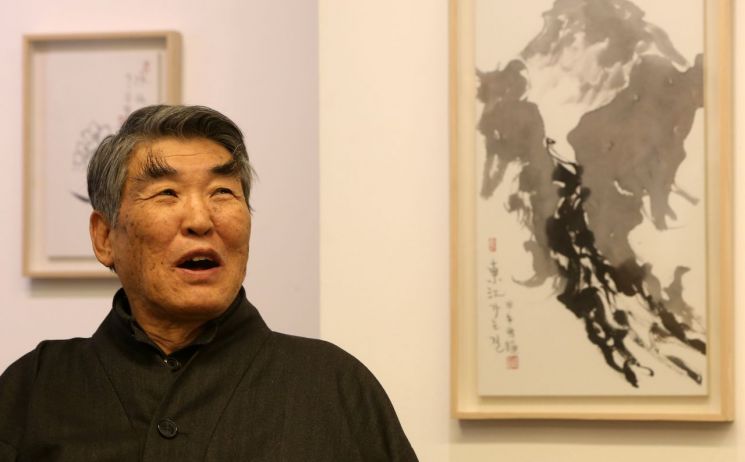
[Asia Economy Reporter Seo Mideum] Kim Ji-ha, who passed away on the 8th, was the "eternal resistance poet" symbolizing the twists and turns of modern Korean history. He conveyed resonant messages to the world, standing against ideological bias and prejudice. His voice, which transcended eras, came to us through his poetry. At times, he stood at the center of controversy and faced public judgment. His sharp critiques of political and social issues are now objects of longing. He passed away after battling illness, at the age of 81.
His surviving family includes his eldest son Wonbo (a writer) and his second son Sehee (Chairman of the Toji Cultural Foundation and Director of the Toji Literature Museum). Kim Ji-ha’s wife, Kim Young-joo, who passed away in 2019, was the only daughter of the late Park Kyung-ni, widely known as the author of the epic novel "Toji".
Kim Ji-ha’s real name was Kim Young-il. He was born on February 4, 1941, in Mokpo, Jeollanam-do. After graduating from Jungdong High School in Seoul, he studied aesthetics at Seoul National University. We remember him as a poet because of the messages he conveyed to the world through his works.
In 1963, he published a poem titled "Evening Story" under the pen name Kim Ji-ha in "Mokpo Literature." The name Ji-ha carries the meaning of working underground. In 1969, he officially debuted as a poet by publishing poems such as "Hwangtotgil" in the magazine "Poet".
His poem "Five Bandits," published in the May 1970 issue of "Sasanggye," was the moment that engraved the name Kim Ji-ha in the public’s mind. The poem criticized corrupt conglomerates, members of the National Assembly, high-ranking officials, generals, and deputy ministers. As a result, Kim Ji-ha was arrested and prosecuted on charges of violating the Anti-Communist Law. In 1974, he was even sentenced to death on charges of masterminding the National Democratic Youth Student Federation (Mincheonghakryeon) incident.
Another poetry collection symbolizing Kim Ji-ha, "With Burning Thirst," was published in 1975. This work led to his nomination for the Nobel Peace Prize and the Nobel Literature Prize. Both "Five Bandits" and "With Burning Thirst" are like alter egos of the resistance poet Kim Ji-ha. His fearless words and actions against dictatorial power caused him great hardship. He was also imprisoned after publishing articles exposing the fabrication of the Inhyukdang incident.
Kim Ji-ha, once regarded as a symbol of the democratization movement, became a target of criticism from former comrades in 1991 due to that incident. When university students continued protests through self-immolation following the death of Myungji University student Kang Kyung-dae in 1991, Kim Ji-ha wrote a controversial column urging to "end the death ritual." This sparked public debate.
As a result of this incident, he was expelled from the Association of Writers for Freedom Practice (now the Writers' Association). In the 2012 presidential election, he faced criticism as a "traitor" after declaring support for Park Geun-hye, the Saenuri Party candidate.
A figure who received both praise and criticism from both progressives and conservatives, regardless of evaluations of his life, the poetry Kim Ji-ha left behind is history itself. He received awards such as the Lotus Special Award from the Asian-African Writers' Conference, the Bruno Kreisky Human Rights Award, the Jeong Ji-yong Literary Award, and the Manhae Literary Award.
Kim Ji-ha’s poetry collections include "Nam (South)" (1984), "Salrim" (1987), "Aerin 1" (1987), "Black Mountain White Room" (1987), "On This Family Day, Rain Clouds" (1988), "My Mother" (1988), "Looking Up at the Star Field" (1989), "The Pain of the Center" (1994), "Hwage" (2002), "Nomadism and Seclusion" (2004), "Silk Road" (2006), "Dawn River" (2006), "Ugly Poems" (2009), "Sikimsae" (2012), and "White Shade" (2018), among others.
© The Asia Business Daily(www.asiae.co.kr). All rights reserved.

















