[Asia Economy Reporter Lee Chun-hee] May 8th is Parents' Day. It is a day to repay the grace of parents, but as parents age, they often hide various illnesses that arise, fearing they might become a burden to their children. In particular, as aging naturally brings weakening of bones and muscles, and related diseases may occur, caution is necessary.
First, unlike other parts of the body, the degree of bone aging cannot be visually detected, which raises concerns. Bone aging is closely related to osteoporosis. When osteoporosis causes a decrease in bone density and strength, even minor impacts or falls can easily result in bone fractures. In fact, many elderly people suffer fractures in the spine, hip joints, or wrist joints due to falls or slips at home.
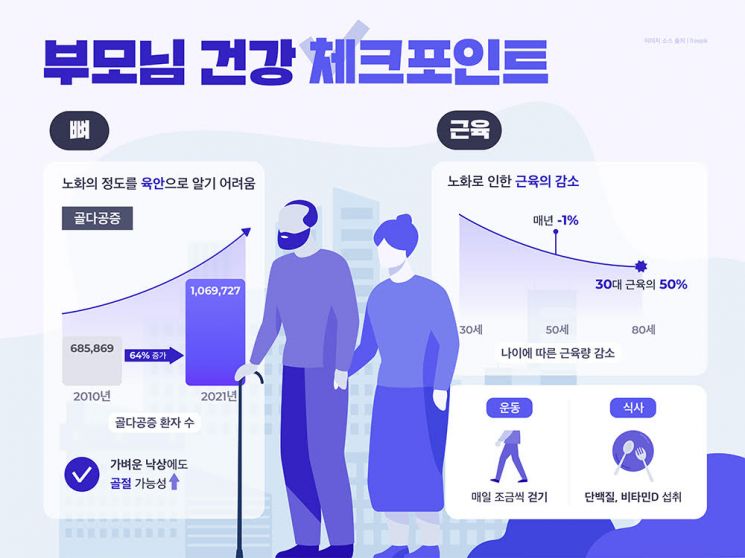
According to the National Health Insurance Service, the number of osteoporosis patients increased by 64% over 10 years, from 685,869 in 2010 to 1,069,727 last year. Especially in women, after menopause, the rapid decrease in estrogen accelerates bone loss, resulting in a higher number of female osteoporosis patients. It has been found that 4 out of 10 women over 50 suffer from osteoporosis.
Muscle loss should also be considered. A rapid decline in physical strength signals a reduction in muscle mass and muscle strength. Typically, muscle mass in our body begins to decrease by about 1% annually from the 50s, and by the 80s, only about half of the muscle mass from the 30s remains. Muscle strength also significantly decreases. Kang Jin-woo, an orthopedic surgeon at Bupyeong Himchan Hospital, said, “Efforts to maintain bone and muscle health are necessary to improve the quality of life in old age,” adding, “Especially if osteoporosis or sarcopenia is present, it is important to build basic physical strength and improve exercise ability to prevent fracture risks.”
In particular, the muscles of the lower back and back support the spine, so when these muscles decrease, it becomes difficult to straighten the back. Many elderly patients who visit hospitals with a bent back have severely diminished back muscles to the point where the spinal bones protrude. Most patients with spinal stenosis or spondylolisthesis also experience deterioration of the lower back and back muscles. If your parents have a bent back and frequently walk with their hands clasped behind their back or rely on strollers, both muscle loss and spinal diseases should be examined.
Yoon Ki-sung, a neurosurgeon at Mokdong Himchan Hospital, explained, “As people age, the elasticity and volume of muscles decrease, making them vulnerable to sprains, pain, and degenerative spinal diseases,” adding, “People with low muscle mass are more prone to spinal compression fractures if they fall.” If diagnosed with osteoporosis or osteopenia, spinal compression fractures can occur more easily, so even without a history of falls, it is advisable to undergo detailed examinations if back pain worsens. More than half of people over 65 experience spinal compression fractures, but two-thirds live unaware of it. Spinal compression fractures occur even from minor trauma such as falls or sitting down abruptly. The fractured vertebrae collapse and become flattened compared to normal. Compression fractures reduce the height of the spine, gradually causing a decrease in height.
© The Asia Business Daily(www.asiae.co.kr). All rights reserved.

















