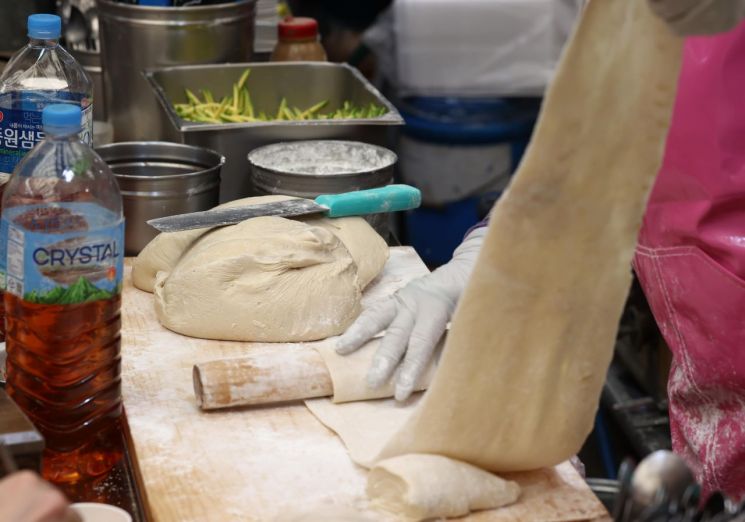
 Due to Russia's invasion of Ukraine, the prices of wheat and cooking oil have surged, causing increasing concerns among self-employed restaurant owners. Since the beginning of this year, soybean oil prices have risen by about 55%, and wheat prices have increased by more than 40%. The photo shows a vendor making dumpling wrappers at Gwangjang Market in Jongno-gu, Seoul, on the 28th of last month.
 Ukraine's wheat production this year is expected to decrease by more than one-third compared to last year. Ukraine is known as the "breadbasket of Europe" due to its fertile black soil, which produces abundant grains including wheat.
According to the British daily The Guardian on the 7th (local time), satellite data analysis company Kairos announced that based on satellite image analysis, Ukraine's wheat production this year is expected to be 21 million tons. This is 23% lower than the average of the past five years and 35% lower than last year's 33 million tons.
Kairos predicted that "due to the chaos caused by the war and the concentration of battles in eastern Ukraine, where major wheat cultivation areas are located, wheat harvests will significantly decrease."
The fact that Russia and Ukraine are major producers of fertilizers is also contributing to increased global agricultural costs.
Carlos Mera, an analyst at the Dutch bank Rabobank, said, "Due to rising fertilizer prices and increased demand for cultivating other price-inflated crops, major food-producing countries find it difficult to significantly increase production," forecasting that wheat prices will remain high.
He also explained, "The issue is not Ukraine's harvest volume but the amount available for export. Usually, 90% of wheat exports pass through the Black Sea, but this has now become difficult. Exports via trains are also affected by the war."
The possibility of a global food crisis intensifying in the future is also increasing.
Low-income populations in developing countries are already suffering from the COVID-19 pandemic, and countries in conflict zones such as Yemen and Afghanistan are facing the threat of famine.
In recent weeks, millions in South Asia have suffered from heatwaves, raising concerns about reduced crop yields.
Last year, wheat production in Canada was disrupted by heatwaves, and another major wheat producer, Australia, experienced severe flooding this year.
© The Asia Business Daily(www.asiae.co.kr). All rights reserved.

















