These Days, 'Ppangji Sunrye' Routes Must Include Salted Butter Bread Shops
Salted Bread Filled with Red Bean Paste and Butter or Topped with Chocolate and Cheese
Macarons and Donuts with Various Fillings Complete the 'Korean-Style Dessert'
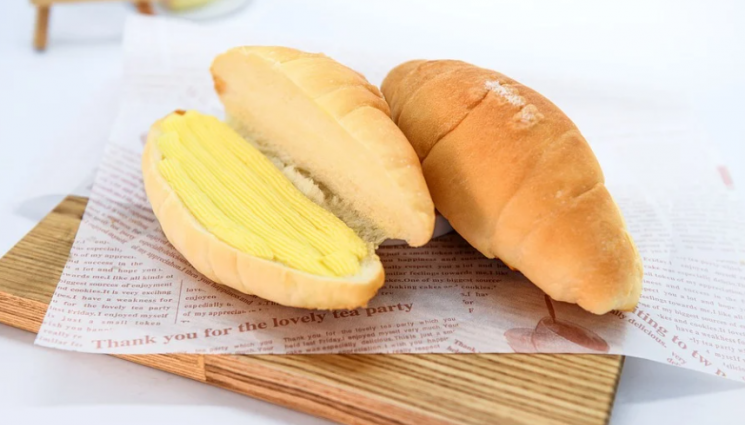 Salt bread flavored with butter and salt has recently become popular among young people. Photo by Pixabay
[Asia Economy Reporter Yoon Seul-gi] Among the MZ generation (Millennials + Generation Z) who go on 'ppangji pilgrimage' (a portmanteau of bread + pilgrimage, meaning visiting famous bakeries nationwide), 'salt bread' is gaining popularity. Although it has a croissant shape, its inside is flavored with butter, and the outside is sprinkled with salt and baked to a crispy finish. In Korea, salt bread has been reinvented as a 'Korean-style dessert' by adding fillings or toppings like chocolate and cheese between the bread.
For those traveling across the country in search of delicious bread, finding a 'salt bread specialty store' has become an essential course. Salt bread is a bread flavored with savory butter and salty salt, shaped like a short and plump pupa. The use of salt for flavoring is unique, and it is praised for pairing well with the strong butter aroma inside. The texture is addictive with a 'crispy outside, moist inside' sensation.
The popularity of salt bread is thanks to young women in their 20s and 30s who lead dessert market trends by visiting famous bakeries. On Instagram, the social networking service (SNS) they mainly use, posts tagged with '#saltbread' have reached 100,000.
Salt bread originated in Japan. Mitoshi Hirata, the owner of a small bakery called 'Pain Maison' located in Ehime Prefecture, Japan, wondered what kind of bread would sell well even in the region's particularly hot summer weather. He heard from his son that salted bread was trending in France. After much thought, he developed 'shio pan' (the Japanese term for salt bread), flavored with salt to stimulate the appetite.
Mr. Hirata focused on creating a soft texture to make bread that everyone could enjoy and chose to significantly increase the amount of butter. Typically, butter accounts for about 10% of the bread's weight, but in salt bread, butter makes up 20%. As a large amount of butter melts inside the dough, air pockets form, making the texture chewy, and butter melting on the surface makes it crispy. Additionally, rock salt is sprinkled on top to enhance the flavor and prevent the bread from becoming greasy.
 Krople highlights the charm of being crispy on the outside and moist on the inside by pressing croissant dough in a waffle iron instead of baking it. Photo by Pixabay
◆ Macarons, Croffles, Bagels, Donuts... Desserts Reborn with MZ Generation's Individuality
Unlike in Japan, in Korea, salt bread is made by adding red bean paste and butter inside or topped with chocolate and cheese. There are even salt breads colored with squid ink to add uniqueness. They have been reborn as distinctive K-desserts.
Macarons, croffles (croissant + waffle), bagels, and donuts, which first gained sensational popularity in the dessert market, also added characteristics of 'Korean-style desserts' to attract the MZ generation's response.
Macarons became wildly popular among women in their 20s and 30s in the form of 'ddungcaron' (a fat macaron) with 2 to 3 times more filling between the 'coque' (the macaron shell). From macarons flavored with Korean tastes like black sesame and injeolmi (roasted soybean powder rice cake) to those using crunch and strawberry jam like the ice cream Pig Bar or a whole commercial snack 'Ppotto' in a yellow cheese-flavored macaron, the range of flavors and forms expanded. Croffles also brought out the charm of 'crispy outside, moist inside' by pressing croissant dough in a waffle iron instead of baking it.
Donuts, popular as 'desserts worth lining up for,' also led bread lovers on a 'ppangji pilgrimage.' The famous donut brand 'Knotted' is characterized by being filled with various fillings such as classic vanilla, milk, earl grey, lemon sugar, and kaya butter inside the donut. As it spread on SNS as a 'donut specialty store,' waiting lines and even 'open runs' (purchasing right at store opening time) occurred.
Experts analyze that the MZ generation's dessert consumption culture is influenced by a small sense of achievement derived from 'experience consumption.' Professor Lee Eun-hee of Inha University's Department of Consumer Studies explained, "For the MZ generation, 'ppangji pilgrimage' is not just an act of eating but is perceived as a game like 'treasure hunting.' Lining up to find famous stores and doing open runs is part of the experience consumption context, giving satisfaction from 'I went to a certain area and did something to eat this.'
Professor Lee added, "Looking at the desserts mainly sought by the MZ generation, many cases involve adding or modifying ingredients or unique collaborations that highlight visual appeal. To attract attention on SNS, food needs to be more colorful or have a more striking form than ordinary food." She continued, "Desserts like black sesame and injeolmi flavors, called 'halmaennial' (grandmother + millennial), are familiar to older generations but feel new to the MZ generation. Also, the increase in health-conscious MZ consumers has influenced this trend."
© The Asia Business Daily(www.asiae.co.kr). All rights reserved.
![Clutching a Stolen Dior Bag, Saying "I Hate Being Poor but Real"... The Grotesque Con of a "Human Knockoff" [Slate]](https://cwcontent.asiae.co.kr/asiaresize/183/2026021902243444107_1771435474.jpg)

















