Market Cap of 6 Major Domestic New Industry Companies... Less Than One-Third of China's Tencent
KEF "Held Back by Various Regulations... Regulatory Barriers Must Be Removed"
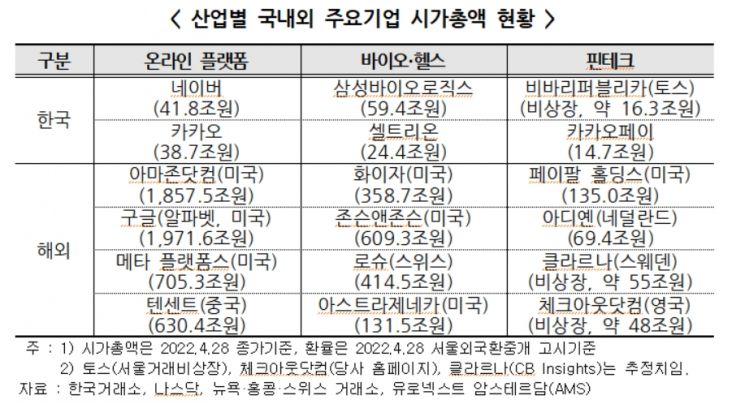
[Asia Economy Reporter Yoo Hyun-seok] The total market capitalization of six major companies in Korea's three new industries?online platforms, bio-health, and fintech (finance + technology)?is less than one-third that of China's Tencent. As innovation growth is hindered and competitiveness falls behind due to various regulations, there are calls to dismantle the tightly intertwined regulatory barriers.
According to the "Improvement Plan for Major New Industry Regulations in Korea" announced by the Korea Employers Federation on the 6th, the combined market capitalization of six companies in Korea's three major new industries?Naver, Kakao, Samsung Biologics, Celltrion, Kakao Pay, and Toss?was 195.3 trillion KRW as of the 28th of last month. This is less than one-third of the 630.4 trillion KRW market capitalization of Chinese company Tencent.
Unicorn companies, referring to unlisted firms valued at over 1 billion USD (approximately 1.1 trillion KRW), are also significantly lagging behind major competing countries. According to global market research firm CB Insights, as of March, there were 1,051 unicorn companies worldwide. Among them, only 12 were Korean companies, accounting for just 1.14% of the total.
Lee Hyung-jun, head of the Korea Employers Federation, pointed out, "The competitiveness of new industries such as online platforms, telemedicine, and fintech is significantly lower than overseas because the regulatory hurdles are excessively high."
According to the Federation, in the case of online platforms, the United States and the European Union (EU) are promoting regulatory legislation to foster competition within their markets to protect domestic companies from global corporations, but these regulations apply only to a small number of companies that meet all the criteria. In contrast, Korea has numerous broad regulatory bills pending in the National Assembly, including regulatory legislation targeting companies with sales exceeding 100 billion KRW (under the Fair Trade Commission).
Regarding telemedicine, among the 38 OECD countries, only six?including Korea?prohibit telemedicine. Although some non-face-to-face medical treatments were temporarily allowed after COVID-19, regulatory restrictions under the Medical Service Act still remain.
Fintech is also blocked by high regulatory barriers. Major advanced countries such as the UK are actively fostering the fintech industry as a next-generation growth engine. However, Korea finds it difficult to secure global competitiveness due to strong preemptive positive regulations such as network separation, personal information protection, and financial regulations, according to the Federation.
To address these issues, the Federation suggested that in online platforms, voluntary self-regulation led by the private sector should be implemented; in telemedicine, the Medical Service Act should be amended to allow remote medical care between patients and medical professionals; and in fintech, efforts should be made to ease network separation regulations to create an innovative environment.
Furthermore, to establish an innovation ecosystem for securing next-generation growth engines, the Federation proposed ▲eliminating regulatory barriers at each stage of corporate growth ▲creating an environment for industry nurturing through voluntary self-regulation led by the private sector ▲establishing a regulatory coordination body to resolve regulations on advanced technology convergence industries. Lee emphasized, "With digital transformation and the decline in potential growth rates accelerating, regulatory reform in new industries has become an urgent task that can no longer be postponed. The new government should promptly establish an innovation environment for the birth and development of next-generation growth industries by applying the negative regulation principle of permitting in principle and prohibiting by exception to new industries."
© The Asia Business Daily(www.asiae.co.kr). All rights reserved.
![User Who Sold Erroneously Deposited Bitcoins to Repay Debt and Fund Entertainment... What Did the Supreme Court Decide in 2021? [Legal Issue Check]](https://cwcontent.asiae.co.kr/asiaresize/183/2026020910431234020_1770601391.png)















