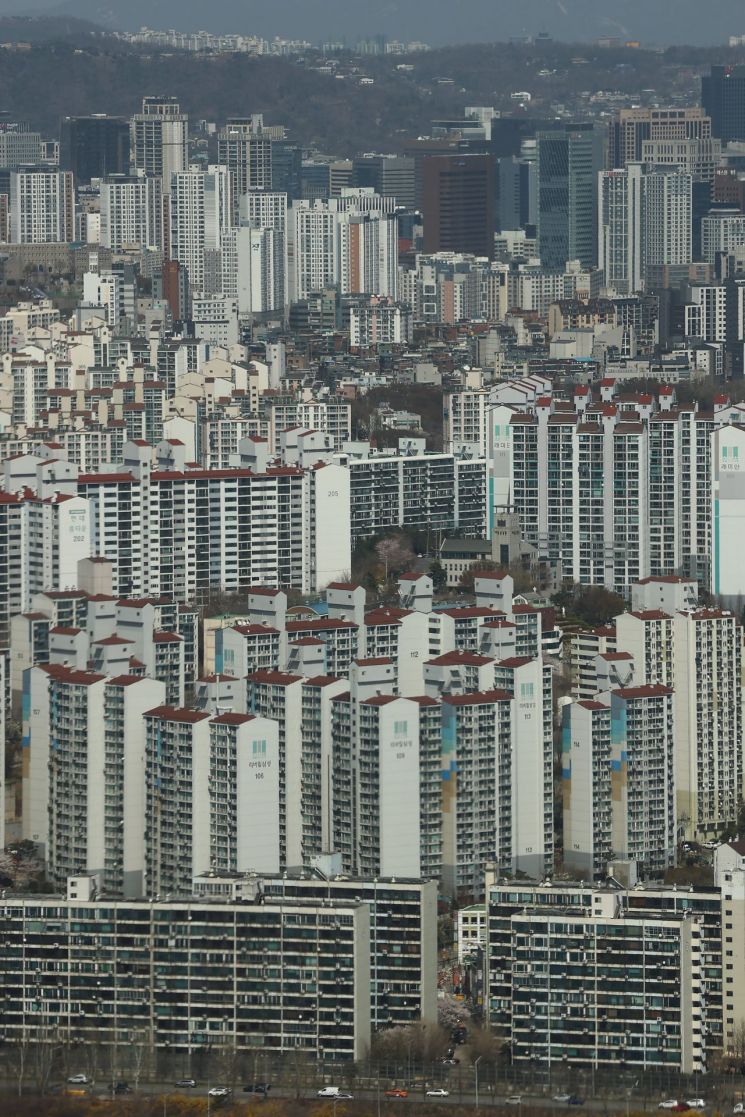
Gangnam Area with Many Reconstruction Complexes
'Office Relocation' Boosts Yongsan
Polarization of Apartment Prices by Region
[Asia Economy Reporter Kim Min-young] Ahead of the new government's inauguration, Seoul apartment prices have turned to an upward trend after 15 weeks, fueled by expectations of real estate regulation easing. The upward trend continues mainly in major reconstruction complexes, including the Gangnam area, while Yongsan is maintaining its rise due to the issue of the presidential office relocation. However, areas such as Dobong-gu, Mapo-gu, and Seodaemun-gu continue to see declines, showing a polarization in apartment prices within Seoul.
According to the weekly apartment price trends from the Korea Real Estate Board on the 6th, Seoul apartment prices rose by 0.01% in the first week of May. This marks a return to an upward trend after 15 weeks since recording 0.01% on January 17. The Real Estate Board explained, "Although there is generally a wait-and-see attitude due to concerns over interest rate hikes and global economic recession risks, in Seoul, reconstruction projects and ultra-high-end complexes in the Gangnam area with expectations of regulation easing have led to a price increase."
Even within Seoul's city center, the real estate market atmosphere varied by region depending on positive factors. As the Real Estate Board noted, the Gangnam area, which has many reconstruction projects and high-priced complexes, showed a prominent upward trend. Among the three Gangnam districts, Gangnam-gu (0.03%) and Seocho-gu (0.05%) maintained the same rate of increase as last week. In contrast, Songpa-gu saw apartment prices fall by 0.01%, marking a decline for two consecutive weeks. Yangcheon-gu, which includes Mok-dong, a district dense with reconstruction complexes, recorded a flat trend this week after rising last week. Yongsan-gu rose by 0.04%, expanding the increase from last week (0.03%) due to the presidential office relocation and redevelopment issues. On the other hand, Dobong-gu fell by 0.03%, deepening the decline from last week (-0.02%). Mapo-gu and Seodaemun-gu also continued their downward trend, dropping by 0.01%.
After the Presidential Transition Committee expressed its intention to promote reconstruction in the first-generation new towns, apartment prices in Gyeonggi Province also turned flat after 14 weeks. The rising expectations for reconstruction in the first-generation new towns led this trend. Apartment sale prices in Bundang-gu, Seongnam, where Bundang New Town is located, rose by 0.05%, the same as last week, while Goyang-si, home to Ilsan New Town, saw an increased rise this week (0.03%) compared to last week (0.01%). Apartment prices in Gunpo-si, which includes Sanbon New Town, also rose by 0.06% this week after being flat last week. While some first-generation new towns rose mainly due to reconstruction expectations, Hwaseong-si (-0.13%), where Dongtan New Town is located, and Uiwang-si (-0.06%), which saw a sharp rise last year, continued to decline.
The market capitalization increase of apartment complexes in the first-generation new towns has surpassed that of Seoul's reconstruction complexes. According to a survey by Real Estate R114, as of the end of last month, the total market capitalization of apartments in first-generation new towns such as Bundang, Ilsan, Pyeongchon, Sanbon, and Jungdong was 145.7663 trillion KRW, up about 0.34% from 145.2789 trillion KRW at the end of February. During the same period, the market capitalization of Seoul reconstruction complexes rose 0.20%, from 244.0211 trillion KRW to 244.6948 trillion KRW.
© The Asia Business Daily(www.asiae.co.kr). All rights reserved.

















