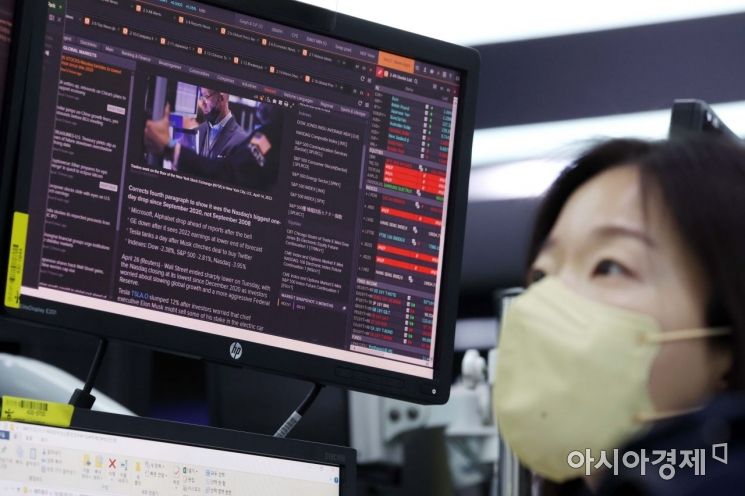
 On the 27th, when the KOSPI and KOSDAQ indices plunged by over 2%, dealers were working in the dealing room of Hana Bank in Euljiro, Seoul. The U.S. stock market sharply declined due to concerns over a slowdown in the economic recession and earnings uncertainty of big tech companies, which appears to have caused a chain reaction. Photo by Moon Honam munonam@
[Asia Economy Reporter Junho Hwang] Ahead of the regular changes in the KOSPI 200 index components next month, the stock prices of the included and excluded stocks are expected to show contrasting performances.
On the 5th, Samsung Securities identified F&F, Meritz Fire & Marine Insurance, and SD Biosensor as stocks to be included in the KOSPI 200. Conversely, CJ CGV, Poongsan, and Bukwang Pharmaceutical are expected to be excluded from the index. When certain stocks are included in the KOSPI 200, passive funds linked to various indices flow in. However, it can also serve as an opportunity for investors holding those stocks to realize profits. Additionally, these stocks may become targets for short selling.
Among the newly included stocks, Meritz Fire & Marine Insurance and SD Biosensor were noted for having inclusion demand more than five times their liquidity. Since demand exceeds existing supply, this is expected to impact their stock prices.
Stocks subject to adjustments in the free float ratio of the KOSPI 200 include KakaoBank, KakaoPay, Krafton, and Hyundai Heavy Industries, which will see an increase in free float ratio due to the lifting of lock-up periods, as well as POSCO Holdings and Shinhan Financial Group, which will experience an increase due to changes in major shareholder stakes. Among these, KakaoBank is expected to see additional buying demand increase to more than six times its liquidity due to the rise in free float ratio.
Regarding the timing of investment in the included stocks, it was observed that one month prior is appropriate. Samsung Securities analyzed that investing in newly included stocks two months before, one month before, and on the official announcement date of the changes all yielded positive returns. Investing two months prior exposes investors more to individual stock-specific factors, while investing on the official announcement date is often affected by profit-taking selling pressure. Therefore, investing one month before the regular change date is considered most effective.
Researcher Gyun Jeon of Samsung Securities stated, "Since short selling is possible for KOSPI 200 constituent stocks, some buybacks of stocks with high existing short positions that are excluded from the index will occur before the regular change date," adding, "It is necessary to monitor whether the loan balance of newly included stocks increases starting from the end of May."
© The Asia Business Daily(www.asiae.co.kr). All rights reserved.

















