A Significant Number of Committee Members Support Additional Interest Rate Hikes
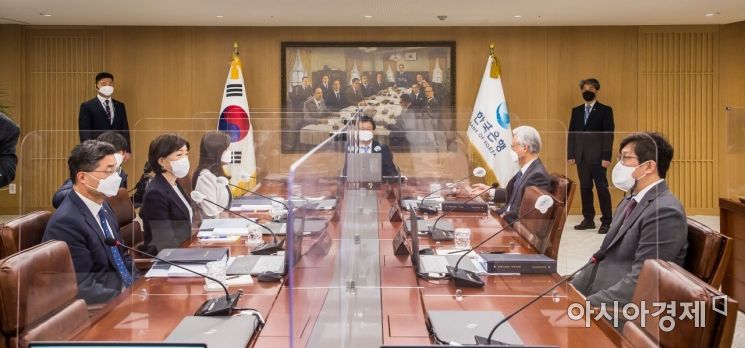
[Asia Economy Reporter Seo So-jeong] The Monetary Policy Committee of the Bank of Korea unanimously raised the base interest rate to 1.50% per annum last month, and many opinions were expressed that it is necessary to continuously pursue a reduction in the degree of monetary easing going forward.
According to the minutes of the Monetary Policy Committee released on the Bank of Korea's website on the afternoon of the 3rd, at the monetary policy direction meeting held on the 14th of last month, a considerable number of members expressed the view that it is necessary to steadily reduce the degree of monetary easing, considering comprehensively the domestic economy's growth, inflation, and financial conditions.
One member said, "Since the second half of last year, the rise in raw material prices and global supply disruptions, which have acted as factors driving inflation, have intensified following the Ukraine crisis, so future inflation trends are expected to significantly exceed the February forecast path," adding, "There is also concern that the secondary effects, which lead to interactions between inflation and inflation expectations, may fully materialize."
He diagnosed, "The recent expansion of wage inflationary pressures and the gradual spread of price increases from raw materials to final goods and service prices show that these concerns are somewhat becoming a reality," and added, "Attention should also be paid to the recent rise in the won-dollar exchange rate, which is acting as an additional upward pressure on domestic prices through import prices."
Regarding the timing of further interest rate adjustments, he mentioned, "While carefully monitoring the developments of uncertainties such as the normalization movements of monetary policies in major countries and the impacts of the Ukraine crisis, if there is no significant change in the situation, I believe that priority should be given to stabilizing inflation expectations and that the reduction of monetary easing should be proactively and consistently pursued."
Another member also said, "Considering the recent rapid decline in real interest rates and the widening gap with the neutral interest rate, monetary policy needs to be operated in a direction that reduces the easing stance," and judged, "The timing and pace of future additional rate hikes should be decided while observing the developments in economic and financial conditions."
He said, "Although it is a dilemma as downside risks to the economy and upside risks to inflation are simultaneously increasing both domestically and internationally, since growth exceeding the potential growth rate is expected to continue as a trend, it is consistent with the policy objective in the medium to long term to stabilize inflation expectations and limit the risk of financial imbalance accumulation by continuing efforts to return the monetary policy stance to a neutral level."
Another member also supported additional rate hikes, saying, "Even if the base interest rate is raised, as the large-scale spread of infectious diseases gradually subsides and quarantine measures are eased, the effect of constraining the momentum of economic recovery is expected to be limited."
In particular, many members focused on the secondary effects of inflation leading to wage increases. One member expressed concern, saying, "The wage increase trend in some industries is accelerating, so it cannot be ruled out that the wage-price pass-through effect through rising inflation expectations has already begun."
Another member added, "The high contribution of fixed wages last year is gradually increasing, and the wage increase trend is spreading to various industries," adding, "Most indicators that affect wages, such as inflation expectations, vacancy rates, and labor market slack indicators like employment rates, unemployment benefit claims, and working hours, have recovered to pre-pandemic levels. This not only indicates a recovery in the real economy but also leads to wage increases, which may cause additional inflation in some items such as personal services."
© The Asia Business Daily(www.asiae.co.kr). All rights reserved.

















