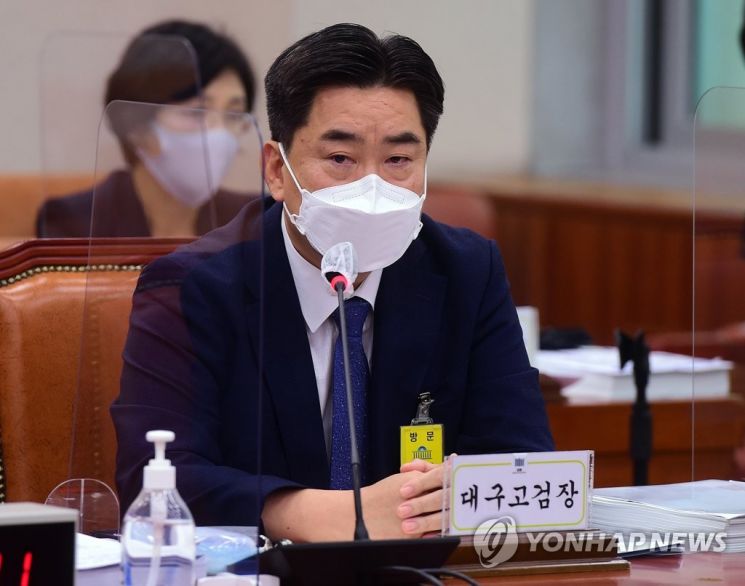
[Asia Economy Choi Seok-jin, Legal Affairs Specialist Reporter] On the 3rd, as the amendment to the Criminal Procedure Act containing the 'Geomsu Wanbak' (complete removal of prosecution's investigative authority) was passed in the National Assembly plenary session, Kwon Soon-beom, Chief Prosecutor of Daegu High Prosecutors' Office (age 53, Judicial Research and Training Institute class 25), expressed strong dissatisfaction with the forced passage of the 'Geomsu Wanbak' bill through a resignation post on the prosecution's internal network.
That morning, Chief Prosecutor Kwon wrote in his 'Resignation Greeting' post on the prosecution's internal network, E-Pros, "All the problematic bills have passed the National Assembly," and added, "Politicians have blocked the prosecution from initiating investigations into their own public office crimes and election crimes."
He pointed out, "They said they would reduce the prosecution's authority, but suddenly deprived the complainants of their right to object," and criticized, "As a result, the rights of powerless complainants are being violated, yet they remain silent as if mute."
Chief Prosecutor Kwon stated, "Even if there is suspicion that the police missed or ignored crimes due to being busy, prosecutors can no longer investigate the hidden truth beyond mere identity," and criticized, "There was no consideration to control the massive police force where power is concentrated, nor any concern for the delays in police investigations and the resulting public suffering that worsened after the adjustment of investigative authority."
He added, "Previously, through appeal and re-investigation request systems, the court held the ultimate judicial termination authority, but now in complaint cases, the police even exercise the court's authority," and expressed regret, "The unconstitutionality and unfairness of the legislative process are not even worth mentioning. It is only heartbreaking to see the dignity of the Republic of Korea and human rights regress. History will pass judgment."
Regarding the background of posting the resignation letter that day, he said, "I, as a senior executive, took responsibility for this situation and submitted my resignation to protest the unjust legislation," and continued, "since then, I have tried to contribute even a little to blocking the legislation, but as of today, there is nothing more I can do, so I bid you farewell with this resignation greeting."
He said, "Some must stay to do their work, and some must leave to fulfill their responsibilities," and added, "Just as the legislation that blocks investigations into those in power and makes it difficult to remedy crime victims remains unchanged, so does my intention."
Chief Prosecutor Kwon said, "What the public truly wants from prosecution reform is for the prosecution to investigate fairly and protect the people safely from crime," and urged, "This time, chief prosecutors, senior prosecutors, ordinary prosecutors, and investigators put their heads together, and the bulletin board was full of the power of collective intelligence. Please do not let this energy go to waste and continue to strive."
He said, "Lastly, I offer some harsh words," and added, "We must take this legislative disaster, stained with arrogance and lack of communication, as a lesson and reflect on ourselves in everything we do."
He continued, "The habit of putting oneself in others' shoes and a humble mindset are virtues necessary for respected public officials and essential cultures for trusted organizations," and said, "As representatives of the public interest, quasi-judicial bodies, and objective duty performers, I urge you to always exercise prudent wisdom."
Chief Prosecutor Kwon is from Seoul and graduated from Seoul Sangmun High School and Korea University Law School. He passed the 35th Judicial Examination in 1993 and, after completing the Judicial Research and Training Institute, began his career as a prosecutor at Seoul District Prosecutors' Office in 1999.
He subsequently held key positions including ▲ Prosecutor of the Ministry of Justice's Prosecution Division 1 ▲ Research Officer at the Supreme Prosecutors' Office ▲ Head of the Criminal Legislation Division at the Ministry of Justice ▲ Director of Policy Planning at the Supreme Prosecutors' Office ▲ Chief of Criminal Division 5 at Seoul Central District Prosecutors' Office ▲ Chief of Criminal Division 1 at Seoul Eastern District Prosecutors' Office ▲ Director of Future Planning at the Supreme Prosecutors' Office ▲ Director of Crime Information Planning at the Supreme Prosecutors' Office ▲ Director of Investigation Information Policy at the Supreme Prosecutors' Office, and was promoted to Chief Prosecutor of the Violent Crimes Division at the Supreme Prosecutors' Office in 2018.
Afterwards, he served as Director of Human Rights at the Supreme Prosecutors' Office, Chief Prosecutor of Jeonju District Prosecutors' Office, Chief Prosecutor of Busan District Prosecutors' Office, and was promoted to Chief Prosecutor of Daegu High Prosecutors' Office in June last year.
© The Asia Business Daily(www.asiae.co.kr). All rights reserved.
![Clutching a Stolen Dior Bag, Saying "I Hate Being Poor but Real"... The Grotesque Con of a "Human Knockoff" [Slate]](https://cwcontent.asiae.co.kr/asiaresize/183/2026021902243444107_1771435474.jpg)
















