Criminal Procedure Act Amendment Passed in Plenary Session
Resolution to Form Special Committee on Criminal Investigation Agency Installation Discussions
2 PM Cabinet Meeting... President Moon Likely to Promulgate
Criminal Procedure Act Excludes Complainants from Police Non-Prosecution Objection, Additional Legislation Needed for Criminal Investigation Agency Installation
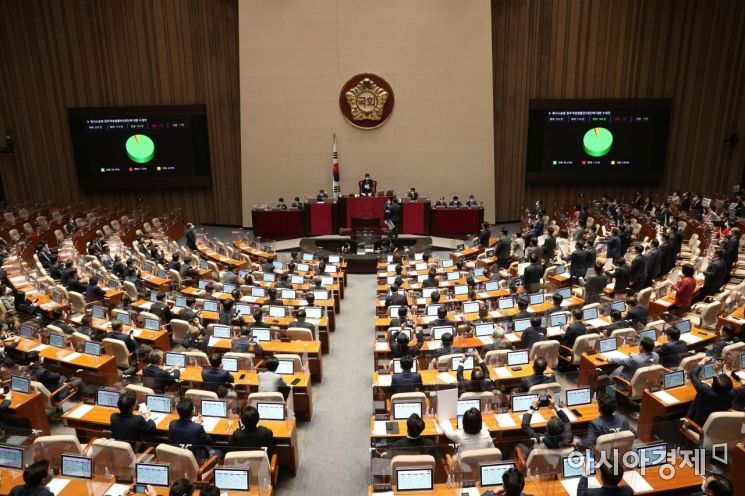 The second bill among the inspection reform bills, the amendment to the Criminal Procedure Act, passed the National Assembly plenary session on the 3rd. Photo by Yoon Dong-joo doso7@
[Asia Economy reporters Naju Seok, Oh Joo-yeon, Kwon Hyun-ji] The remaining pillar of the Criminal Procedure Act amendment, which is centered on the separation of prosecution and investigation powers under the 'Geomsu Wanbak (Complete Removal of Prosecution's Investigation Rights),' passed the plenary session on the 3rd. Accordingly, along with the previously passed amendment to the Prosecutors' Office Act, the first legislative process of Geomsu Wanbak has been completed. President Moon Jae-in plans to hold a Cabinet meeting in the afternoon to promulgate these amended laws.
The National Assembly passed the second Geomsu Wanbak bill, the Criminal Procedure Act, in the plenary session that morning with 164 votes in favor, 3 against, and 7 abstentions. It was processed swiftly within 21 minutes of the session's opening.
After the plenary session, Floor Leader Kwon told reporters, "From the beginning, it was a process marked by disguised trickery such as sham substitutions, trick resignations, trick agenda adjustment committees, trick plenary sessions, and trick Cabinet meetings," adding, "I believe the public will make a sound judgment on this matter."
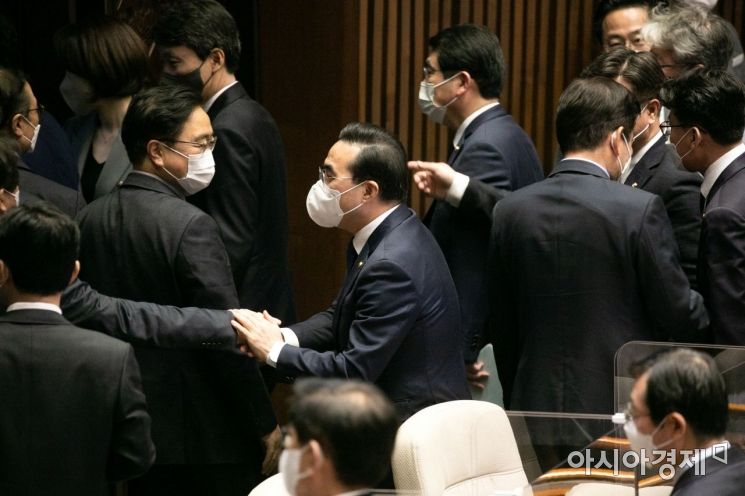 Park Hong-geun, floor leader of the Democratic Party of Korea, is greeting lawmakers after the plenary session was adjourned on the 3rd, following the passage of the second "Complete Criminal Prosecution Reform" bill, the amendment to the Criminal Procedure Act, and the establishment of the Special Committee on Judicial Reform in the National Assembly plenary session. Photo by Yoon Dong-joo doso7@
Speaker Park expressed regret over the overturning of the mediation agreement prepared through bipartisan consensus after handling the agenda. He said, "This agreement was the highest level of consensus that the political circles could reach," and added, "If it is outright denied by one side, the politics of dialogue and compromise, and parliamentary politics will no longer have a place to stand."
The Democratic Party plans to begin follow-up measures for the modernization of investigative agencies, including the establishment of the Serious Crime Investigation Office (Jungsucheong), after the Criminal Procedure Act also passed the plenary session. On the same day, a resolution to form the Special Committee on Judicial Reform (Sagye Special Committee), a body for discussing the establishment of Jungsucheong, was also passed. President Moon Jae-in is expected to preside over a Cabinet meeting at 4 p.m. and promulgate the Geomsu Wanbak laws passed by the plenary session.
Unlike the passage of the Prosecutors' Office Act amendment on the 30th of last month, the Criminal Procedure Act amendment did not trigger physical clashes but proceeded amid loud exchanges between ruling and opposition lawmakers. The People Power Party protested across from the plenary hall before the session, holding placards and pickets with slogans such as "Stop the legislative rampage of Geomsu Wanbak."
Before handling the Criminal Procedure Act in the plenary session, Song Eon-seok, the senior deputy floor leader of the People Power Party, requested a procedural speech, but Speaker Park Byung-seok rejected it, citing the National Assembly Act that bills after unlimited debate must be voted on without delay. Consequently, the vote took place amid chants demanding Speaker Park's resignation from People Power Party lawmakers and others.
Although the Geomsu Wanbak law was passed, there are remarks that this is just the end of the first round. Since the Sagye Special Committee has declared plans to establish the Serious Crime Investigation Office, also known as the Korean FBI, a second round of Geomsu Wanbak is inevitable. Democratic Party Floor Leader Park Hong-geun promised at the floor strategy meeting that "We will conclude the abolition of the remaining direct investigative powers of the prosecution by establishing the Korean FBI."
The second bill among the inspection reform bills, the amendment to the Criminal Procedure Act, passed the National Assembly plenary session on the 3rd. Photo by Yoon Dong-joo doso7@
Additionally, regarding the Criminal Procedure Act, there are criticisms that excluding complainants from the subjects eligible to appeal police non-prosecution decisions is problematic and requires revision. Yoon Ho-jung, the emergency committee chairman of the Democratic Party, said, "Although the opposition party opposes it, the actual bill had been coordinated to the wording stage, and we intend to process it as is to respect the agreed wording," but added, "Once the Sagye Special Committee is formed, I think we need to promptly prepare countermeasures starting with this issue."
The process of passing the Geomsu Wanbak law led to extreme confrontation between the ruling and opposition parties, resulting in the worst relations during the regime transition period. Various tricks testing the limits of the National Assembly Act appeared, such as so-called disguised resignations by lawmaker Min Hyung-bae, changes to the plenary session opening time, and splitting the agenda. Furthermore, controversies arose over the renegotiation and cancellation of bipartisan agreements. Moreover, with the ruling and opposition parties switching roles a week later, starting a minority government with opposition majority and entering the local election phase, the relationship between the parties is expected to become bleak.
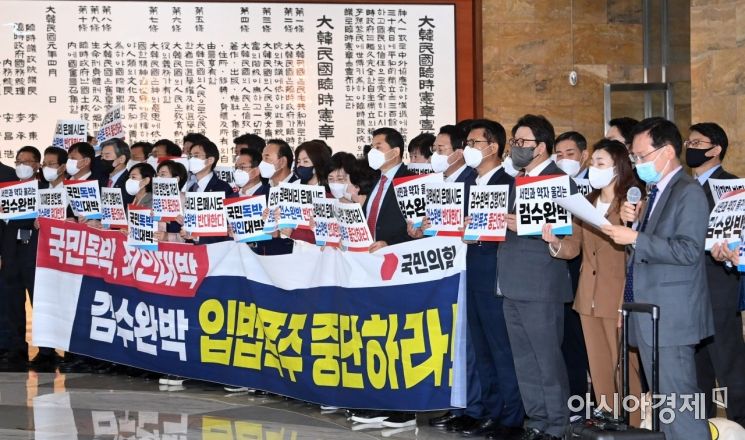 Rep. Kwon Seong-dong, floor leader of the People Power Party, and other lawmakers are condemning the Complete Inspection Abolition Act in front of the National Assembly plenary session hall on the 3rd. Photo by Yoon Dong-joo doso7@
After the plenary session, the People Power Party held a rally in front of the Blue House urging President Moon Jae-in to exercise his veto power.
© The Asia Business Daily(www.asiae.co.kr). All rights reserved.
![Clutching a Stolen Dior Bag, Saying "I Hate Being Poor but Real"... The Grotesque Con of a "Human Knockoff" [Slate]](https://cwcontent.asiae.co.kr/asiaresize/183/2026021902243444107_1771435474.jpg)


















