Resumption of Short Selling After 1 Year
Concentration of Short Selling on Top KOSDAQ Stocks
But Stock Prices Follow an Upward Curve
[Asia Economy Reporters Ji Yeon-jin and Hwang Jun-ho] "Short selling drives stock prices down."
One year after the partial resumption of short selling?borrowing stocks to sell and then buying them back if the price drops?contrary to such concerns, the stock prices of KOSDAQ stocks heavily shorted have risen. Foreign investors who bet on stock price declines to earn substantial profits appear to have not enjoyed much success.
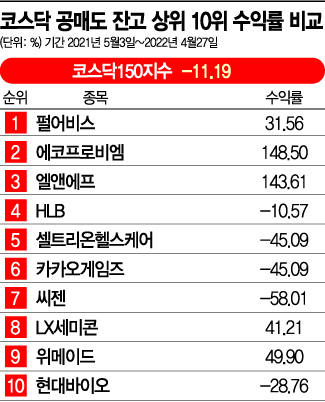
According to the Korea Exchange on the 3rd, from May 3 last year when short selling began until the 27th of last month, the daily average short selling transaction amount on KOSDAQ was 149 billion KRW. The daily average proportion of short selling in KOSDAQ trading volume was about 1.48%. Although this proportion seems small in the overall KOSDAQ trading volume, there were many days when short selling accounted for a significant portion of individual stocks' trading volume. For Pearl Abyss, which had the largest cumulative short selling balance on KOSDAQ over the past year (358.7 billion KRW), short selling accounted for up to 37% of its trading volume on some days.
However, despite heavy short selling, stock prices soared. Pearl Abyss's stock price was 56,400 KRW per share on April 30 last year but rose 31.56% to 74,200 KRW as of the 27th. EcoPro BM (269.5 billion KRW) and L&F (218.2 billion KRW) also saw their stock prices jump 148.50% and 143.61%, respectively, during the same period. The average return of the top five stocks with the highest short selling balances (average 233.7 billion KRW), including these stocks, was 52.60%. Among the top 10 stocks (157.7 billion KRW), LX Semicon and Wemade showed increases of 41.21% and 49.90%, respectively.
On the other hand, most of the bottom 10 stocks in terms of short selling balance (1.2 billion KRW) recorded negative returns. Among them, M2N (-75.10%), Cellid (-67.92%), and Huons Global (-62.55%) showed double-digit declines. The concern that short selling drives stock prices down does not seem to apply, at least among the top 10 KOSDAQ stocks.
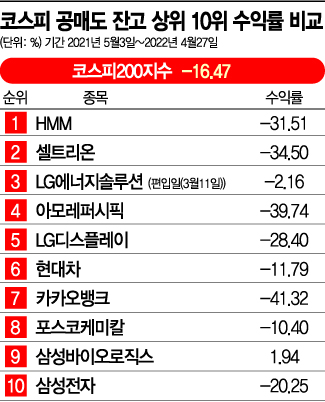
The KOSPI market showed a different pattern. Among KOSPI200 stocks subject to short selling, those with large short selling balances showed notable stock price declines. The average stock return of the top 10 stocks with the highest short selling balances over the past year was -21.81%, a larger drop than the KOSPI200 index return of -16.47% during the same period. Among these 10 stocks, only Samsung Biologics saw its stock price rise, while the other nine recorded declines. Newly listed stocks that sparked high valuation controversies amid the IPO investment boom also faced heavy short selling, but their stock returns varied significantly. LG Energy Solution, listed on the KOSPI on January 27 this year, experienced short selling worth 2.2762 trillion KRW from March 11, when short selling was permitted, until the 27th of last month, but its stock price fell only 2.16%. In contrast, Kakao Bank, which was included in the KOSPI200 shortly after its listing last year, saw about 4 trillion KRW in short selling transactions and its stock price dropped 41.32%.
The 10 KOSPI companies with low short selling balances also performed relatively well, with an average return of -13.79%, outperforming the index. Among the bottom 10 stocks in short selling balance, six fell more than the KOSPI200 index, but their declines were not as steep as those of the top 10 stocks. Additionally, Posco International experienced short selling transactions worth 534.6 billion KRW over the past year, yet its stock price rose 15.71%.
Hwang Se-woon of the Korea Capital Market Institute stated, "Although it is generally true that stock prices fall when short selling increases, it cannot be concluded that concentrated short selling necessarily drives stock prices down. Short selling should be viewed as one investment technique and a tool to understand investors' perspectives, rather than as a direct cause of stock price fluctuations, which is not a reasonable claim."
© The Asia Business Daily(www.asiae.co.kr). All rights reserved.
![Clutching a Stolen Dior Bag, Saying "I Hate Being Poor but Real"... The Grotesque Con of a "Human Knockoff" [Slate]](https://cwcontent.asiae.co.kr/asiaresize/183/2026021902243444107_1771435474.jpg)


















