LTV and Rental 3 Laws Regulation Easing Signals Speed Adjustment
"Sale of KEB Hana Bank to Lone Star Followed Law and Principles... Same Decision Even If Reversed"
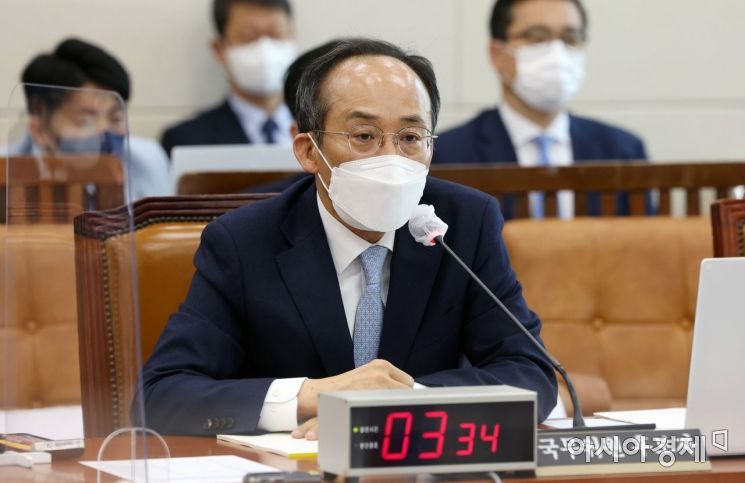 Deputy Prime Minister and Minister of Economy and Finance nominee Choo Kyung-ho is attending the confirmation hearing held at the National Assembly on the 2nd, responding to questions from lawmakers. Photo by Yoon Dong-joo doso7@
[Asia Economy Sejong=Reporter Kwon Haeyoung] Choo Kyung-ho, nominee for Deputy Prime Minister and Minister of Economy and Finance, stated that the planned introduction of the financial investment income tax next year should be postponed for two years and that the securities transaction tax should be reduced. This judgment was made considering the difficult domestic and international economic conditions and the need for productive capital inflow into the stock market. Regarding the comprehensive real estate tax, which has taken on a more 'punitive tax' nature under the Moon Jae-in administration, he expressed that immediate abolition is difficult.
"Productive capital inflow into the stock market through a 2-year postponement of the financial investment income tax"... Virtual asset taxation scheduled for next year should also be delayed
At the confirmation hearing held at the National Assembly on the 2nd, nominee Choo mentioned the need for postponement regarding the financial investment income tax, saying, "We must consider the current domestic and international conditions of the stock market, the necessity of productive capital inflow, and investor acceptance."
The financial investment income tax is a tax imposed on capital gains exceeding 50 million KRW annually from stocks, funds, bonds, etc., and is scheduled to be implemented from 2023. Currently, only major shareholders holding a single stock worth 1 billion KRW or more or holding more than 1% of shares (based on KOSPI) pay capital gains tax on stocks. However, with the introduction of the financial investment income tax, even non-major shareholders will have to pay 20-25% tax if their stock capital gains exceed 50 million KRW annually. Previously, President-elect Yoon Seok-yeol pledged to abolish the stock capital gains tax.
Nominee Choo emphasized, "Good capital should flow into the market, and conditions should be created so that many investors can invest," adding, "Through a 2-year postponement of the financial investment income tax and a reduction in the securities transaction tax, the inflowing capital should firmly support the stock market."
Accordingly, the new government is expected to pursue tax law revisions that delay the imposition of the financial investment income tax while reducing the securities transaction tax. Additionally, nominee Choo stated that it is necessary to ease capital gains tax on major shareholders.
Regarding virtual asset taxation scheduled for next year, he also expressed the position that it should be delayed by two years. Nominee Choo said, "Transparency in transactions, investor protection, and legal system improvements are necessary," adding, "Taxation on virtual assets should be implemented after the system is established."
Mention of the need to normalize real estate regulations... LTV and the Three Lease Laws regulation easing signals 'speed adjustment'
Regarding real estate policy, he emphasized the need to normalize the current administration's regulation-focused policy but showed a cautious stance due to concerns about market instability and legislative limitations.
Regarding the abolition of the comprehensive real estate tax, which President-elect Yoon pledged, nominee Choo took a step back, saying, "It is difficult to abolish it immediately." He stated, "It is appropriate to study and discuss the integration with property tax," but added, "It is not a matter to be done in the short term and should be reviewed after sufficient research." He further said, "I understand that the current administration used tax policy to stabilize the real estate market, but I think it was excessive," and added, "Tax normalization is necessary, and we will review the normalization of the comprehensive real estate tax and capital gains tax together."
Regarding real estate financial regulations, he mentioned the need for normalization but maintained a cautious stance. Nominee Choo said, "The current Debt Service Ratio (DSR) calculation method does not sufficiently reflect future income and is rigidly operated," adding, "We should actively consider reflecting future income for young people to help them purchase homes when calculating DSR." On the other hand, he suggested that there would be no abrupt easing of the Loan-to-Value (LTV) ratio regulation. He said, "LTV should be adjusted and responded to while monitoring the real estate market," adding, "Because the market is sensitive, it should be done orderly and sequentially considering those factors."
Regarding the Three Lease Laws, he expressed the position that "If the system is unfair, suddenly reversing it all at once could cause confusion, so we need to observe the market situation and prepare supplementary measures."
"Sold Korea Exchange Bank to Lone Star according to law and principles... Would make the same decision if returned to that time"
At the hearing, responsibility for the 'fire-sale' of Korea Exchange Bank to the U.S.-based private equity fund Lone Star also surfaced. Nominee Choo served as the head of the Banking System Division at the Ministry of Finance and Economy when Lone Star acquired Korea Exchange Bank in 2003. In 2012, when Lone Star sold Korea Exchange Bank to Hana Financial Group, making a profit of 4.7 trillion KRW and leaving Korea, he was the Vice Chairman of the Financial Services Commission.
Nominee Choo said, "There was no problem in the process of handling the sale of Korea Exchange Bank to Lone Star," adding, "If I were in that market situation again, I would probably make the same decision." He continued, "There were issues raised by the National Assembly and some civic groups, as well as audits by the Board of Audit and Inspection and investigations by the prosecution, but the courts consistently ruled in all three trials that there was no problem," emphasizing, "While Korea Exchange Bank played a role in attracting capital, there was no problem. In carrying out the work at that time, I acted according to law and principles for national interest and the market."
© The Asia Business Daily(www.asiae.co.kr). All rights reserved.
![Clutching a Stolen Dior Bag, Saying "I Hate Being Poor but Real"... The Grotesque Con of a "Human Knockoff" [Slate]](https://cwcontent.asiae.co.kr/asiaresize/183/2026021902243444107_1771435474.jpg)
















