"South Korea Leading Memory Semiconductor Market
Integration with System Semiconductors
Expansion of Advanced Talent Training Needed"
Thorough Scrutiny at Tomorrow's Hearing
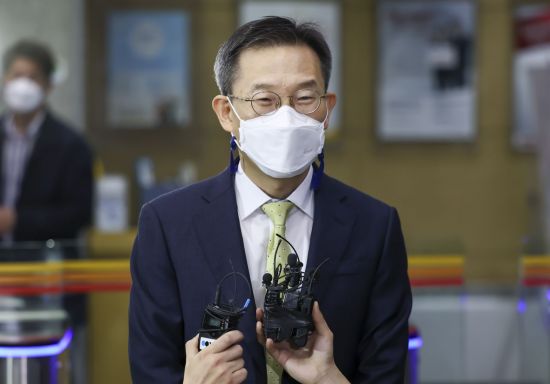
[Asia Economy Reporter Minyoung Cha] On the 3rd, Lee Jong-ho, the nominee for Minister of Science and ICT, emphasized "private sector" and "creativity" in his written responses submitted ahead of the ministerial confirmation hearing. While he is recognized as a semiconductor expert, he has also faced criticism for lacking experience and insight to cover the entire science and technology sector, so a rigorous verification process is expected.
According to the National Assembly on the 2nd, Lee stated in his written responses submitted to the National Assembly's Science, Technology, Information and Broadcasting, and Communications Committee, "I will systematically respond to the era of technological hegemony and digital transformation through science, technology, and ICT innovation together with the private sector." He added, "I plan to establish a science and technology system where private sector demand is faithfully reflected, projects are carried out jointly with the private sector, and achievements naturally spread throughout society," and "Based on the creativity of the private sector, I will foster digital new technologies such as artificial intelligence (AI), software (SW), 6G, metaverse (extended virtual world), and cloud, and realize a digitally shared prosperous society."
Regarding questions about the Moon Jae-in administration's failures, he evaluated, "Foundations for responding to the 4th Industrial Revolution, such as the Digital New Deal and 5G commercialization, have been established," but also noted, "Although there were constraints due to COVID-19, the revitalization of the private sector was not sufficiently achieved."
Lee, widely recognized as a semiconductor expert, assessed that while South Korea leads in memory semiconductors, it is at a disadvantage in system semiconductors. He stated, "To develop the semiconductor industry overall, we need to apply South Korea's strengths and know-how in memory semiconductors to the system semiconductor field and expand the training of highly skilled talent."
In response to criticism that the space industry competitiveness is weak, he presented a government-led industrial development roadmap, saying, "We will secure independent space technology and actively invest in space security and space exploration," and "We plan to prepare a national mid- to long-term space strategy with related ministries and announce it in the second half of the year." He also emphasized his intention to foster the nuclear power industry. Lee pointed out, "Small Modular Reactors (SMRs) are game changers in the future nuclear power market and core technologies for achieving carbon neutrality," and added, "Upon assuming office, I will take an interest in and actively support R&D related to SMRs."
Regarding complaints about 5G communication quality, he took a fundamental stance. On the controversy over 5G coverage, Lee said, "Continuous efforts such as quality evaluation, tax support, investment inspection, and encouragement are necessary to ensure the nationwide network is built without setbacks." He agreed with criticism about the underutilization of the 5G 28 GHz band and responded that he would work to expand its use. On disputes over network usage fees with overseas content providers (CPs) such as Netflix, he avoided a direct answer, stating, "After taking office, I will gather opinions from stakeholders and experts and review the matter." Regarding the reorganization of science and technology organizations, he said, "It is not appropriate to mention reorganization plans at this point," but added, "Strengthening functions such as a science and technology/digital-based control tower or coordinator is necessary."
© The Asia Business Daily(www.asiae.co.kr). All rights reserved.

![Clutching a Stolen Dior Bag, Saying "I Hate Being Poor but Real"... The Grotesque Con of a "Human Knockoff" [Slate]](https://cwcontent.asiae.co.kr/asiaresize/183/2026021902243444107_1771435474.jpg)














