KMA Announces Forecast of Air Stagnation Days Based on Carbon Emission Scenarios
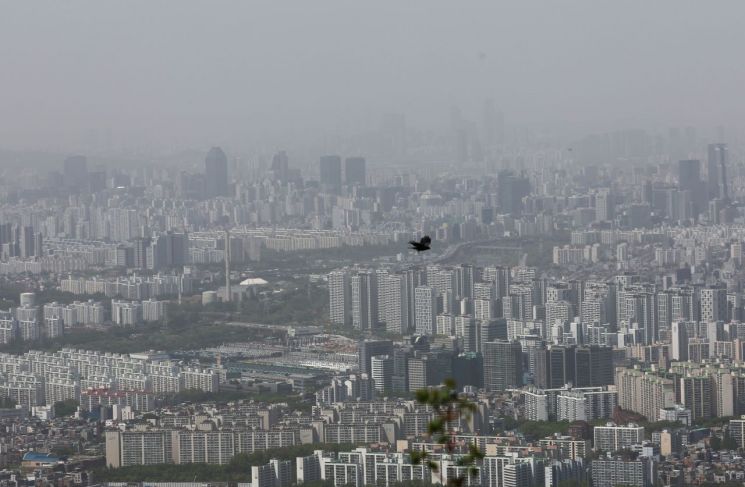
[Asia Economy Intern Reporter Kim Nayeon] Due to global warming, the number of days with stagnant air preventing fine dust from dispersing is expected to increase by up to 42 days.
The Korea Meteorological Administration announced on the 1st the predicted trend of stagnant air days based on carbon emission scenarios.
When the air is stagnant, fine dust generated domestically or inflowing from abroad accumulates, causing fine dust concentrations to intensify.
Currently (1995?2014), the number of stagnant air days from winter to spring is 26.2 days.
Stagnant air days refer to days when the 'stagnant air index,' which quantifies the wind strength in the upper and lower layers of the atmosphere, is 1 or higher. Between 2001 and 2014, during winter and spring in Seoul, 80% of the days with stagnant air had fine dust (PM10) concentrations of 50㎍/㎥ or higher, exceeding the World Health Organization (WHO) guideline (AQG: maintained below 45㎍/㎥ daily average).
If carbon emissions continue at the current level or increase further (SSP5-8.5/SSP3-7.0), the number of stagnant air days from winter to spring is projected to rise to 26?28.5 days in the early 21st century (2021?2040), 30.2?31 days in the mid-century (2041?2060), and 39.5?41.5 days in the late century (2081?2100).
When the air is stagnant in winter, the upper atmosphere experiences a strong westerly jet stream flowing north of the Korean Peninsula, resulting in relatively weak upper-level winds over South Korea.
Additionally, in the lower atmosphere, the 'high pressure in the east and low pressure in the west' pattern causes the seasonal northerly wind to be relatively weak.
© The Asia Business Daily(www.asiae.co.kr). All rights reserved.
![Clutching a Stolen Dior Bag, Saying "I Hate Being Poor but Real"... The Grotesque Con of a "Human Knockoff" [Slate]](https://cwcontent.asiae.co.kr/asiaresize/183/2026021902243444107_1771435474.jpg)
















