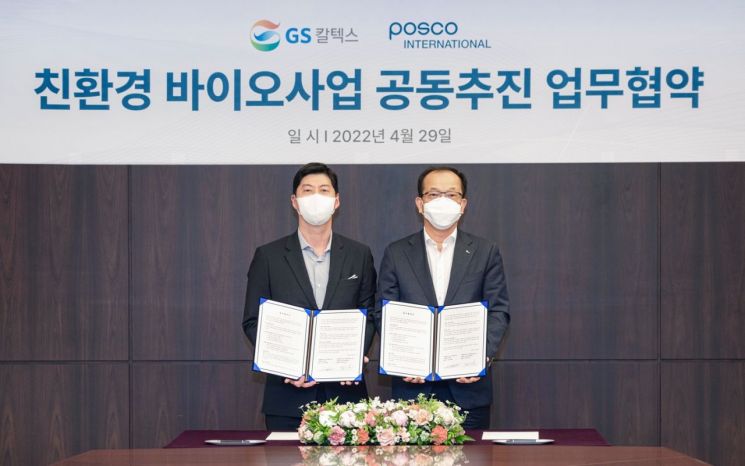
 At the ceremony for the joint promotion of the eco-friendly bio business, Huh Se-hong, President of GS Caltex (left), and Joo Si-bo, President of POSCO International, are taking a commemorative photo.
 Photo by GS Caltex
[Asia Economy Reporter Hyunseok Yoo] GS Caltex has decided to promote an eco-friendly bio business based on palm oil in partnership with POSCO International.
GS Caltex announced on the 1st that on the 29th of last month, it signed a business agreement for joint development of an eco-friendly bio business at the GS Tower in Gangnam-gu, Seoul, attended by President Huh Se-hong of GS Caltex and President Ju Si-bo of POSCO International.
Based on the business agreement, the two companies plan to gradually expand the value chain from raw material refining to bio product production, and further to next-generation biofuel business through waste oil collection.
Utilizing GS Caltex’s biofuel production technology and POSCO International’s bio raw material refining infrastructure, they will build a supply chain from raw material refining to biochemicals production and expand the bio business.
As a leading company in the energy sector, GS Caltex will be able to expand its scope into eco-friendly high value-added businesses such as biochemicals and bio aviation fuel. POSCO International will also be able to advance its business structure by connecting processing and distribution, moving beyond its limited business structure centered on palm crude oil. Ultimately, it is significant that both companies can jointly respond to food security and climate change risks through the convergence of the food industry and energy industry.
The two companies plan to establish raw material refining facilities and biofuel plants in Indonesia as their first cooperative project. In addition, as part of the Clean Development Mechanism, they plan to reduce greenhouse gases by simultaneously producing biofuels and collecting waste oil. The Clean Development Mechanism is a system that recognizes greenhouse gas reductions achieved through projects implemented by investing technology and capital in developing countries as reductions in the advanced countries’ own targets.
Currently, about 65 countries have introduced or are considering mandatory blending systems for biofuels to reduce greenhouse gases, and palm oil is evaluated as a more eco-friendly crop compared to soybean, sunflower, and rapeseed. Although palm cultivation accounts for only 10% of the world’s vegetable crop area, its production accounts for one-third, demonstrating excellent productivity per unit area. Palm is a perennial crop that can be economically harvested for about 30 years, which can reduce environmental damage caused by land cultivation and management.
A GS Caltex official said, "Starting with this business agreement, we hope to secure competitiveness in the eco-friendly bio business by expanding the supply chain from raw materials to products and contribute to global greenhouse gas reduction." A POSCO International official said, "Since entering Indonesia, we have focused on environment and coexistence for growth, and have implemented environmental policies exceeding international standards such as the NDPE declaration on palm business environmental and social policy in 2020 and obtaining the RSPO international palm oil certification in 2021." He emphasized, "This agreement is meaningful in that it can contribute to global greenhouse gas reduction by entering the eco-friendly bio business at a time when the importance of carbon neutrality is emerging."
© The Asia Business Daily(www.asiae.co.kr). All rights reserved.

















