[Asia Economy Reporter Park Sun-mi] It has been argued that South Korea’s labor productivity in the service sector ranks among the lowest in the OECD, highlighting the urgent need to revitalize and increase the value-added of the service industry.
On the 1st, the Federation of Korean Industries (FKI) announced in its report titled "International Comparison of Employment Structure and Labor Productivity in the Service Sector" that South Korea’s labor productivity per employee in the service sector was $64,000 in 2019, ranking 28th out of 36 OECD countries surveyed. This is lower than Italy ($83,000) and Spain ($76,000), countries with similar gross national income per capita, indicating the weak international competitiveness of South Korea’s service sector.
South Korea also showed a significant gap in labor productivity between the service and manufacturing sectors compared to major countries, revealing severe polarization in productivity between industries. Looking at the ratio of service sector labor productivity to manufacturing, South Korea’s ratio was 49.6% in 2019, less than half, ranking 34th out of 35 OECD countries surveyed, placing it near the bottom. This is lower than major manufacturing powerhouses such as Germany (70.5%) and Japan (70.4%).
Service sector jobs in South Korea are concentrated in low value-added industries such as wholesale and retail trade, and accommodation and food services, showing a higher degree of small-scale service businesses compared to major countries. The share of wholesale and retail trade and accommodation and food services among total service sector employment was 30% in 2020, ranking 9th out of 36 OECD countries surveyed, a relatively high level.
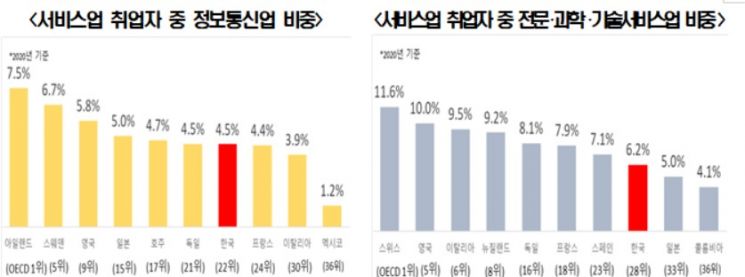
On the other hand, the proportion of employment in high value-added knowledge-based industries such as information and communications, and professional, scientific, and technical services is low compared to major countries, indicating a lack of sustainable service jobs for the future. The share of information and communications employment in South Korea’s total service sector was 4.5% in 2020, ranking 22nd out of 36 OECD countries surveyed. The share of service sector in corporate R&D expenditure was 10.4% in 2019, ranking last among 35 OECD countries surveyed. Furthermore, there is also a shortage of R&D professionals in high value-added knowledge-based service fields. The share of professional, scientific, and technical services among total service sector R&D personnel in South Korea was 26.7% in 2019, ranking 23rd out of 29 OECD countries surveyed, a low level.
The FKI argued that expanding tax incentives to promote private R&D investment is necessary as a policy task to revitalize and increase the value-added of the domestic service sector. It also proposed deregulation of businesses, improvement of private employment conditions such as reforming the dual labor market centered on regular workers and labor unions, fostering an educational ecosystem to nurture talent in high value-added industries, and enacting the Service Industry Development Framework Act. Choo Kwang-ho, head of the FKI Economic Headquarters, said, “As the share of the service sector increases due to the advancement of the industrial structure, the productivity of the service sector is expected to directly affect the total productivity of the national economy,” adding, “It is necessary to create quality jobs and enhance industrial competitiveness through the value-added of the service sector, which has high employment potential.”
© The Asia Business Daily(www.asiae.co.kr). All rights reserved.
![Clutching a Stolen Dior Bag, Saying "I Hate Being Poor but Real"... The Grotesque Con of a "Human Knockoff" [Slate]](https://cwcontent.asiae.co.kr/asiaresize/183/2026021902243444107_1771435474.jpg)
















