"'Not a Tax but a Money-Making' Carbon Reduction Mechanism Needed"
"Government and Private Sector Should Work Together to Accelerate the 'Golden Cross'" Emphasized
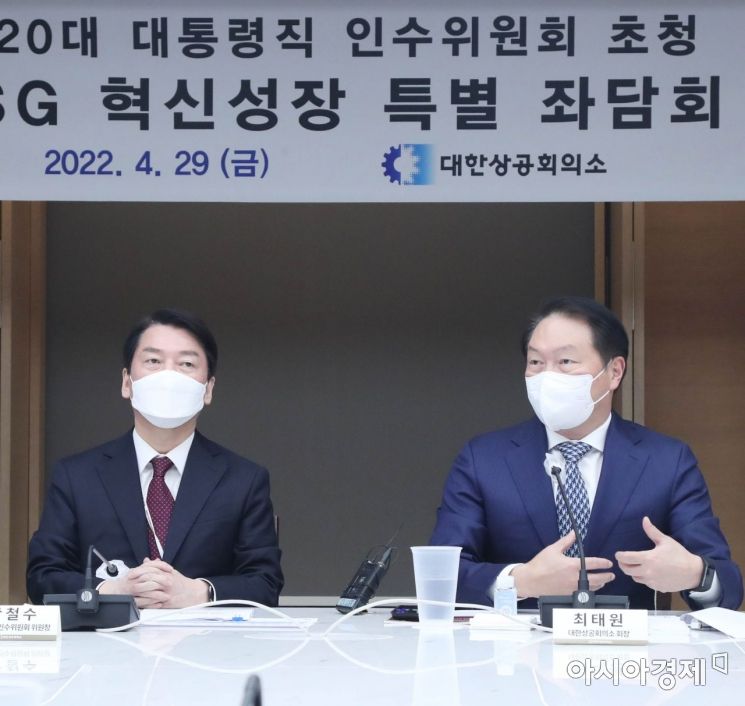 Choi Tae-won, Chairman of the Korea Chamber of Commerce and Industry (right), and Ahn Cheol-soo, Chairman of the Presidential Transition Committee, speaking at the "ESG (Environment, Social, Governance) Innovation Growth Special Forum" held on the 29th of last month at the Sangyoihoegwan in Jung-gu, Seoul. (Photo by Korea Chamber of Commerce and Industry)
[Asia Economy Reporter Moon Chaeseok]
"Companies are asking to create a structure where they can 'see money' in carbon neutrality. In particular, it is important to develop a model that quantitatively evaluates the 'cost-benefit' of carbon neutrality and the effects of energy policies."
SK Group Chairman Chey Tae-won, in his capacity as chairman of the Korea Chamber of Commerce and Industry, has been continuously advocating the 'Net Zero Growth Theory,' drawing attention from both inside and outside the business community. He argues that although the initial costs of carbon neutrality are considerable, the government and the private sector must work together to advance the 'golden cross' point where benefits surpass costs. Chairman Chey assessed that by encouraging companies to make proper investments beyond merely complying with the carbon emissions trading system?which is practically a 'tax'?or expanding social contribution activities as risk management, a 'large market' can be created.
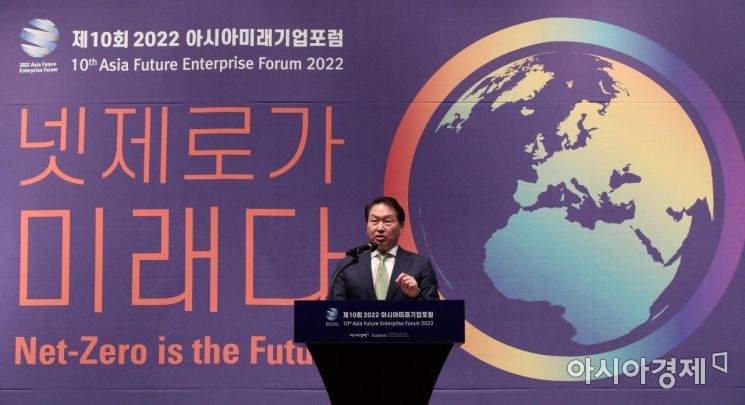 Choi Tae-won, Chairman of the Korea Chamber of Commerce and Industry (Chairman of SK Group), is delivering a congratulatory speech at the '2022 Asia Future Business Forum' hosted by Asia Economy at the Western Chosun Hotel in Jung-gu, Seoul, on the 27th of last month. Photo by Kim Hyun-min kimhyun81@
Chairman Chey emphasized this repeatedly during the 10th 2022 Asia Future Business Forum hosted by Asia Economy from the 27th to 29th of last month, the Korea Chamber of Commerce and Industry’s own carbon neutrality seminar, and a special ESG (Environmental, Social, and Governance) roundtable with Chairman Ahn. Over the three days, he stressed that to induce corporate carbon reduction, a proper quantitative evaluation system must be established, and the government should seek private sector cooperation through 'collaboration' to bring forward the 'golden cross' point. He stated that the moment when the benefits of carbon neutrality exceed the costs is what he calls 'net zero growth.' Chairman Chey views net zero growth as aligned with the growth drive policy of the Yoon Seok-yeol administration, which is set to launch on the 10th.
At the meeting with Chairman Ahn, Chairman Chey conveyed the voices of over 30,000 citizens collected through a 'communication platform' during his one year as chamber chairman since March last year. The message was that the era demands prioritizing solving social issues such as the environment over the so-called 'business patriotism,' which refers to 'contributing to the national economy.' Chairman Chey diagnosed that corporate 'ESG management' is not a mere 'excuse' for managing credit ratings and fundraising in financial markets but a timely task desired by both the public and stakeholders. However, he emphasized that for ESG management to take root in the Korean economy, the government must design sophisticated incentive systems rather than imposing strong regulations. Chairman Ahn agreed with Chairman Chey’s view, stating that environmental and social issues will act not as a 'crisis' but as an 'opportunity' to foster new industries.
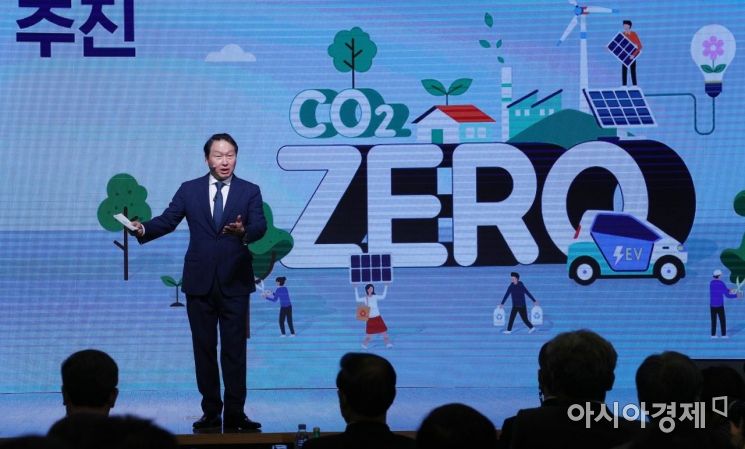 Chairman Chey Tae-won of the Korea Chamber of Commerce and Industry delivering the keynote speech at the 'Energy Transition and Carbon Neutrality Policy Seminar' held at the Korea Chamber of Commerce and Industry in Jung-gu, Seoul on the 28th of last month. Photo by Kim Hyun-min kimhyun81@
Chairman Chey detailed what kind of 'carbon neutrality incentives' companies want during his keynote speech at the seminar. He described the current carbon emissions trading system as a kind of 'tax.' If companies fail to reduce emissions to a certain extent, they have to pay money, which is no different from taxation. He believes that if a mechanism is created where companies can 'earn money by drastically reducing carbon,' companies will participate, and the market will grow. Chairman Chey said at the seminar, "Even as the CEO of SK Group, if I could make more money by reducing carbon, I would immediately do so and ask how far we can reduce it." He explained, "Such competition must arise to generate industrial growth momentum, and creating such a system is the 'incentive.'"
He defined the point at which the initial costs of carbon neutrality are surpassed by 'growth benefits' as the 'golden cross.' To bring this point forward, he stressed that voluntary participation by the public and companies must be encouraged. Chairman Chey said, "We need to develop a model that can quantitatively evaluate the cost-benefit of carbon neutrality and the effects of various energy policies to measure policy effectiveness and propose solutions. Because only with such a measurement model can policymakers and companies make (proper) decisions."
Meanwhile, the Korea Chamber of Commerce and Industry proposed forecasts for the scale of carbon-neutral growth and improvements to incentive systems. These include ▲ changes in business models ▲ public-private cooperation ▲ performance-based incentives. At the seminar, Na Seok-kwon, director of the Social Value Research Institute, who presented the current status of ESG, emphasized, "Rather than uniformly providing subsidies once certain criteria are met, it is necessary to induce voluntary and innovative ESG behavioral changes by giving more incentives to companies with better performance through measurement and evaluation."
© The Asia Business Daily(www.asiae.co.kr). All rights reserved.



















