[Asia Economy (Suwon) = Reporter Lee Young-gyu] Im Tae-hee, a preliminary candidate for Gyeonggi Province Superintendent of Education, promised to increase the support amount per multicultural family student in the Gyeonggi Provincial Office of Education, which is the lowest in the country, to match other cities and provinces.
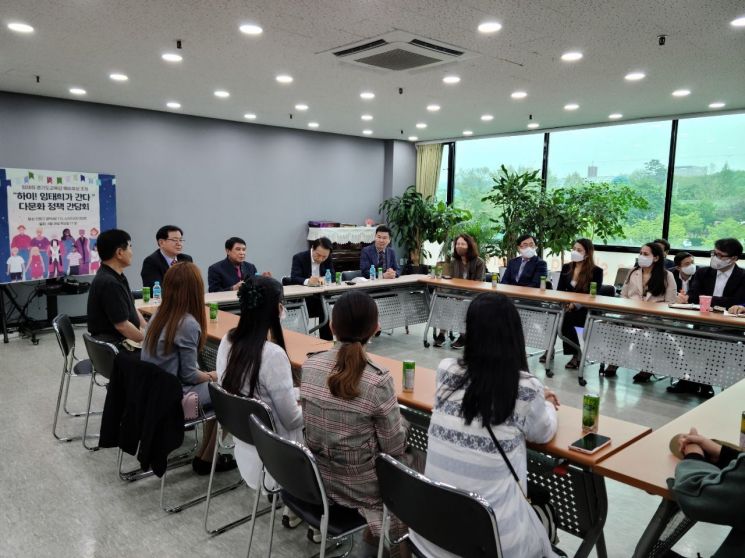
On the 28th, preliminary candidate Im Tae-hee visited Ansan, Gyeonggi Province, which has the largest number of multicultural families in the province, and held a policy meeting, stating, "The number of students in kindergarten, elementary, middle, and high schools is continuously decreasing, but the number of multicultural students is increasing every year," and emphasized, "In particular, since Gyeonggi Province has the largest number of multicultural students among the 17 metropolitan cities and provinces, detailed policy support is necessary."
According to preliminary candidate Im, as of 2021, the number of multicultural students nationwide is highest in Gyeonggi Province with 40,667 students, followed by Gyeongnam (12,315 students) and Seoul (19,368 students). Additionally, the total number of multicultural students nationwide is estimated to be 160,000, an 8.6% increase from the previous year.
Preliminary candidate Im stated, "(Although there are many multicultural students in Gyeonggi Province) the support amount per multicultural student by the Gyeonggi Provincial Office of Education is the lowest in the country, and for four consecutive years, the per capita support budget has ranked the lowest among local governments nationwide," and added, "(If I become the Superintendent of Education of Gyeonggi Province) I will increase the support budget to match other cities and provinces."
In fact, as of 2021, the support amount per multicultural student by the Gyeonggi Provincial Office of Education is 195,400 KRW, the lowest in the country. Especially, the Gyeonggi Provincial Office of Education has recorded the lowest per capita support amount nationwide for four consecutive years.
On this day, preliminary candidate Im promised ▲ expansion of Korean language education and career and academic counseling support ▲ support for native language education and cultural transmission instructors for multicultural immigrants ▲ expansion of opportunities for care instructors ▲ support for post-COVID-19 psychological support centers and healing centers, including mental health issues of multicultural students.
Meanwhile, a migrant woman from Cambodia who attended the meeting said, "It is difficult to communicate with mothers, and the school’s home correspondence and surveys are in Korean, making them hard to understand. I do not expect home correspondence in the Cambodian language, but it would be good if it were at least in English. If that is difficult, it would be good to operate a mentor-mentee system," pointing out language issues.
Another migrant woman suggested a policy, saying, "I have two children, a son and a daughter, but the father of the children passed away, so I do not know how to educate my son," and added, "I hope there will be guidance on raising my son."
© The Asia Business Daily(www.asiae.co.kr). All rights reserved.

















