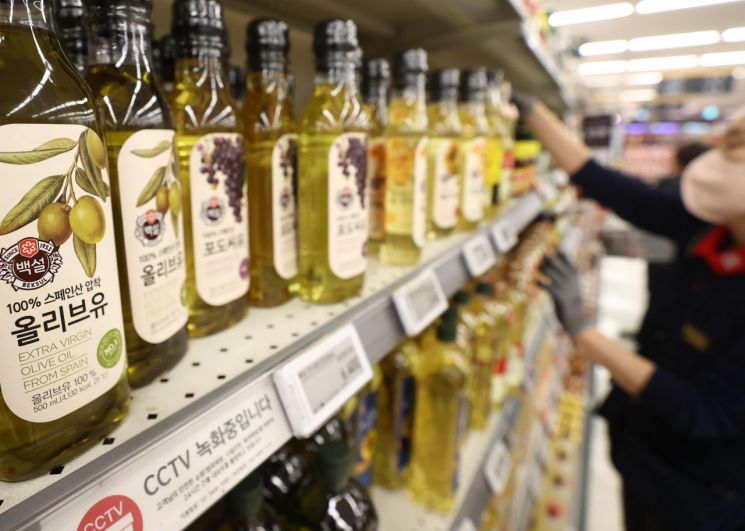
 Indonesia has decided to ban the export of edible palm oil starting from the 28th to stabilize domestic cooking oil prices. Palm oil, used as a raw material for cooking oil, processed food manufacturing, and cosmetics, accounts for more than half of the global supply from Indonesia. This export suspension is expected to affect the prices of many food products, including ramen and snacks. The photo shows the cooking oil aisle at a large supermarket in Seoul on the 25th.
 The Indonesian government has shocked the international market by halting all exports of Crude Palm Oil (CPO) and RBD palm oil starting from midnight on the 28th.
According to major foreign media, the price of July delivery soybean oil (soybean oil) for Indonesia on the Chicago Board of Trade (CBOT) briefly surged by 0.87% to $85.46 per pound (approximately 109,000 KRW) on the morning of the 28th Korean time, marking an all-time high. Soybean oil prices have soared by more than 55% since the beginning of this year. Canola oil also approached its record high set in March.
Palm oil prices on the Malaysia Kuala Lumpur exchange for July delivery in Indonesia jumped 9.17% the previous day and as of 12:03 PM Korean time on the same day, rose another 0.44% to 7,018 ringgit per ton (approximately 2.04 million KRW). This means palm oil prices have surged by more than 48% this year.
This is due to poor crop yields and reduced edible oil supply caused by the Ukraine war, coupled with Indonesia, the world's largest edible oil exporter, tightening export controls on edible oils and related products.
On the 26th, the Indonesian government initially announced it would ban exports of only palm olein but reversed the decision to include crude palm oil in the export ban.
Crude palm oil is extracted by pressing palm fruit, and when refined, it becomes RBD palm oil, which is then separated into solid palm stearin and liquid palm olein.
By expanding the export ban to include crude palm oil, not only food companies producing ramen, snacks, and chocolate but also cosmetics, detergent, and biodiesel companies have been affected.
Corn prices have also reached their highest since 2012. On the Chicago Board of Trade, July delivery corn briefly rose 2.1% to $8.185 per bushel on the same day.
President Joko Widodo chaired a national development planning meeting on the 28th, stating, "Despite uncertainties, the Indonesian economy shows positive trends such as an expanding trade surplus," and issued seven guidelines including expanding the use of domestically produced goods instead of imports, transitioning to high value-added industries, and increasing independence in food and energy sectors.
He specifically instructed the cabinet to prepare for the continuation of global economic, food, and energy crises through next year. This suggests the possibility of export bans expanding to other sectors and that these measures may continue for a certain period.
In January this year, President Joko Widodo also imposed a complete ban on coal exports for a month when coal producers focused solely on exports due to rising international prices and neglected domestic supply obligations, putting some power plants at risk of shutdown.
At that time, about 100 ships carrying coal or scheduled to load coal were anchored off the coast of Indonesia, appealing for compensation due to delays in contract fulfillment, but the government remained firm.
© The Asia Business Daily(www.asiae.co.kr). All rights reserved.
![Clutching a Stolen Dior Bag, Saying "I Hate Being Poor but Real"... The Grotesque Con of a "Human Knockoff" [Slate]](https://cwcontent.asiae.co.kr/asiaresize/183/2026021902243444107_1771435474.jpg)
















