Jeong Geunsik, Chair of the Truth and Reconciliation Commission, "Will Announce Investigation Results Soon"
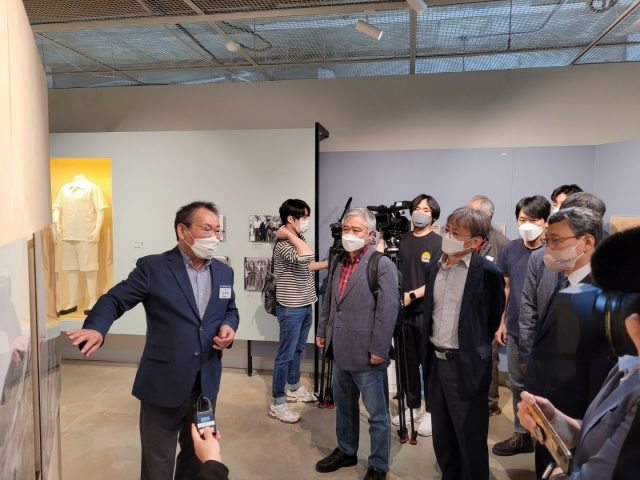 On the 28th, Kim Young-bae, chairman of the Seongam Academy Child Victim Countermeasures Council, explained the actual damage to the members of the Truth and Reconciliation Commission at the Seongam History Museum. Photo by Gong Byung-sun mydillon@
[Asia Economy Reporter Gong Byung-sun] “The naked mountain was filled with trees by those young residents.” Kim Young-bae, chairman of the Seongam Institute Child Victim Countermeasure Council, showed photos of Seongam Island, which was once just a barren mountain, to the Truth and Reconciliation Commission for the Resolution of Past Issues (Truth and Reconciliation Commission) members. Additionally, Chairman Kim explained that the residents stayed up at night managing the Seongam Institute’s livestock barns and sericulture, such as raising silkworm cocoons. He said, “If the profits generated here had been given to the residents, there would have been no anger,” adding, “The children were thoroughly exploited.”
On the 28th, the Truth and Reconciliation Commission announced that Chairman Jeong Geun-sik and seven commissioners toured the Seongam Institute site located in Ansan City, Gyeonggi Province. This was the first time all commissioners visited a site related to past issues.
Before the site inspection, they held a 30-minute private meeting with Chairman Kim, a victim of the Seongam Institute case. Afterwards, guided by Jeong Jin-gak, director of the Ansan Regional History Research Institute, they toured the Seongam History Museum, the former detention facility site, the memorial for the sacrificed children, and the victims’ cemetery.
Victims of the Seongam Institute still cannot forget the scenes of violence. Chairman Kim testified, “Many died crossing the sea, from beatings, and from malnutrition,” and said, “It is tragic that many victims’ lives were ruined due to state violence.”
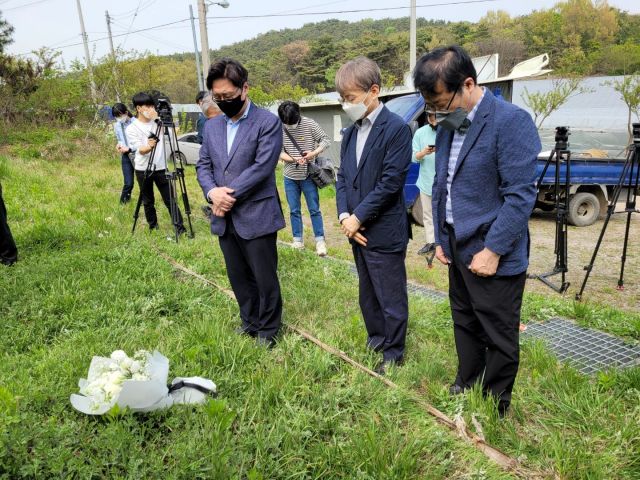 On the 28th, members of the Truth and Reconciliation Commission are seen bowing their heads in silent tribute in front of the communal grave where the victims of the Seongam Hakwon incident are buried. / Photo by Gong Byung-sun mydillon@
He also pointed out that the truth has yet to be uncovered. In front of the communal grave where the residents are buried, Director Jeong said, “It is known that about 150 residents are buried here, but proper excavation has not yet been done,” and explained, “If the excavation area is expanded to the nearby mountains, more remains could be discovered.” Chairman Jeong said, “There are concerns about how many victims’ identities can be confirmed,” adding, “We will decide on excavation after discussion.”
The Seongam Institute was a facility established by the Japanese colonial government to mobilize boy soldiers for the Pacific War. However, even after liberation, it was used by authoritarian regimes to forcibly detain children and adolescents and exploit their labor. About half of the applicants for victim status were forcibly detained without guardian consent despite having guardians during the admission process. The institute was operated by Gyeonggi Province until its closure in 1982.
The Truth and Reconciliation Commission plans to investigate ▲legal issues regarding policies for children under protection during authoritarian regimes ▲structural causes of public authority exercised during crackdowns ▲and the operational realities of the Seongam Institute. Chairman Jeong said, “The state violated human rights by turning socially vulnerable people under its protection into vagrants,” and added, “Having toured the site with the commissioners and listened to the victims’ voices, we will strive to announce the results of the truth investigation as soon as possible.”
© The Asia Business Daily(www.asiae.co.kr). All rights reserved.
![Clutching a Stolen Dior Bag, Saying "I Hate Being Poor but Real"... The Grotesque Con of a "Human Knockoff" [Slate]](https://cwcontent.asiae.co.kr/asiaresize/183/2026021902243444107_1771435474.jpg)

















