[20s in Debt, Faded Youth]
Hetsalron Youth Increasingly Problematic
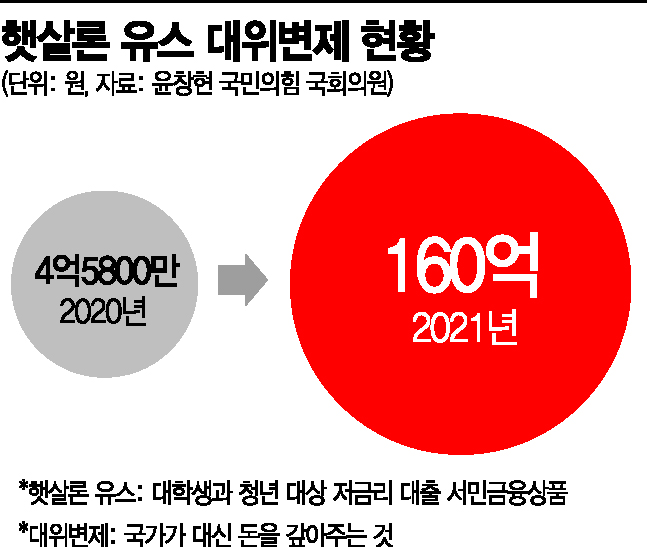
Subrogation Payment 458 Million KRW → 16 Billion KRW Surge
Loan Cases Up 57.6%
[Asia Economy Reporters Sim Nayoung and Song Seungseop] # Kwon Jinseok (24, pseudonym), who lives in Gwangjin-gu, Seoul, is a basic livelihood security recipient. At the end of last year, he borrowed money through the "Haetsal Loan Youth" program because he had no way to pay his monthly rent. Due to the COVID-19 pandemic, he lost his part-time job at a restaurant, making it difficult to repay the principal and interest. His payments have been overdue for two months. The amount he owes is 4,773,200 KRW. Kwon is currently debating whether to accept a substitute payment (where the government repays the loan on his behalf) or to choose debt adjustment by extending the repayment period, after hearing from a bank employee that there could be disadvantages.
College students and young adults who find it difficult to borrow money from formal financial institutions are turning to the government for help. Although they borrow money at much lower interest rates than the market, cases where the government has to repay on their behalf due to nonpayment are increasing.
According to data submitted by the Korea Inclusive Finance Agency to Yoon Changhyun, a member of the People Power Party, the number of Haetsal Loan Youth loans last year totaled 91,222. This is a 57.6% (33,354 cases) increase from 57,868 cases in 2020, when the program was first implemented.
Haetsal Loan Youth is a financial product designed to alleviate funding difficulties for college students and young adults. It targets individuals aged 34 or younger with an annual income of 35 million KRW or less. Only job seekers or young workers with less than one year of experience at small and medium-sized enterprises can borrow. Borrowers can take out up to 12 million KRW per person at an annual interest rate of 3.5% for a maximum of 15 years.
The loan volume has also surged. As of the end of last year, it reached 345.2 billion KRW, a 54.5% increase compared to the previous year. Initially, applications for Haetsal Loan Youth were about 50 to 60 billion KRW every six months. However, during the second half of last year alone, 213.2 billion KRW in loans were disbursed.
The problem is that despite the low interest rates, many young borrowers are unable to repay the principal and interest. The amount of substitute payments has rapidly increased. When defaults occur, the government repays the banks on behalf of the youth borrowers. In 2020, when Haetsal Loan Youth was first launched, the substitute payment amount was only 458 million KRW. By the first half of 2021, it jumped to 6.4 billion KRW, and in the second half, it rose to 16 billion KRW?an increase of 35 times. This statistic excludes funds recovered through subrogation claims. The actual scale of defaults is estimated to be even larger.
The substitute payment rate, which shows how much faster delinquencies and defaults are increasing compared to the growth rate of Haetsal Loan Youth loans, is also on the rise. The substitute payment rate was 0.2% in 2020, rising to 1.9% in the first half of last year and 2.9% in the second half. A financial industry official said, "Considering the rapid increase in Haetsal Loan Youth loans and the long loan terms, the quality of youth debt is deteriorating further."
© The Asia Business Daily(www.asiae.co.kr). All rights reserved.
![Clutching a Stolen Dior Bag, Saying "I Hate Being Poor but Real"... The Grotesque Con of a "Human Knockoff" [Slate]](https://cwcontent.asiae.co.kr/asiaresize/183/2026021902243444107_1771435474.jpg)
















