Ministry of Gender Equality and Family, 2021 Survey on Living Conditions of Users at Crisis Youth Support Centers
32.6% of Crisis Youth Have Run Away from Home, 19.8% Exposed to Crime
29.8% of Female Youth Attempted Self-Harm or Suicide, 21.6%p Higher than Males
[Asia Economy Reporter Han Jinju] More than 40% of at-risk youth have experienced violence and abuse from their parents or guardians. Family conflicts are also the leading cause of running away among these youths compared to the general youth population.
On the 28th, the Ministry of Gender Equality and Family announced the results of the '2021 Survey on the Living Conditions of Users of At-Risk Youth Support Institutions.' The survey was conducted by the Korea Youth Policy Institute and Korea Research on 4,399 youths aged 9 to 18 who had used or been admitted to at-risk youth support institutions.
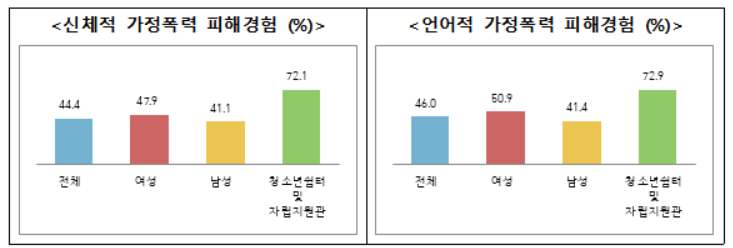
Among at-risk youth, the proportion who experienced physical violence (44.4%) or verbal abuse (46.0%) from parents or others reached nearly half. Youth who used youth shelters and youth independence support centers reported even higher rates of physical violence (72.1%) and verbal abuse (72.9%).
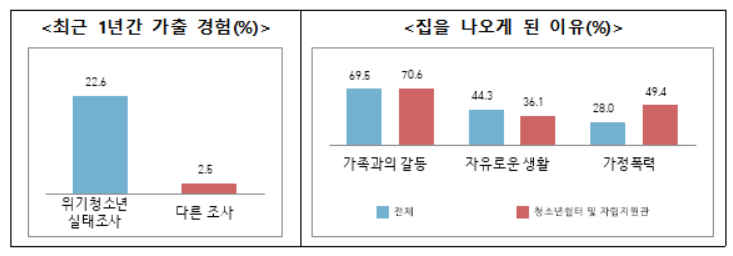
The experience of running away among at-risk youth is 32.6%, with 22.6% having run away within the past year. This is more than nine times higher than the running away rate among the general youth population (2.5% in the past year). The main reasons for running away are family conflicts (69.5%), desire for a free lifestyle (44.3%), and domestic violence (28.0%). However, among youths using shelters and similar facilities, the proportion citing family conflicts (70.6%) or violence (49.4%) as reasons was significantly higher.
At-risk youth are also more vulnerable to online crimes. 19.8% of at-risk youth reported experiencing online human rights violations such as digital sexual crimes or personal information leaks. Female youths (26.6%) reported higher victimization rates than male youths (13.5%). Perpetrators were mostly strangers (61.1%), people met online (38.2%), and acquaintances (22.6%) in that order.
At-risk youth also have 2 to 3 times higher rates of harmful substance use such as smoking (33.5%), drinking (29.6%), and hallucinogenic substances (0.9%) compared to the general youth population. Youths admitted to juvenile detention centers and probation offices showed the highest rates: smoking 72.7%, drinking 44.6%, and hallucinogenic substances 1.1%.
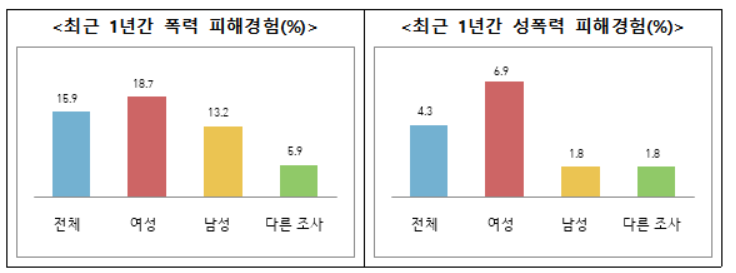
Experiences of violence, especially sexual violence, were notably higher than in other surveys. 15.9% of at-risk youth reported experiencing violence from friends or seniors/juniors within the past year. The rate of sexual violence experience was 4.3%, more than twice that of the general youth population (1.8%).
Regarding psychological and emotional characteristics, 26.2% of at-risk youth experienced depression in the past year. Female youths (32.1%) reported higher rates than male youths (20.6%). Youths using shelters and similar facilities had an especially high depression experience rate of 35.6%.
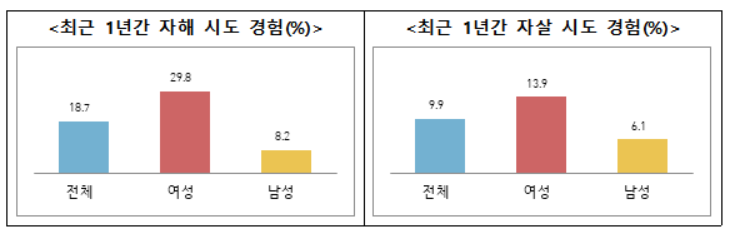
18.7% of at-risk youth have attempted self-harm or suicide. Among them, female youths accounted for 29.8%, which is 21.6 percentage points higher than male youths (8.2%). The main reasons for suicide attempts were psychological anxiety (48.4%) and family conflicts or abuse (26.3%). However, youths using youth shelters, youth independence support centers, and child protection agencies cited family conflicts and abuse as the main reasons at higher rates of 45.2% and 59.2%, respectively.
Kim Gwonyoung, Youth Policy Officer, said, "Female youths show higher exposure rates to domestic violence, online human rights violations, and sexual violence, and these negative experiences are linked to slightly higher rates of depression and relatively higher rates of suicide and self-harm attempts. For male youths, those who have experienced significant violence or negative experiences also show higher tendencies toward suicidal and self-harm thoughts and attempts."
The difficulties faced when living outside the home include ▲lack of living expenses (54.0%) ▲no place to go or rest (42.4%) ▲depression and anxiety (33.3%) ▲lack of jobs (20.9%). The most needed support for youths is economic support such as living expenses (37.1%) and living support including accommodation and meals (34.3%).
At-risk youth face difficulties due to anxiety about the future, finding career paths, family conflicts, and unstable living conditions. They responded that they need job provision (77.6%), vocational education and certification acquisition (76.6%), and economic support (75.4%).
The Ministry of Gender Equality and Family plans to strengthen youth welfare and protection policies based on these survey results.
Although youth counseling 1388 has been operated through various channels for at-risk youth counseling, it will be consolidated into the '1388 Integrated Call Center' starting next year. To prevent self-harm and suicide, the ministry plans to newly assign two clinical psychologists each to regional youth counseling and welfare centers. A youth treatment and rehabilitation center for emotional and behavioral problem youths will also be additionally established in the Honam region. Career and employment support services through regional youth safety nets will be strengthened.
A legal basis will be established for independent support for youths living outside the home to create a practical independence support system. Although Article 16 of the Youth Welfare Support Act stipulates support for youths outside the home, specific support details are not clearly defined.
Policy Officer Kim explained, "The purpose of the amendment is to clarify the legal basis for specific matters such as housing, education, and employment when youths leave shelters. We also plan to establish a legal basis to support asset formation necessary for independence after leaving shelters."
© The Asia Business Daily(www.asiae.co.kr). All rights reserved.



















