Transition Team Reflects 1st Generation New Towns in Housing Supply Plan
Regulation Easing and Overcrowding Prevention Measures Expected
Residents of 1st Generation New Towns Welcome
Concerns Raised Over Surge in Jeonse and Monthly Rent Demand and Need for Large-Scale Relocation Measures
[Asia Economy Reporters Kim Hyemin, Kim Minyoung, Hwang Seoyul] The Presidential Transition Committee (PTC) plans to announce a housing supply plan immediately after the launch of the Yoon Seok-yeol administration, including a detailed plan for the redevelopment of the 1st generation new towns. This indicates an intention to accelerate the process, as a substantial volume can be supplied to the market. The redevelopment plan for the 1st generation new towns is expected to include measures such as increasing floor area ratios (FAR) and easing reconstruction regulations, as well as solutions to address issues of overdevelopment caused by these changes. However, the market is divided between concerns over potential housing price stimulation and calls for further deregulation.
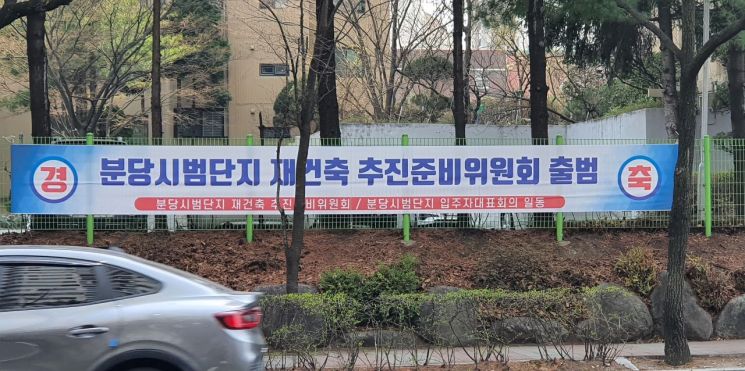
◆ The 1st Generation New Town Redevelopment Plan to Include FAR Increase and More = According to comprehensive coverage on the 28th, the PTC’s real estate task force is concretizing measures to enable redevelopment projects in 1st generation new towns such as Bundang, Ilsan, Pyeongchon, and Sanbon in Gyeonggi Province, which are reaching 30 years since completion, to proceed simultaneously with the new government’s launch. A PTC official said, "This means preparations for the redevelopment of the 1st generation new towns will proceed alongside the start of the new administration."
The redevelopment plan for the 1st generation new towns is fundamentally approached in the direction of ‘loosening regulations.’ The PTC is reportedly considering proactively raising apartment FARs to over 300%, and in the case of apartments near subway stations, increasing up to 500% through zoning upgrades. FAR is considered the biggest obstacle preventing reconstruction in the 1st generation new towns. Currently, the FAR of apartments in these towns ranges from 169% to 226%.
The PTC also discussed a plan to exempt safety inspections for one apartment complex among those over 30 years old, effectively granting a safety inspection exemption effect to all 1st generation new town apartments, though this has not been finalized. A PTC official stated, "Discussions on how to exempt the first complex are not yet mature." Discussions at the working level have also been confirmed regarding road expansion and subway extensions to resolve parking shortages and traffic congestion issues that may arise from increased demand due to redevelopment projects.
However, within the expert group of the PTC, there are also opinions that redevelopment should proceed sequentially from an urban planning perspective. Instead of focusing on the FAR of individual complexes, it has been suggested to view the entire Bundang apartment area, created as a 1st generation new town, as a single block and first establish an overall basic plan including urban infrastructure expansion measures.
The PTC is also reportedly considering alternative measures to address concerns that easing reconstruction regulations first could stimulate housing prices.
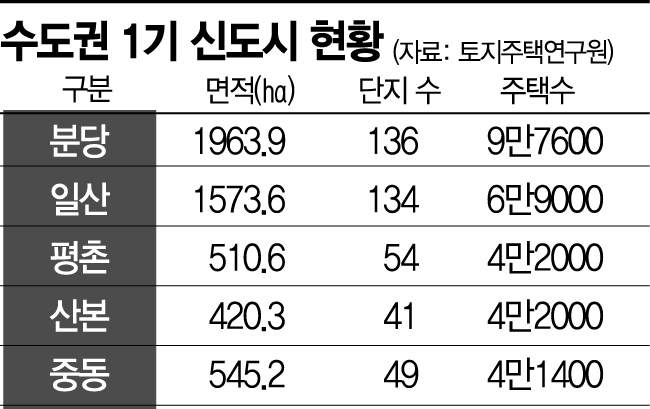
◆ 40% Increase in Households in 1st Generation New Towns... Market Stimulation Concerns Remain = If the current FAR of 169% to 226% is raised to 300%, estimating the increase in the number of households is currently difficult. A simple calculation suggests an increase of about 100,000 households from the current 292,000, but exact figures vary due to differing FARs by complex.
According to the Bundang Reconstruction Association, if the FAR is raised to 350%, the number of households in the Seohyeon-dong pilot complex is expected to increase from 7,769 to about 12,000 (approximately 54%). A FAR of 350% is estimated by the association as the most feasible ratio for business viability. Lee Jong-seok, president of the Bundang Reconstruction Association, said, "If large units are reconfigured into smaller units, the number of households could increase further." Similarly, in Yangji Village in Sunae-dong, where six complexes are jointly pursuing reconstruction, supply is expected to increase from 4,400 to 6,400 households.
The increase in supply volume gained from raising FAR could positively contribute to stabilizing the real estate market, but the acceleration of reconstruction projects may also cause the market to become volatile again. Lee Eun-hyung, a research fellow at the Construction Policy Research Institute, said, "There is a possibility of rising rent and overall housing prices due to a surge in relocation demand in areas surrounding reconstruction projects," adding, "This is why relocation measures must be prioritized in advance." Issues related to infrastructure such as transportation, water, electricity, and schools are also shadows cast by raising FAR. It is necessary to consider whether there is sufficient land to prepare infrastructure to accommodate the increased number of households.
Meanwhile, residents of the 1st generation new towns have welcomed the PTC’s moves to ease regulations such as raising FAR but agree that the FAR increase should be above 300%. A representative of the Bundang Reconstruction Association stated, "The FAR must be raised to at least 350% to make business feasibility reviews possible and accelerate reconstruction projects," adding, "To maintain comfort within complexes, raising FAR should be accompanied by lowering building coverage ratios." A resident living in Ilsan expressed concern, saying, "If safety inspection exemptions are not applied uniformly, opposition from neglected complexes could prolong reconstruction periods despite deregulation."
© The Asia Business Daily(www.asiae.co.kr). All rights reserved.


















