Efforts to Secure Appropriate Construction Costs and Schedules
"Local Government-Ordered Projects Lack Proper Management"
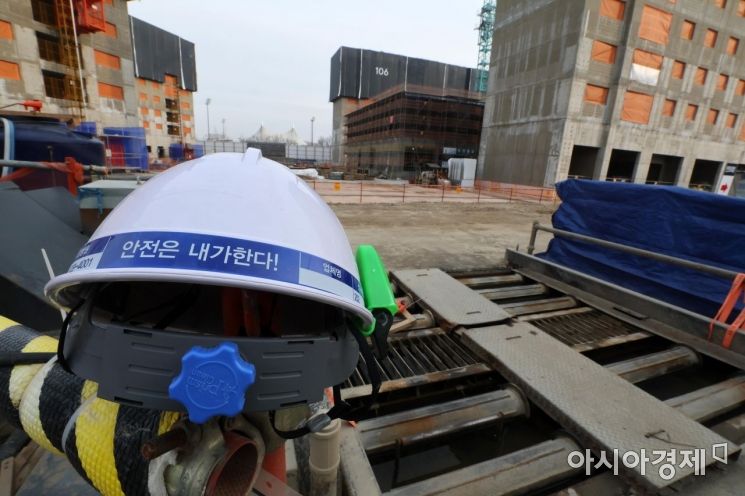
Despite the enforcement of the Serious Accidents Punishment Act (Serious Accident Punishment Act), concerns remain that construction sites commissioned by local governments are still safety blind spots. This is because the government's safety improvement measures have mainly focused on projects commissioned by the central government, leaving local government projects relatively outside the scope of management.
According to an analysis of CSI statistics compiled by the Korea Land and Housing Safety Agency by the Ministry of Land, Infrastructure and Transport on the 28th, there were 14 deaths at construction sites of the top 100 construction companies in the first quarter of this year. This is the same as the 14 deaths in the first quarter of last year, before the Serious Accident Punishment Act was enforced.
The construction industry has long demanded securing appropriate construction costs and construction periods (gonggi) as a prerequisite for safety. The government is also evaluated to have made related efforts accordingly. Since 2020, the government has prepared measures to secure appropriate construction costs and periods, such as 'excluding bidders with less than 98% of net construction cost for projects under 10 billion KRW (revision of the National Contract Act)' and 'establishing standards for calculating construction periods for public construction projects.' These are mechanisms to minimize vicious cycles such as low-price dumping bids, cutthroat competition, and minimizing safety costs caused by intensified competition.
The problem is that these mechanisms have been applied mainly to projects commissioned by the central government. Contracts with the state as a party are subject to the regulation of 'excluding bids below 98% of net construction cost for projects under 10 billion KRW' according to the revised National Contract Act as of May 2020. On the other hand, the Local Contract Act, which governs contracts with local governments as parties, does not have related regulations. This creates a structure where there can be a gap in construction costs depending on whether the National Contract Act or the Local Contract Act is followed, even for projects of the same scale. Local government projects are generally smaller in scale compared to the central government, but there is also a lack of design standards reflecting the characteristics of small-scale construction projects. A representative of a specialized construction company said, "Even if the same equipment is rented, the cost inevitably varies depending on the scale and duration of the project," adding, "If construction costs are uniformly cut off on an hourly basis, small-scale construction sites will inevitably face increased cost burdens."
Experts advise that the Local Contract Act applied by local governments should be aligned with the National Contract Act to induce securing appropriate construction costs for small and medium-sized projects. Kwangpyo Lee, Associate Research Fellow at the Korea Research Institute for Construction Industry, said, "The issue of securing appropriate construction costs and periods for projects commissioned by local governments is difficult to resolve by efforts of either the central government or local governments alone, and improvement through mutual cooperation is essential," adding, "The central government should prepare policies to solve industry-wide problems along with institutional improvements including the Local Contract Act."
Meanwhile, the Ministry of Land, Infrastructure and Transport plans to conduct special inspections by June on 15 major construction companies and related subcontractors where fatal accidents have occurred. Construction companies that have experienced fatal accidents for four or more consecutive quarters or have had serious construction accidents will also undergo focused inspections.
© The Asia Business Daily(www.asiae.co.kr). All rights reserved.

















