[Asia Economy Reporter Song Hwajeong] #Mr. A, who had previously taken out a Saehee Hope Loan to repay a second-tier financial loan and restore his credit, urgently needed hospital fees due to his mother's chronic illness. Having faithfully repaid the Saehee Hope Loan for one year without any delinquency history, Mr. A was able to secure additional loans to cover his mother's hospital expenses.
#Mr. B, who incurred tens of millions of won in debt after being defrauded by a close relative, was unable to refinance his card loans and cash advances due to his lowered credit score. However, he qualified for the Saehee Hope Loan, a loan aimed at low-income and low-credit individuals, and was able to receive it. Through this, Mr. B was able to refinance his existing high-interest card loans and cash advance debts. Since then, he has consistently managed his financial situation and credit, enabling him to obtain a salaried worker credit loan and repay most of the debts caused by the fraud.
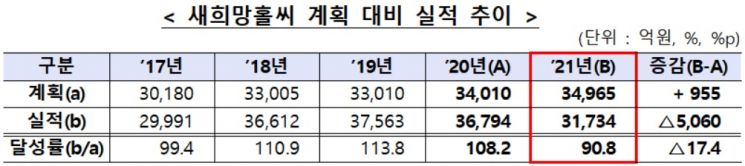
It has been reported that the banking sector supplied 3.2 trillion won in Saehee Hope Loans last year. This year, the plan is to supply 3.5 trillion won.
According to the Financial Supervisory Service on the 28th, domestic banks supplied 3.1734 trillion won in Saehee Hope Loans last year, achieving 90.8% of the supply target (3.5 trillion won). The target was not met due to a decrease in branch visitors caused by COVID-19 and the overall reduction of bank branches, which weakened customer contact points and sales capabilities. The number of branches handling Saehee Hope Loans decreased by about 300, from 6,326 at the end of 2020 to 6,023 at the end of last year. The demand for funds also somewhat decreased due to maturity extensions and repayment deferrals that have continued since April 2020 to overcome COVID-19.
The Saehee Hope Loan, an unsecured credit loan handled with banks' own funds to expand funding and ease financial burdens for low-income groups, has supported a total of 2.23 million low-income individuals with 29 trillion won since its launch in November 2010 until the end of last year.
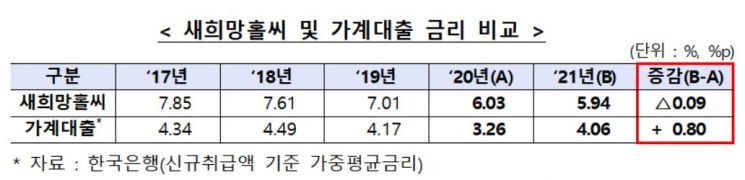
The average interest rate for new Saehee Hope Loans last year was 5.94%, down 0.09 percentage points from 6.03% the previous year, contributing to reducing interest burdens for low-income groups. The Financial Supervisory Service explained, "Despite the average interest rate on household credit loans in the banking sector turning upward last year, relatively low-interest funds were supplied to borrowers with low income and credit who are disadvantaged in terms of limits and rates."
Among the supported borrowers, the cumulative loan proportion for low-income and low-credit borrowers, who have relatively lower income and credit, was high at 91%. As of the end of last year, the delinquency rate was 1.43%, showing an improving trend by falling 0.28 percentage points compared to the previous year. The delinquency rate decreased from 2.33% in 2017 to 2.23% in 2019 and 1.71% in 2020.
By bank, Kookmin Bank led with 549 billion won, followed by Hana Bank with 529.7 billion won, Shinhan Bank with 510.8 billion won, Nonghyup Bank with 506.3 billion won, Woori Bank with 460.8 billion won, and Industrial Bank of Korea with 244.4 billion won. The top six banks accounted for 2.8 trillion won, representing 88.3% of the domestic banking sector's performance. Daegu Bank, Gwangju Bank, and Hana Bank showed increases compared to the previous year. Daegu Bank increased by 126.9% to 87.4 billion won, Gwangju Bank by 63.0%, and Hana Bank by 0.7%, respectively.
To provide stable funding to low-income groups, the banking sector plans to supply 3.5 trillion won in Saehee Hope Loans this year. A Financial Supervisory Service official stated, "Each bank will independently set this year's supply targets considering last year's Saehee Hope Loan handling performance, operating profits, and household loan growth rates. The banking sector will actively strive to achieve the supply targets this year, taking into account the difficulties faced by low-income groups due to COVID-19, inflation, and interest rate hikes."
© The Asia Business Daily(www.asiae.co.kr). All rights reserved.


















