"YouTubers and One-Person Media Included, Tax Support Scope Is Too Broad"
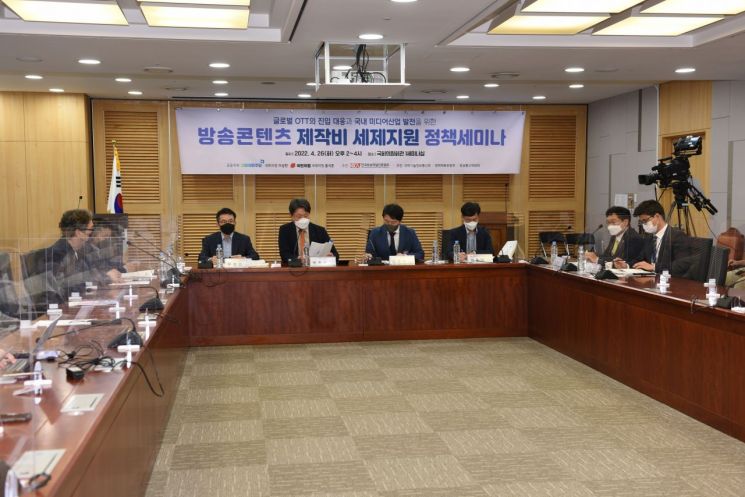 Participants are discussing at the seminar on tax support policies for broadcasting content production costs to respond to global OTT entry and develop the domestic media industry, held at the National Assembly on the 26th.
[Asia Economy Reporter Lim Hye-seon] The government is pushing to expand the scope of tax credits for video content production costs to include online video service (OTT) providers as part of its plan to foster the digital content industry, but there is still a long way to go. While there is consensus on the broad framework of 'tax support,' disagreements among ministries remain regarding detailed aspects such as the target entities.
According to industry sources on the 27th, the Ministry of Economy and Finance, Ministry of Science and ICT, Ministry of Culture, Sports and Tourism, and the Korea Communications Commission reached a consensus on OTT tax support measures at the 'Broadcast Content Production Cost Tax Support Policy Seminar for Responding to Global OTT Entry and Developing the Domestic Media Industry' held the previous day. Kim Yong-hee, a research fellow at Open Route, analyzed at the seminar that while most overseas countries operate high-rate tax credit systems for content production costs to boost the content industry and create jobs, South Korea’s tax credit rate is only about one-tenth of that of major advanced countries. Citing the UK’s video content production tax support system as an example, Kim stated that tax support policies generate positive economic effects by increasing production expenditures, added value, employment, and tax revenue in the industry. According to the UK case presented by Kim, total added value created by the industry under the tax support policy increased by 73% in 2016 compared to 2013, the number of 'full-time equivalent employees' created directly and indirectly rose by 62%, and tax revenue increased by 67%.
Lee Dong-jung, Director of Broadcasting Promotion Planning at the Ministry of Science and ICT, said, "It is essential to introduce tax credits for OTT to align with market realities." In line with the Ministry of Economy and Finance’s interpretation that a legal definition of OTT is necessary to include OTT in the tax credit targets under the Restriction of Special Taxation Act, the Ministry of Science and ICT proposed an amendment defining OTT as 'value-added communication services' under the Telecommunications Business Act. This amendment was also approved at the Korea Communications Commission’s plenary meeting.
The Ministry of Economy and Finance has pointed out issues. Yoon Jeong-in, Director of the Tax Incentive System Division at the Ministry of Economy and Finance, said, "OTT is defined as value-added communication services, but this could include individual YouTubers as well," adding, "We cannot provide tax support to all, so a more detailed review is necessary." He further mentioned, "If the 'Act on the Promotion of Film and Video' (Yeongbi Act) being promoted by the Ministry of Culture, Sports and Tourism passes, there will at least be a standard to select content," and "Tax credits for OTT can be supported after the Yeongbi Act is passed."
The OTT industry welcomes tax support but expressed concerns about the legal status under discussion, saying it "could increase regulatory burdens comparable to those on pay TV." An OTT industry official said, "There are even talks about receiving integrated media funds for OTT, but we should not impose the responsibilities previously given to terrestrial broadcasters."
Domestic OTT providers fully support investment costs for content, but production is mostly carried out by subcontractors. One official said, "Tax support is limited to production entities, but investors should also be supported," adding, "The effect of supporting OTT platform investment activation is minimal." He explained, "Domestic OTTs find it difficult to fully recover original investment costs but invest heavily, enduring large deficits to strengthen competitiveness." He added, "Effective investment promotion measures are needed to help domestic OTTs expand into overseas markets."
© The Asia Business Daily(www.asiae.co.kr). All rights reserved.
![From Bar Hostess to Organ Seller to High Society... The Grotesque Con of a "Human Counterfeit" [Slate]](https://cwcontent.asiae.co.kr/asiaresize/183/2026021902243444107_1771435474.jpg)
















