Utilizing 70.8MW of Hydrothermal Energy
Over 50% of Building Cooling and Heating Energy Uses Hydrothermal Energy... Expectation to Mitigate Urban Heat Island by Not Operating Cooling Towers
[Asia Economy Reporter Lim Cheol-young] The Seoul Metropolitan Government announced on the 26th that it will introduce water-source heat energy using Han River water at Samsung Seoul Hospital and the Korea International Trade Center. This is part of a plan to expand various renewable energy sources such as water-source heat, small hydropower, geothermal, and fuel cells to reduce dependence on fossil fuels.
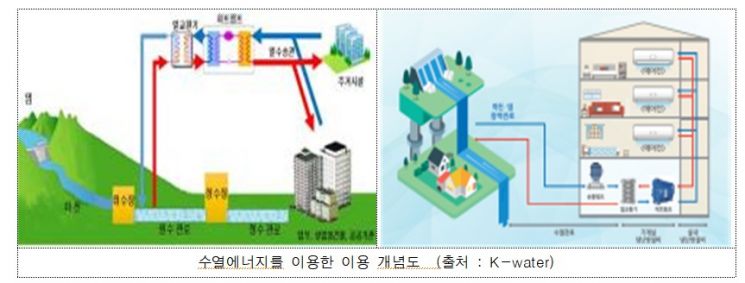
The water-source heat energy facilities to be applied at Samsung Seoul Hospital and the Korea International Trade Center will have a capacity of 70.8 MW. Design will begin this year, with installation scheduled by 2024, and the project will be promoted as a Ministry of Environment national subsidy project. Through this project, more than 50% of the total heating and cooling energy consumption of the buildings will be replaced with water-source heat energy, resulting in an annual energy saving effect of 30 GWh and a reduction of 15,000 tons of greenhouse gases.
Using the energy of raw Han River water passing through the metropolitan water supply network underground along Yeongdong-daero and Yangjae-daero, Samsung Seoul Hospital will apply 39.4 MW and the Korea International Trade Center 31.4 MW. This will reduce noise and vibration caused by the non-operation of cooling towers installed for building heating and cooling, and it is expected to alleviate the urban heat island effect, where temperatures rise compared to surrounding areas.
Currently, water-source heat energy is being used for building heating and cooling at Jamsil Lotte World Tower (10.5 MW) and the Han River Flood Control Office (351 KW). Since 2014, Jamsil Lotte World Tower has supplied 10.5 MW, which is 10% of its total heating and cooling, using metropolitan water supply water-source heat, achieving a 35.8% reduction in energy consumption and a 37.7% reduction in greenhouse gas emissions.
The Seoul Metropolitan Government plans to introduce 7.3 MW of water-source heat energy at Jamsil Sports Complex in 2025 and 14.1 MW at the Yeongdong-daero Complex Transfer Center in 2027. In addition, it plans to actively introduce water-source heat energy using raw water pipelines to large-scale buildings such as public facilities, large-scale redevelopment areas, and energy-intensive buildings (large department stores, complex commercial facilities, etc.).
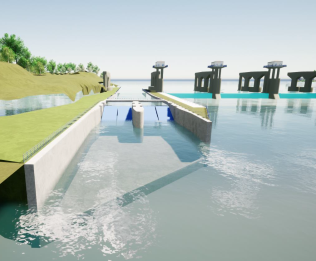
Furthermore, a 2.5 MW small hydropower generation project at the northern end of Jamsil Bridge on the Han River will be launched in earnest. Small hydropower generation can produce 14 GWh of eco-friendly electricity annually. The basic and detailed designs for the power generation facilities will be completed this year, with construction expected to be completed by December next year. The Jamsil small hydropower project is expected to produce enough electricity to supply 3,440 households in the Seoul area for one year and reduce 6,600 tons of greenhouse gases.
In addition to water-source heat and small hydropower, the Seoul Metropolitan Government plans to investigate the potential of various renewable energy sources that have been underutilized and devise concrete utilization plans to reflect them in future renewable energy expansion policies aimed at reducing greenhouse gases.
Yoo Yeon-sik, head of the Seoul Climate and Environment Headquarters, said, “The Seoul Metropolitan Government will provide active administrative support to ensure the smooth promotion of water-source heat energy expansion and small hydropower projects. We will also strive to actively discover various renewable energy sources and expand their use in Seoul to achieve carbon neutrality by 2050.”
© The Asia Business Daily(www.asiae.co.kr). All rights reserved.
![Clutching a Stolen Dior Bag, Saying "I Hate Being Poor but Real"... The Grotesque Con of a "Human Knockoff" [Slate]](https://cwcontent.asiae.co.kr/asiaresize/183/2026021902243444107_1771435474.jpg)

















