Rain Mostly Stops in the Morning in Seoul Metropolitan Area, Gangwon, and Chungnam Regions, Afternoon Elsewhere
Expected Rainfall on 26th: Jeju 20-60mm, Southern Coast of Gyeongnam and Northern Coast of Jeju 10-30mm
Over 100mm of Rain Fell in Jeju and Southern Coast Since Afternoon of Previous Day
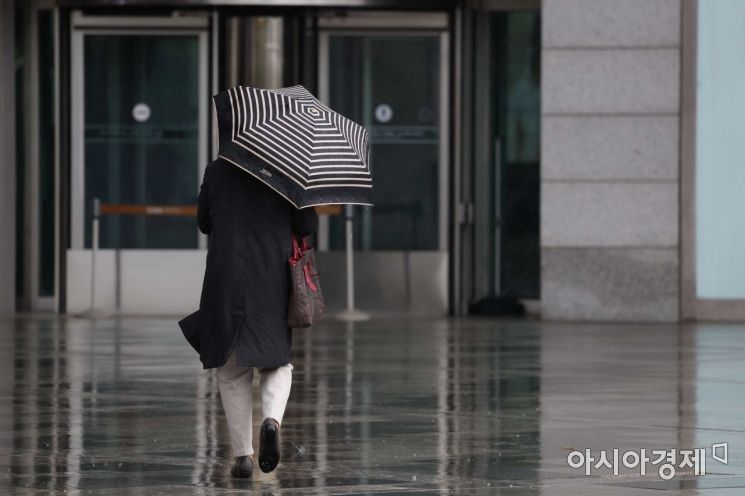 On the 14th, spring rain fell across the country, and citizens carrying umbrellas are moving at the National Museum of Korea in Yongsan-gu, Seoul. Photo by Mun Ho-nam munonam@
[Asia Economy Reporter Han Jinju] On Tuesday the 26th afternoon, rain will stop in most parts of the country. In Jeju, more than 100mm of heavy rain fell since the previous day, and some areas experienced rainfall exceeding 20mm per hour until the morning.
According to the Korea Meteorological Administration, as of 6 a.m. on this day, Jeju Island is experiencing rainfall of over 10mm per hour, some areas in Gangwon Province, Chungcheong region, and southern regions are seeing less than 5mm per hour, and most other areas are receiving light rain under 1mm per hour.
Starting from the western regions, the influence of the low-pressure system will wane, with rain stopping mostly in the Seoul metropolitan area, Gangwon Province, and Chungnam region during the morning (06:00?12:00), and in other regions during the afternoon (12:00?18:00).
Expected precipitation on the 26th is 20?60mm along the coastal areas of Gyeongnam and Jeju Island (excluding the northern coast), as well as Ulleungdo and Dokdo; 10?30mm in inland Gyeongnam and the northern coast of Jeju; 5?20mm in southern Gyeonggi, central and southern Gangwon, Chungcheong, Jeolla, and northern Gyeongbuk regions. Seoul, Incheon, northern Gyeonggi, and northern Gangwon will see less than 5mm.
The Korea Meteorological Administration stated, "Strong southerly winds are bringing in a large amount of moisture, and due to topographical effects, areas such as the coastal Gyeongnam region and Jeju Island are experiencing heavy rain exceeding 20mm per hour until the morning. Attention should be paid to flooding in low-lying areas such as underground passages, facility management, and safety accidents."
The entire country will be mostly cloudy, with the central region clearing up from the afternoon. The daytime high temperature will range from 18 to 30 degrees Celsius, higher than the average. On the morning of the 27th, the minimum temperature will drop sharply by about 20 degrees, with expected lows between 6 and 15 degrees Celsius.
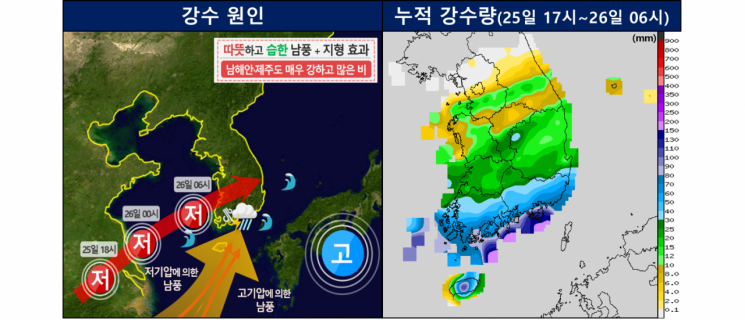
From 5 p.m. the previous day to 6 a.m. on this day, over 100mm of rain fell in Jeju and the southern coastal areas. Cumulative rainfall amounts include 180mm at Samgakbong (Jeju), 157.0mm at Jindallaebat (Seogwipo), 139.5mm at Witseoreum (Jeju), and 120.5mm at Seongpanak (Jeju). In the Gyeongnam region, Maemuldo (Tongyeong) recorded 160.0mm, Seoimal (Geoje) 146.0mm, Gadukdo (Busan) 91.5mm, and in the Jeonnam region, Sorido (Yeosu) 173.0mm, Hataedo (Shinan) 105.0mm.
Heavy rain exceeding 20?50mm per hour fell the previous day, breaking daily April rainfall records in some southern coastal areas. In the Jeolla region, Jindo-gun recorded 80.2mm and Heuksando 78.7mm, both setting new record highs. Gimhae in Gyeongnam recorded 63mm, ranking second for April daily rainfall, and Tongyeong recorded 103.8mm, ranking third.
Regions that set new records for the highest hourly rainfall in April include ▲Tongyeong 74.9mm ▲Geoje 57.9mm ▲Gimhae 41.9mm ▲Changwon 35.0mm ▲Heuksando 43.8mm ▲Jindo-gun 41.3mm ▲Gangjin-gun 34.8mm.
© The Asia Business Daily(www.asiae.co.kr). All rights reserved.
![Clutching a Stolen Dior Bag, Saying "I Hate Being Poor but Real"... The Grotesque Con of a "Human Knockoff" [Slate]](https://cwcontent.asiae.co.kr/asiaresize/183/2026021902243444107_1771435474.jpg)

















