Formation of Emergency Transport Countermeasure Headquarters by City, Traffic Operation Agencies, and Autonomous Districts to Focus on Supporting Citizen Mobility with Alternative Public Transport
Last Train Extended by 1 Hour to Operate Until 1 AM Next Day... 190 Additional Runs per Day
Village Buses Operate Normally, 436 Free Shuttle Buses Including Charter Buses Rapidly Deployed... Operation Linked to Subway Stations
Additional Supply of 14,800 Private Taxis by Lifting Driving Restrictions
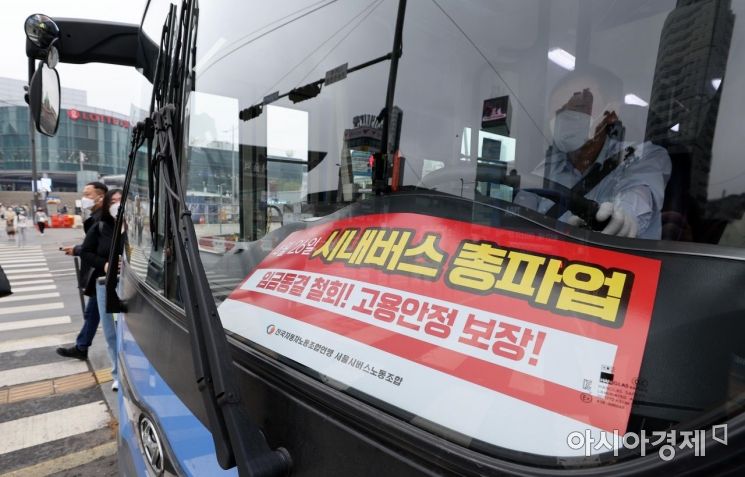 On the 25th, one day before the total strike announced by the Seoul City Bus Union, pickets related to the strike were placed on all city buses passing through the Seoul Station Bus Transfer Center. Photo by Hyunmin Kim kimhyun81@
[Asia Economy Reporter Lim Cheol-young] As the Seoul city bus labor union announced a strike starting from the first bus on the 26th, the Seoul Metropolitan Government is activating an emergency transportation plan to minimize inconvenience to citizens in preparation for the bus strike. The city plans to make every effort, including continuously striving to reach an agreement between labor and management.
On the 25th, Seoul announced that it will maintain a close cooperative system with related organizations such as transportation operating agencies, autonomous districts, and the police agency, and will mobilize all personnel and transportation means to implement measures according to various strike scenarios.
Seoul City, autonomous districts, and the bus association will form an emergency transportation headquarters to maintain a 24-hour communication system, and will establish a cooperative system in advance with transportation operating agencies such as Seoul Transportation Corporation, Seoul Metro Line 9, Ui-Sinseol Light Rail, and the chartered bus association to promote transportation measures. In particular, all possible alternative transportation means will be operated to minimize inconvenience to citizens during commuting and other travel times.
Seoul will add and extend public transportation operations until the strike ends. First, the subway will increase the total number of trips by 190 per day to alleviate congestion during commuting hours and resolve inconveniences. Train deployment will be increased by extending the main commuting congestion hours by one hour compared to the current schedule, and the last subway train will be extended until 1 a.m. the next day to promptly support late-night travel.
The number of trips during congestion hours will increase by 71, and the last train operation will be extended until 1 a.m. the next day at terminal stations, increasing by a total of 119 trips. Fourteen emergency standby train sets will be prepared to be deployed immediately in case of train delays or congestion. Order maintenance personnel will be deployed at 15 major stations with high congestion, including Seoul Station, Hongdae Entrance Station, Jamsil Station, Gangnam Station, and Sadang Station.
To facilitate quick connections for subway commuting, free shuttle buses will operate in all 25 autonomous districts of Seoul. A total of 436 public and private vehicles will be rapidly deployed to connect major hubs to subway stations, focusing on areas where village buses do not operate among city bus routes that have been suspended. In particular, a total of 139 free shuttle bus routes will operate centered on major subway stations in each autonomous district, with concentrated deployment during congestion hours to support citizens and students commuting to work and school.
Seoul is expanding the personal taxi restriction lift, which has been in effect since the 20th from 9 p.m. to 4 a.m. the next day to all hours starting from the strike day, to alleviate late-night boarding difficulties. This will supply an additional average of 14,800 taxis per day to disperse bus travel demand to taxis.
To encourage the use of personal transportation means, the city will also promote citizen guidance on carpooling and the use of Ddareungi (Seoul’s public bike-sharing system). Especially for short distances, where Ddareungi usage is expected to increase, management will be conducted to ensure smooth supply and demand. Monitoring will be carried out near bus stops to ensure smooth supply of Ddareungi, and focused management will be promoted in high-demand areas.
Furthermore, to prepare for a prolonged strike and to disperse concentrated travel demand during commuting hours, the city plans to request schools (elementary, middle, and high schools), public institutions, and private companies to adjust school and work start times by one hour during the strike period. Real-time citizen information will be provided through the 120 Dasan Call Center, the Traffic Information Center TOPIS, the city website and SNS accounts, road electronic signboards, and bus information terminals at stops.
Meanwhile, the city will make every effort to achieve a smooth labor-management agreement and the prompt normalization of public transportation operations. It will also continue multifaceted efforts such as monitoring transportation operation status. For transportation companies that quickly return from the strike and operate temporary routes, the city will focus on improving operation rates by awarding additional cooperation points.
Baek Ho, Director of Urban Transportation, said, “We will mobilize all possible transportation capacity to minimize inconvenience to citizens using public transportation and make every effort. We hope that an agreement between labor and management will be reached quickly, and we will do our best to support alternative transportation means for citizens and normalize operations.”
© The Asia Business Daily(www.asiae.co.kr). All rights reserved.

![Clutching a Stolen Dior Bag, Saying "I Hate Being Poor but Real"... The Grotesque Con of a "Human Knockoff" [Slate]](https://cwcontent.asiae.co.kr/asiaresize/183/2026021902243444107_1771435474.jpg)















