Palm Oil Prices Surge Due to Ukraine-Triggered Supply Chain Collapse
Palm Oil Widely Used in Cooking Oil, Processed Foods, and Cosmetics
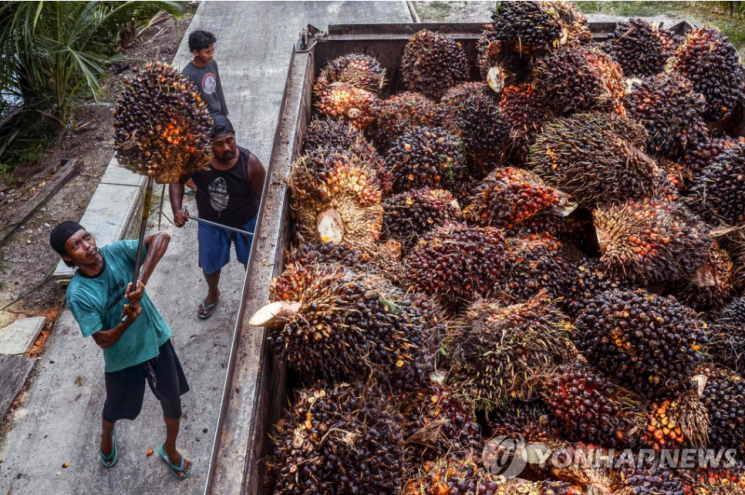 Workers at a farm in Indonesia are loading palm fruit, the raw material for palm oil, onto a truck.
 [Image source=Yonhap News]
[Asia Economy Intern Reporter Kim Nayeon] Indonesia has decided to ban the export of edible palm oil starting from the 28th, raising concerns in the domestic food industry.
If Indonesian palm oil, which accounts for more than half of the global palm oil supply, disappears from the market, it could ultimately lead to an increase in raw material costs.
There are growing concerns that Indonesia's export suspension decision will further drive up international edible oil prices, leading to higher food prices and pushing up already elevated dining costs. This could not only impact the cost of living for ordinary people but also negatively affect this year's economic growth rate, which is already expected to be around 2%.
According to industry sources on the 24th, ramen manufacturers and confectionery companies, which use the most palm oil among various types of edible oils in their product production, are particularly on high alert regarding this situation.
Generally, companies secure supplies for as short as three months and as long as six months, so there is no immediate significant impact. However, if palm oil prices surge or the export ban prolongs, it will inevitably cause major disruptions in product manufacturing.
Edible palm oil prices have already been soaring due to supply chain disruptions caused by COVID-19 even before the Ukraine crisis, so the pressure of additional cost burdens cannot be ignored.
Major food companies such as Orion stated on the 24th, "Most food companies have stockpiled three to four months' worth of palm oil, so considering current inventory, the possibility of immediate supply disruptions is low," but they also expressed concerns that "if the situation prolongs, it could lead to increased cost burdens."
Nongshim also said, "As far as we know, Indonesia has not yet announced specific implementation plans regarding the palm oil export ban," adding, "We cannot disclose the exact amount of our palm oil inventory, but it is at a level that does not cause immediate supply issues."
The cosmetics industry is also closely monitoring Indonesia's palm oil export suspension situation, as palm oil is used as a raw material in various cosmetics such as soaps, cleansing foams, creams, and lotions.
Meanwhile, Indonesian local media, citing data from the Ministry of Trade and the Central Statistics Agency (BPS), estimated that monthly export losses would exceed 27 trillion rupiah (2.3 trillion KRW). From July last year to March this year, Indonesia's edible palm oil export amount totaled 242 trillion rupiah (21 trillion KRW) over nine months, averaging 26.97 trillion rupiah (2.3 trillion KRW) per month.
© The Asia Business Daily(www.asiae.co.kr). All rights reserved.
![Clutching a Stolen Dior Bag, Saying "I Hate Being Poor but Real"... The Grotesque Con of a "Human Knockoff" [Slate]](https://cwcontent.asiae.co.kr/asiaresize/183/2026021902243444107_1771435474.jpg)
















