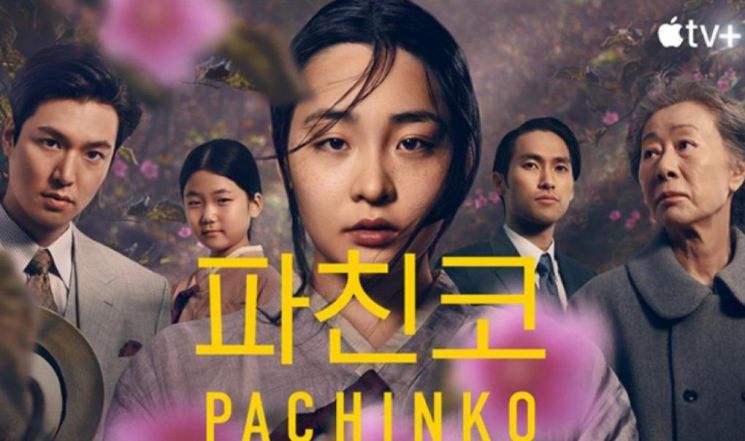
[Asia Economy Reporter Hwang Sumi] The Apple TV+ original series "Pachinko," which tells the story of a Zainichi Korean family, is gaining great popularity worldwide, but foreign media reports indicate that the response in Japan has been notably muted.
Recently, the British daily The Guardian published an article noting that while "Pachinko" has received critical acclaim in countries such as the United States and the United Kingdom, it is hardly mentioned in Japan, one of the countries that influenced the work.
Justin McCurry, the Tokyo correspondent who wrote the article, analyzed that this is because "Pachinko" evokes a universal migration experience while also reminding people of the uncomfortable and painful history of Japan’s colonial rule over the Korean Peninsula.
McCurry pointed out that the main reasons Japan is turning a blind eye to "Pachinko" include the historical awareness of Japan’s mainstream society and the reporting by right-wing media. He cited the legal battle between director Miki Dezaki, who made the film "Juju Senjo" (The Battle of the Sexes), which deals with the issue of Japanese military comfort women, and right-wing forces as a representative example.
"Juju Senjo" is a film that explores why Japanese right-wingers, nationalists, and historical revisionists deny and conceal the comfort women issue. After its release, right-wing figures filed lawsuits against the distributor, claiming that interview footage was used without consent, but they lost the case. At that time, director Dezaki pointed out on TV news that not only was "Juju Senjo" not aired, but even progressive media in Japan barely covered the court ruling, calling this a lack of balance.
Additionally, there is analysis that the long-term administration of Prime Minister Shinzo Abe accumulated attempts in Japan to deny the facts of comfort women and forced labor. This has led Japanese people to question the history that had been previously accepted.
Toko Oka Norimatsu, co-director of the International Network of Museums for Peace (INMP), stated, "Such political moves have spread a narrow-minded atmosphere throughout Japanese society," adding, "Japanese people refuse to acknowledge that racial discrimination exists in Japan and that they are perpetrators who discriminated against Zainichi Koreans."
In this atmosphere, McCurry reported that Japan’s political circles and mainstream society persist in historical revisionism. Examples include the Japanese government’s push to register the Sado Mine, a site of forced Korean labor during the Japanese colonial period, as a UNESCO World Cultural Heritage site, distorting textbook content, and pressuring countries like the United States and Germany to remove comfort women statues.
Meanwhile, the eight-episode drama "Pachinko," based on the novel of the same name by Korean American author Min Jin Lee, was simultaneously released worldwide on the 25th of last month and has received favorable reviews. It scored 100% freshness on the prominent review site Rotten Tomatoes, and overseas media have showered it with praise such as "Pachinko has it all" and "a powerful, timeless story that deeply moves the heart."
© The Asia Business Daily(www.asiae.co.kr). All rights reserved.

















