Concerns Raised Ahead of Local Elections Amid Expected Conflicts
Criticism Emerges Over Transition Team's Weak 'Agenda-Setting Function'
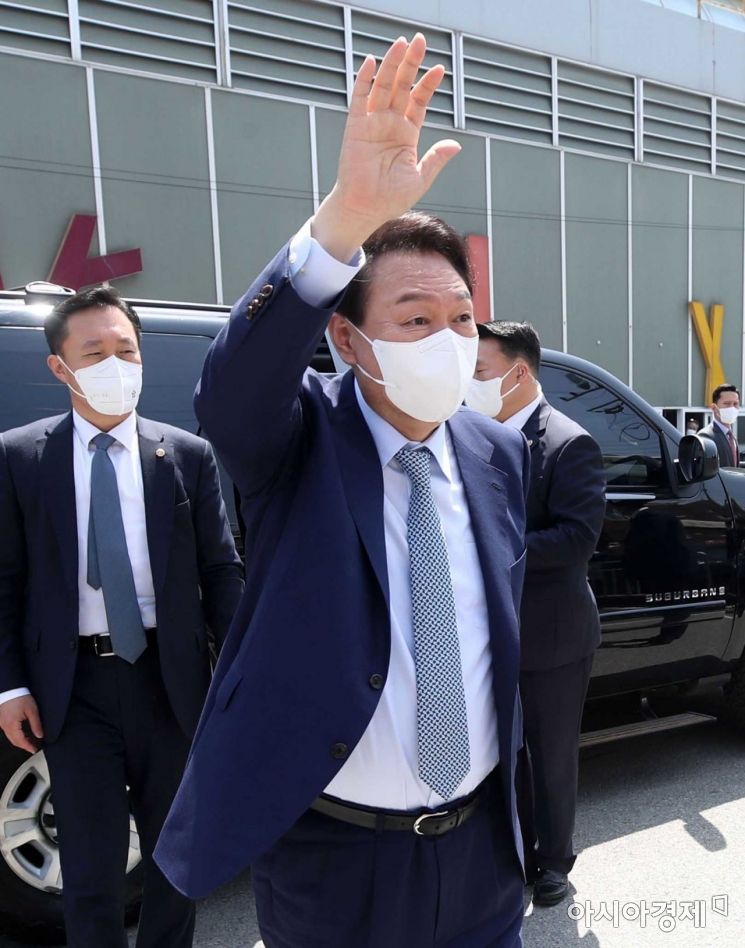 President-elect Yoon Seok-yeol is greeting citizens on the morning of the 22nd at Bansong Big Market in Haeundae-gu, Busan. Photo by the Transition Team Press Corps
[Asia Economy Intern Reporter Kim Se-eun] President-elect Yoon Seok-yeol's presidential transition committee is mainly announcing policies that do not require legislative procedures.
This appears to be influenced by the ruling Democratic Party's reluctance to push for legal amendments in the opposition-majority National Assembly.
Additionally, it is considered burdensome to raise issues expected to cause intense conflict between the ruling and opposition parties ahead of the June local elections.
However, there are concerns that focusing on 'detailed tasks' that do not require legislation has weakened the transition committee's role in setting policy agendas.
Currently, excluding ministry work reports, the transition committee has announced a total of 26 policies.
Among these, 19 policies, accounting for 73%, focus on government-initiated actions such as revising enforcement ordinances, strengthening jurisdictional duties, or formulating strategies, which either do not require legislation or involve legislative steps that do not provoke partisan conflict.
A representative example is the policy that received the most attention from the transition committee: the one-year temporary exclusion of the capital gains tax surcharge on multi-homeowners.
This policy requires a 'revision of enforcement ordinances.' The transition committee requested the current government to revise the enforcement ordinances, but the request was rejected. Subsequently, the committee announced it would implement the policy "from the day after the new government takes office."
The policy to revitalize private rental housing was also noted by Shim Gyo-eon, head of the transition committee's real estate task force (TF), who said, "A significant portion can be implemented without legal amendments," and "We prioritized including content that both ruling and opposition parties agree on."
Among the seven policies that require legislation, most are those unlikely to cause disagreement between the ruling and opposition parties.
These include unifying the existing legal and social age calculation method to the 'international age,' expanding the scope of emergency treatment by 119 paramedics, broadening eligibility criteria for housing pensions in line with rising official housing prices, and resolving the 'blind spots' in agricultural direct payments.
However, there is also criticism that, to promote major pledges requiring public opinion gathering and social consensus during the early stage of government when policy momentum is strongest, the transition committee should present directions for various policies in advance.
© The Asia Business Daily(www.asiae.co.kr). All rights reserved.

















