After Father’s Funeral, Ahn Returns to Transition Team for Work
"Reviewing COVID Special Committee Schedule for Announcement"
Support Scale, Targets, Methods Expected to Be Included
Second Supplementary Budget Also Outlined...Concerns Over Inflation and Fiscal Health
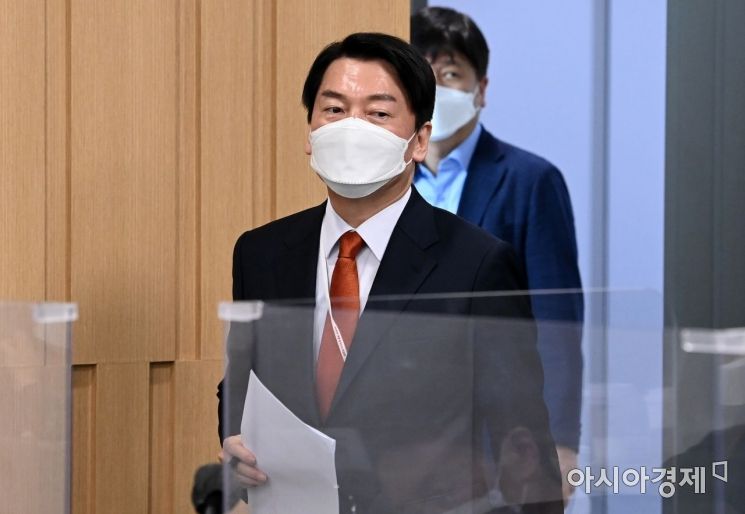 Ahn Cheol-soo, Chairman of the Presidential Transition Committee, is attending the 13th Special Committee Meeting on COVID-19 Emergency Response held at the Transition Committee in Samcheong-dong, Jongno-gu, Seoul, on the afternoon of the 18th. Photo by Transition Committee Press Corps
Support measures for small business owners and self-employed individuals affected by COVID-19 will be announced next week. The transition committee is preparing a 'comprehensive package' plan that includes not only cash support but also financial and tax support measures. As the comprehensive package for loss compensation is finalized, the outline of the second supplementary budget is also expected to take shape. Amid concerns about rising prices and fiscal soundness, attention is focused on the level of support measures the transition committee, which has emphasized full loss compensation so far, will present.
According to the transition committee on the 23rd, Ahn Cheol-soo, the chairman of the committee, will discuss a package support plan including cash, financial, and tax support for small business loss compensation at the committee office in Tongui-dong, Jongno-gu, Seoul. Chairman Ahn, who recently mourned the loss of his father, returned to work this morning after staying at the funeral hall until the previous day. He told reporters, "We are reviewing the overall progress and plan to start announcing parts that can be officially disclosed," adding, "Since I am in charge of the COVID-19 special committee, I will also check the special committee's work and plan to announce it around next week."
Earlier, Hong Kyung-hee, deputy spokesperson of the transition committee, also explained at a briefing on loss compensation on the 21st, "Among various simulations included in the COVID-19 loss compensation comprehensive package, we have approached conclusions on the specific compensation scale, payment targets, and payment methods," and "It will be finalized through a final review next week." The comprehensive package is expected to be announced on the 25th.
The transition committee plans to finalize the scale of loss compensation for small business owners and self-employed individuals, as well as the payment targets and methods. The comprehensive loss compensation package consists of cash support, financial support, and tax support. Regarding cash support, which is of great interest, President-elect Yoon stated during the election campaign, "If I become president, I will immediately provide an additional 6 million KRW separate from the existing government plan, supporting up to 10 million KRW." Since 1 million KRW and 3 million KRW were paid as the first and second support funds respectively, an additional 6 million KRW would bring the total to about 10 million KRW.
They are also considering raising the correction rate for small business loss compensation from the current 90% to 100%, and increasing the minimum amount from 500,000 KRW to 1 million KRW. Regarding financial support included in the comprehensive package, the goal is to reduce excessive debt burdens by shifting non-bank loans to banks with relatively lower interest rates and having the government bear part of the interest. Tax support discussions include extending the income tax payment period for small business owners, deferring social insurance premiums, and expanding tax credits.
The issue is securing funding. Initially, President-elect Yoon pledged a supplementary budget of 50 trillion KRW, but due to difficulties in raising funds, the scale is likely to be reduced to the 30 trillion KRW range. The transition committee is reportedly planning to combine the already executed first supplementary budget of 16.9 trillion KRW to reach 50 trillion KRW. However, even with a reduced scale, many analyses suggest that issuing deficit bonds of at least 10 trillion KRW is inevitable. The transition committee has stated it will secure funds by adjusting the existing expenditure structure to reduce fiscal burden, but fiscal authorities have reportedly expressed that excessive adjustments are difficult.
Concerns about inflation caused by the supplementary budget and its impact on the national credit rating are also obstacles. A growing fiscal deficit inevitably has a negative effect on credit ratings. Hong Nam-ki, Deputy Prime Minister and Minister of Economy and Finance, recently revealed that policy consultations are underway with the international credit rating agency Standard & Poor's (S&P) regarding the supplementary budget. In particular, if the supplementary budget injects money into the market, inflationary pressure will increase, potentially causing discord with the Bank of Korea, which is signaling interest rate hikes. Lee Chang-yong, Governor of the Bank of Korea, stated at a confirmation hearing on the 19th, "We expect the inflationary phase to continue for at least 1 to 2 years."
© The Asia Business Daily(www.asiae.co.kr). All rights reserved.
![Clutching a Stolen Dior Bag, Saying "I Hate Being Poor but Real"... The Grotesque Con of a "Human Knockoff" [Slate]](https://cwcontent.asiae.co.kr/asiaresize/183/2026021902243444107_1771435474.jpg)











