Isolation release decision to be made by Yoon government... Concerns about 're-spread' arise
From the 25th, 'food consumption' allowed in indoor multi-use facilities
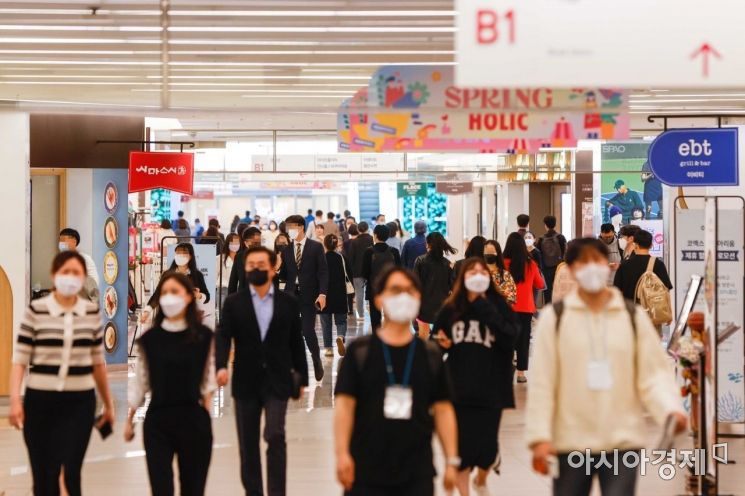 On the 21st, when social distancing measures were fully lifted, Starfield COEX Mall in Gangnam-gu, Seoul, was crowded with citizens.
[Asia Economy Intern Reporter Kim Se-eun] The COVID-19 infection disease classification will be downgraded to 'Level 2' starting from the 25th.
On the 22nd, Park Hyang, head of the Central Disaster and Safety Countermeasures Headquarters' quarantine team, announced that from the 25th, the COVID-19 infectious disease classification will be adjusted from the current Level 1 to Level 2.
However, the isolation obligation for confirmed cases, along with full government support for hospitalization and treatment costs, is expected to be maintained for at least four more weeks. The decision on lifting the isolation obligation will be made by the next administration under President Yoon Seok-yeol.
Level 1 infectious diseases are those with high fatality rates or significant risk of outbreaks, requiring high-level isolation such as 'negative pressure isolation.' In such cases, immediate reporting to health authorities upon occurrence or outbreak is mandatory.
In contrast, if downgraded to Level 2, infectious diseases must be reported within 24 hours of occurrence or outbreak, and a lower level of isolation is required compared to Level 1.
Along with the downgrade in infectious disease classification, the operation of temporary COVID-19 screening centers is expected to gradually reduce. On the same day, a total of 23 locations, including the Seoul Plaza testing site, were closed.
The government plans to prepare a 'transition period' that maintains the current Level 1 infectious disease system while lowering the classification to Level 2. The goal during this transition period is to enable rapid face-to-face medical consultations within the general healthcare system.
After the transition period, in the 'settling period,' isolation of confirmed cases will change from being 'mandatory' to 'recommended.' At the same time, the government’s full support for hospitalization and treatment costs will be discontinued.
Additionally, starting from the 25th, indoor multi-use facilities will allow food consumption based on the facility operator’s discretion.
According to the Central Disaster and Safety Countermeasures Headquarters (CDSCH), simple food and beverage consumption will be permitted not only in movie theaters, religious facilities, and indoor sports venues but also on transportation such as trains, subways, domestic flights, intercity and express buses (excluding city and village buses), as well as in large marts and department stores.
Contact visits at nursing hospitals or facilities will also be temporarily allowed.
The CDSCH has permitted contact visits for three weeks from the 30th of this month to the 22nd of next month. However, there are restrictions on the visit targets and the number of visitors.
Only up to four people who have completed three or more doses of vaccination or those recently confirmed and released from isolation (regardless of vaccination status, within 3 to 90 days after release) are allowed contact visits.
Furthermore, those wishing to have contact visits must prove a 'negative' result through PCR or rapid antigen tests within 48 hours. On-site confirmation using self-test kits is also allowed. Food and beverage consumption is prohibited during visits.
Meanwhile, concerns have been raised about the easing of social distancing measures following the downgrade of the infectious disease classification.
Ahn Cheol-soo, chairman of the Presidential Transition Committee, stated, "Completely lifting the isolation obligation by the end of May after a four-week transition period is a rather hasty approach."
He added, "We have conveyed to the current government not to finalize the transition period schedule," and "The next government will lift the isolation obligation after thorough review."
Park also explained, "We will decide on lifting the isolation obligation for confirmed cases after monitoring the situation for the next four weeks," and "The transition period was not fixed at four weeks during the infectious disease classification adjustment process."
© The Asia Business Daily(www.asiae.co.kr). All rights reserved.

















