Interview with Baeshingyu, CEO of MDimmune (Chairman of Exosome Industry Association)
[Asia Economy Reporter Kim Young-won] “Exosome therapeutics evenly combine the advantages of cell therapies and antibody therapies. We expect domestic exosome companies with excellent platform core technologies to stand out in the global market in the future.”
The pharmaceutical industry at home and abroad is focusing on ‘exosome’-based therapeutics. The Korea Research Institute of Bioscience and Biotechnology selected exosome-based drug delivery technology as one of the ‘Top 10 Future Promising Bio Technologies of 2022.’ Exosomes are extracellular vesicles (EVs) that are nano-sized particles measuring 50?200 nm. When drugs are loaded onto exosomes, they can be delivered into target cells, attracting attention as next-generation drug delivery systems (DDS). Exosomes have already been commercialized in diagnostics as ‘biomarkers’ that indicate the state of the body.
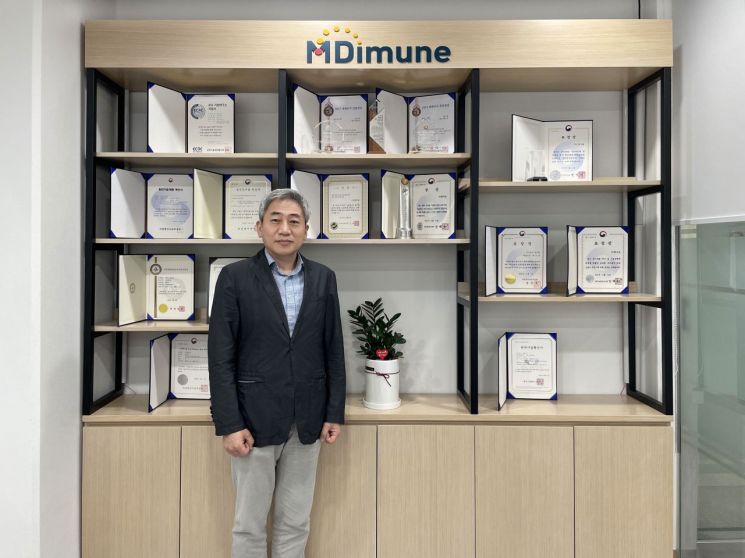
Shinkyu Bae, CEO of MDimmune (Chairman of the Exosome Industry Council, pictured), founded MDimmune relatively early among exosome companies. The motivation for founding the company came after his mother was diagnosed with cancer in 2010 and he witnessed patients struggling with side effects of anticancer drugs. On the 22nd, CEO Bae said, “While thinking about commercializing technology that delivers anticancer drugs only to cancer tissues, I came across an exosome patent developed at Pohang University of Science and Technology in 2015, acquired the technology transfer, and established MDimmune.”
The strength of exosome therapeutics lies in evenly possessing the advantages of antibody therapies and cell therapies. He explained, “Exosomes can solve the storage issues of cell therapies and, compared to antibody therapies, can carry a much wider variety of drugs.” Cell therapies require rapid freezing to keep cells alive, making storage relatively challenging.
CEO Bae says the key to developing exosome therapeutics is ‘yield.’ Productivity and cost depend on how much exosome can be obtained from cell culture media. MDimmune holds a patented technology that physically extrudes cells to produce ‘cell-derived vesicles (CDV).’ Bae said, “The extrusion method yields about 10 to 100 times more than naturally secreted exosomes. We have patents registered in major countries such as the U.S., Europe, and China, so we possess world-class production technology.”
Globally, exosome therapeutic development remains at the early stage of Phase 1 clinical trials. The U.S. company Codiak BioSciences, considered a world leader, started the world’s first Phase 1/2 clinical trial in 2020 for the candidate ‘exoSTING’ targeting cancer diseases. In Korea, on the 7th, Ilias Biologics received approval for Phase 1 clinical trials in Australia for the candidate ‘ILB-202’ targeting acute kidney injury (AKI). CEO Bae said, “The progress of domestic exosome companies is not far behind the global level,” adding, “The academic research level in Korea is also relatively high.” The Korean Society for Extracellular Vesicles (KSEV) was founded in 2009 as the world’s first academic society related to exosomes.
Recently, large domestic pharmaceutical companies have shown interest in exosomes. Daewoong Pharmaceutical signed a joint development agreement for exosome therapeutics with Exostemtech, and Chong Kun Dang Bio signed a contract for contract development and manufacturing organization (CDMO) with Prostemics. MDimmune conducted joint research in 2020 with Lonza, the world’s number one contract manufacturing organization (CMO). CEO Bae stated, “Multinational pharmaceutical companies are already actively conducting joint research and development through strategic investments in exosome companies,” and “Large domestic pharmaceutical companies are well aware of these global trends and are showing great interest.”
The Exosome Industry Council plans to activate exchanges related to exosome therapeutics with the Ministry of Food and Drug Safety (MFDS). Although the MFDS created guidelines for extracellular vesicle therapeutics development in 2018 and a quality and nonclinical evaluation information book in 2021, some companies still face difficulties during development. The council discussed the challenges faced by exosome therapeutic developers at a meeting with the MFDS on the 7th. CEO Bae said, “We plan to establish regular meetings with the MFDS going forward.”
After the meeting with the MFDS, inquiries about joining the Exosome Industry Council have increased from exosome companies. CEO Bae explained that by the end of the year, more than 30 companies, representing the majority of domestic exosome companies, are expected to join. The council plans to hold a joint workshop with KSEV at the end of June to discuss technical challenges in exosome technology. Additionally, the council is expected to host a networking forum in the fall where exosome companies gather to exchange ideas for the development of the exosome industry.
© The Asia Business Daily(www.asiae.co.kr). All rights reserved.
![Clutching a Stolen Dior Bag, Saying "I Hate Being Poor but Real"... The Grotesque Con of a "Human Knockoff" [Slate]](https://cwcontent.asiae.co.kr/asiaresize/183/2026021902243444107_1771435474.jpg)
















