Explosive Power 2000 Times Hiroshima
Kamchatka Target Set... US-Japan Check
US Defense Department "Routine Test Launch"
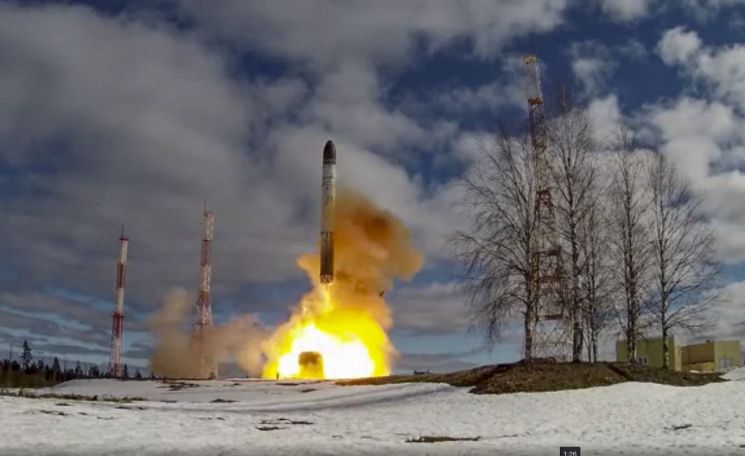 On the 20th (local time), Russia's new intercontinental ballistic missile (ICBM) RS-28 "Sarmat" was test-fired at the Plesetsk Cosmodrome in the Arkhangelsk region of western Russia. The Russian Ministry of Defense announced that the Sarmat missile successfully hit a target on the Kamchatka Peninsula, approximately 6,000 km away from Plesetsk, marking a successful test launch. Plesetsk, Russia = Photo by EPA·Yonhap News
[Asia Economy Reporter Lee Hyun-woo] Russia has announced the successful first test launch of its new intercontinental ballistic missile (ICBM), showcasing its nuclear capabilities. Russia set the target of this test launch as the Kamchatka Peninsula, adjacent to Alaska, emphasizing the possibility of a nuclear threat aimed at the United States from the Arctic region.
The U.S. government dismissed it as a routine test launch but is reportedly highly concerned internally. This test launch is understood to be intended to weaken the coordinated sanctions against Russia by the U.S. and the West, as well as to soften the hardline anti-Russia sentiment within the United States.
According to TASS on the 20th (local time), the Russian Ministry of Defense stated, "At 3:12 PM Moscow time, the first test launch of the Sarmat missile was successfully completed at the Plesetsk Cosmodrome in Arkhangelsk Oblast," adding, "The test warhead precisely hit the designated area in the Kamchatka Peninsula. Once the testing process is complete, the Sarmat missile will be deployed operationally with the Strategic Missile Forces."
According to the Associated Press, the Sarmat missile is Russia's latest ICBM developed since 2009, with a maximum range of 18,000 km. In this test launch, the Sarmat missile reportedly flew over 3,700 miles (approximately 5,954 km) from Plesetsk in western Russia to the Kamchatka Peninsula, hitting its target. The Kamchatka Peninsula faces northern Hokkaido, Japan, and is adjacent to Alaska across the Bering Sea, aiming to simultaneously check both the United States and Japan.
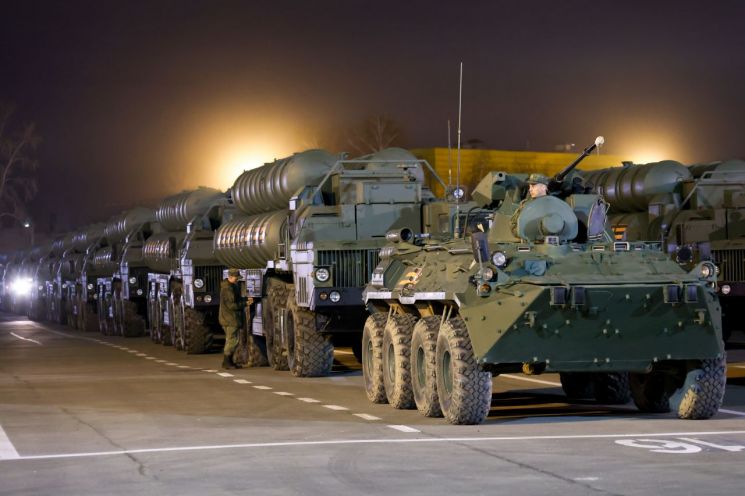
The explosive power of this Sarmat missile is said to exceed 2,000 times that of the atomic bomb dropped on Hiroshima in 1945. The Associated Press reported that the explosive power of a single Sarmat missile could completely devastate the entire country of France or the U.S. state of Texas.
The Sarmat missile can theoretically strike anywhere in the world within an hour if equipped internally with Russia's hypersonic glide vehicle (HGV) warheads. It can carry up to 15 nuclear warheads internally.
Russia has openly warned that it can use nuclear threats aimed at the United States and the West. Russian President Vladimir Putin congratulated the successful launch in a TV speech immediately afterward, stating, "This unique weapon will strengthen our military combat power and firmly guarantee Russia's security against threats," emphasizing, "Those who intend to threaten Russia will think twice."
The U.S. Department of Defense superficially dismissed President Putin's nuclear threat remarks, downplaying the significance as a routine test launch. John Kirby, spokesperson for the U.S. Department of Defense, explained, "This test launch is routine and not surprising. It is not considered a threat to the United States or its allies," adding, "Russia gave prior notification that it planned the test launch in accordance with its obligations under the New START treaty."
However, it is known that concerns about the realization of Russia's nuclear threat are growing within the U.S. Department of Defense. CNN cited a senior U.S. defense official saying, "General Charles Richard, commander of the U.S. Strategic Command, reports two to three times a week or more on the status of Russia's nuclear weapon storage and various information to Defense Secretary Lloyd Austin and military leadership," and reported, "While the actual possibility of Russia using nuclear weapons is assessed to be about 1%, preparations are being reviewed for all scenarios that President Putin might undertake."
© The Asia Business Daily(www.asiae.co.kr). All rights reserved.


















